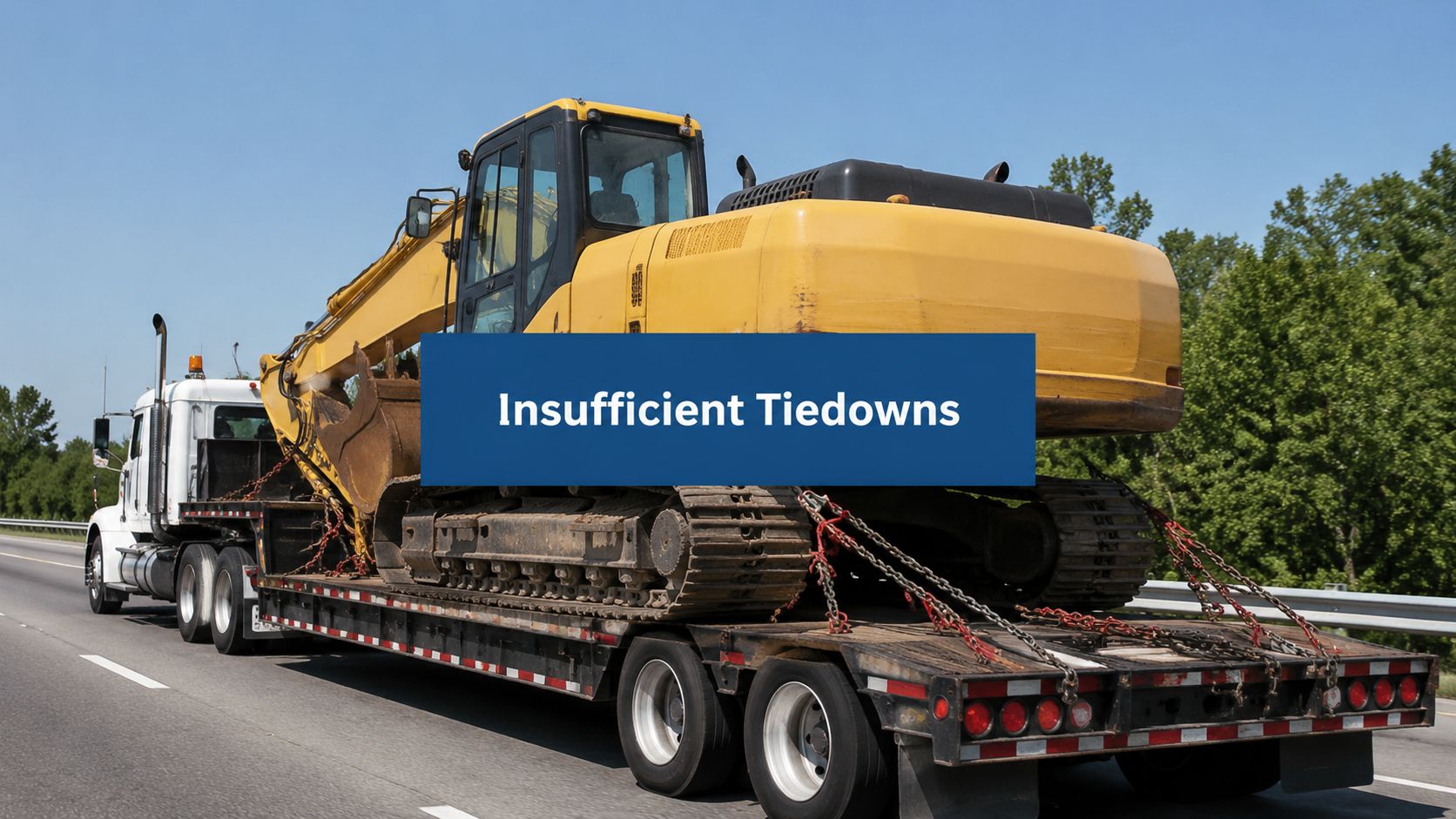
Insufficient tiedowns DOT violation is probably on your mind when a load leaves the yard looking fine, then comes back from a roadside inspection with a citation that should have been avoidable. If you own the fleet or manage safety, you know the pain isn't just the write-up. It's the delay, the customer call, the equipment sitting still, and the question of what your team missed.
Most securement problems don't happen because your people ignored the load. They happen because someone followed one rule and missed another, counted tiedowns without checking Working Load Limit, or added good chains to a weak binder and assumed the system was still strong enough. Heavy equipment adds another layer of confusion because length rules and weight rules don't work the same way.
What's really going on is that insufficient tiedowns is not one simple mistake. It's a category of mistakes. If you separate the violation into the right buckets and train your team to calculate securement the same way an inspector does, you can catch problems before the truck hits the road.
Your Guide to Insufficient Tiedowns Violations
You can have a clean trailer, experienced loaders, and decent equipment, then still get hit with an insufficient tiedowns DOT violation because one calculation was off. That is what makes this issue so frustrating for fleet owners and safety managers. It feels preventable because it usually is.

A lot of fleets get tripped up in the same places. Someone totals the chain ratings incorrectly. Someone assumes enough tiedowns by count means enough tiedowns by law. Someone secures a machine by its length and forgets that heavy equipment has its own rule set. Those aren't careless mistakes. They're process mistakes.
Why this violation keeps showing up
The problem usually starts when your securement check is too informal. "Looks tight" is not a compliance method. Neither is "we always do it this way."
You need a repeatable system that answers a few basic questions every time:
- What does the cargo weigh and how was that weight verified
- How many tiedowns are required based on the cargo type, size, and whether forward movement is blocked
- What is the aggregate WLL of the actual devices on the trailer
- Is there a weak component in the assembly that lowers the rating
Practical rule: If your team can't show the math on the side of the road, you don't have a securement system. You have a guess.
What works in the real world
The fleets that stay out of trouble don't rely on memory alone. They standardize load plans, tag securement gear clearly, and make the pre-trip check part of dispatch, loading, and driver signoff. If you want the plain-English rulebook behind that process, keep the FMCSA load securement regulations guide in your compliance library.
What Exactly Is an Insufficient Tiedowns Violation
A driver gets pulled in for inspection with a machine that looks secure. Four chains are on the deck. Nothing appears loose. Then the inspector starts checking ratings and required securement points, and the load fails anyway.

An insufficient tiedowns DOT violation usually means one of two things. The load does not have enough total tiedown capacity, or it does not have enough tiedowns by count. Those are different violations, and fleets often confuse them.
Insufficient aggregate Working Load Limit
The first type is a WLL violation. Under the general cargo securement standard, the aggregate Working Load Limit of the tiedowns used to secure an article must meet the minimum required for that load. In practice, that is where crews make bad assumptions. They count chains, see that the binders are tight, and stop there.
The inspection math is straightforward. A 40,000 pound excavator needs at least 20,000 pounds of aggregate WLL. If the gear on the trailer does not reach that threshold, the load is short.
| Cargo | Required aggregate WLL | Common mistake |
|---|---|---|
| 40,000-pound excavator | 20,000 pounds | Using tiedowns that add up to less than the required minimum |
A common failure looks like this. Four tiedowns are used, each with a 4,500 pound WLL. The total is 18,000 pounds. The load is still in violation.
One point gets missed all the time. The assembly is only as strong as its lowest-rated part. If a chain, hook, ratchet, or anchor point carries a lower rating than the rest of the tiedown system, that lower number controls the WLL for that tiedown. That is the weakest-link problem, and it is one of the easiest ways to fail an inspection while thinking the math works.
For the plain-language framework behind those calculations, keep the FMCSA load securement regulations guide in your compliance file.
Insufficient number of tiedowns
The second type is a quantity violation. This one is about the minimum number of tiedowns required for the article, based on length, weight, and whether the load is blocked against forward movement.
The basic rule is simple. Shorter and lighter articles may need only one tiedown. Longer cargo requires more. For articles not blocked by a headerboard or equivalent structure, the count increases with length. Two tiedowns are required for the first 10 feet, and one more is required for each additional 10 feet or fraction of 10 feet.
That means a 31 foot article needs 4 tiedowns. Three tiedowns may provide enough total WLL on paper and still draw a citation because the count is short.
Heavy equipment adds another layer. Machines with crawler tracks or wheels are not secured under the same logic as a general piece of freight by length alone. They are subject to cargo-specific securement rules, including minimum tiedown requirements for the equipment itself and separate securement for accessories such as booms, buckets, or blades when required. Often, fleets struggle with this aspect. They apply the general length rule to a machine that falls under the heavy equipment rule, and the load fails even though the trailer has multiple chains on it.
A load can be legal on tiedown count and illegal on WLL. It can also pass WLL and fail tiedown count.
Why crews miss this
The mistake usually starts in the yard, not at the scale house. One person counts tiedowns. Another person assumes the gear rating is enough. No one checks whether the machine falls under a special rule or whether one low-rated component drags down the whole assembly.
The fix is to verify three things every time. Confirm the cargo category. Confirm the minimum number of tiedowns. Confirm the actual aggregate WLL of the full tiedown assemblies being used. That is how you avoid the citation that surprises fleets because the load "looked secure."
The Real Cost of a Securement Violation
A driver leaves the yard with a load that looks fine, gets stopped thirty miles later, and the rest of the day unravels from there. An insufficient tiedowns DOT violation rarely ends with a single citation. It creates delays, extra labor, safety exposure, and a record that can follow the fleet long after the load is fixed.

The hit you feel right away
The first cost is downtime.
If an officer finds the tiedown count short, or finds that the aggregate Working Load Limit does not support the load, the truck can be delayed until the problem is corrected. That often means sending chains, straps, or binders to the roadside, finding a safe place to resecure the cargo, and resetting delivery expectations with the customer. Drivers lose time. Dispatch loses flexibility. The receiver may lose confidence in your operation.
The expensive part is that this violation often comes from a calculation error, not from a load that looked obviously unsafe. A crew may count the number of tiedowns and miss that one component has the lowest rating in the assembly. Or they may have enough total WLL on paper and still fail because the tiedown quantity rule was not met. Those are preventable mistakes, but they are still costly once the truck is rolling.
If cargo can shift, the risk goes beyond the citation. Equipment can be damaged, the trailer can be affected, and the driver is left dealing with a preventable problem in traffic instead of in the yard. For a broader look at that hazard, review this guide on cargo not secured against shifting.
The compliance problem that keeps showing up later
A securement violation does not stay at the scale house. It becomes part of the fleet's inspection history, and repeated securement issues tend to bring more attention on later stops.
That pattern matters because insufficient tiedown cases are often misunderstood internally. One terminal may be checking only the number of chains. Another may be looking only at the tag rating on the strap and not the full tiedown assembly. Heavy equipment can be mishandled too, especially when a team applies the general length rule to cargo that falls under equipment-specific securement requirements. The result is inconsistency, and inconsistency is what enforcement keeps finding.
Insurance and risk teams notice that pattern as well. They do not need to see a crash to question whether load securement controls are being followed.
What disciplined fleets put in writing
Good fleets do not treat securement as a judgment call that changes by driver, loader, or location. They build a standard that forces the right checks before release, especially on loads where WLL math and tiedown quantity can point to two different answers.
A practical internal standard usually includes:
- Approved tiedown assemblies for common freight and machinery
- A clear WLL verification step that accounts for the lowest-rated component in the system
- Cargo-specific instructions for heavy equipment, attachments, and mixed securement setups
- Photo records or loader-driver signoff on higher-risk loads
- Supervisor review when the load falls under special securement rules
Teams that want a useful outside reference can compare their process against these essential HGV load securing practices.
If your securement method changes from one employee to the next, your violation rate usually does too.
How to Avoid Critical Cargo Securement Mistakes
A driver pulls into a scale house with a machine that looked fine in the yard. Four chains are on the trailer. Nothing appears loose. Then the inspection starts, and the violation shows up anyway. In many cases, the problem is not that someone forgot to secure the load. The problem is that the team applied the wrong rule, or counted capacity that the assembly did not possess.
That is why this violation keeps showing up in fleets that believe they are doing the basics right. Two mistakes cause a large share of preventable citations. One is using the general tiedown-count rule on cargo that falls under heavy-equipment rules. The other is miscalculating working load limit because the crew counts the strongest part of the assembly instead of the lowest-rated part.
Heavy equipment has its own rule set
For equipment over 10,000 pounds, the securement approach changes. FMCSA cargo securement rules for automobiles, light trucks, and machinery require a different setup than the shortcut many crews use for ordinary freight. A practical summary from J. J. Keller's cargo securement guidance explains the point clearly. Heavy equipment is not secured by length alone. The rule calls for tiedowns at four corners, and wheeled or tracked machinery over 10,000 pounds must be secured with at least four direct tiedowns.
That changes the plan for skid steers, excavators, loaders, and similar machines. A loader may be short enough that someone reaches for the general tiedown chart, but if it meets the equipment-specific threshold, the chart is no longer the starting point.
Use this sequence:
- Identify whether the cargo is subject to the heavy-equipment rule before counting tiedowns
- Verify the machine weight from reliable paperwork, not memory or a rough estimate
- Confirm four direct tiedowns at the corners when the rule requires them
- Check attachments, buckets, booms, and accessories separately if they can move in transit
Crews miss that last point often. The machine may be secured correctly while an attachment creates a separate securement failure.
A good outside reference on broader transport safety is this guide to essential HGV load securing practices. The terminology differs from U.S. practice in places, but the planning and verification process is useful.
The weakest-rated component controls the WLL
The second mistake is more technical, and it leads directly to the wrong answer on an insufficient tiedowns citation. A tiedown assembly is only credited for the working load limit of its lowest-rated component. FMCSA states that the working load limit of a tiedown assembly is based on the component with the lowest working load limit, as shown in the Cargo Securement Rules driver handbook.
In practice, that means a high-rated chain does not save a lower-rated binder, hook, or anchor point. If one part of the assembly is the weak point, that weak point controls the number you can use in your securement math.
Fleets often get tripped up. The trailer has enough chains on paper. The driver used good equipment. But one binder with a lower rating, one unmarked strap, or one anchor point with a lower capacity cuts the credited WLL. The load then fails the math even though the tiedown count looks acceptable at first glance.
Mistakes that turn into citations
These are the errors I see repeatedly during reviews and post-inspection cleanup:
- Counting the chain rating instead of the lowest-rated part of the full assembly
- Using straps, chains, or binders with missing or unreadable markings
- Treating the general length rule as if it also covers heavy equipment
- Forgetting that attachments or accessories may need their own restraint
- Assuming one more trip is acceptable with worn, bent, cut, or damaged gear
The financial risk is obvious. The safety risk is worse. A team that misses WLL math usually also has weak inspection discipline, and that same gap often shows up in tension problems. For a related example, review these common causes of loose tiedown DOT violations.
The fix is straightforward. Train crews to answer two separate questions every time. First, what rule applies to this cargo type? Second, what is the actual credited WLL after using the lowest-rated component in each assembly? If your team gets those two answers right before the truck leaves, you avoid a large share of the securement mistakes that lead to citations.
Your Pre-Trip Cargo Securement Checklist
A driver is ten minutes from the gate. The freight is loaded, the straps look tight, and the count seems right. Then an inspection finds the setup fails for a reason the crew never checked: the load needed more tiedowns, or the credited WLL was short because one part of the assembly had the lower rating.
That is why the pre-trip check has to separate those two questions every time. Do you have enough tiedowns for this cargo? And does the full securement system provide enough credited WLL after you account for the weakest component in each assembly?

The six checks that matter most
Confirm the cargo details
Verify the weight, dimensions, and cargo type before anyone selects chains or straps. If the paperwork is vague, stop and fix that first. Securement mistakes often start with bad load information.Inspect every tiedown component
Check chains, straps, binders, hooks, and anchor points for wear, damage, deformation, and readable markings. If the rating is missing or unreadable, do not count that device toward compliance.Decide the required tiedown count
Determine the minimum number of tiedowns based on the cargo, its length, weight, and whether it is blocked against forward movement. Heavy equipment needs special attention because the equipment-specific rule can require more than the general freight rule.
The calculation check crews miss under time pressure
Compute the required aggregate WLL
The aggregate WLL must be at least one-half of the cargo weight, and the calculation is based on the sum of one-half the WLL for each indirect tie-down plus the full WLL for each direct tie-down, as explained in this DOT load securement overview.Apply the weakest-link rule to each assembly
Count the assembly by its lowest-rated component, not by the chain or strap alone. If the binder, hook, or anchor point carries the lower rating, that lower number controls the credited WLL. This is one of the most common calculation errors I see after inspections.Finish with tension and stability checks
Tighten the system, confirm the cargo is seated, and look for shifting risk before departure. The driver also needs a clear plan for the first recheck and all required in-transit inspections.
A field-ready version for your team
Use this as a dock-side routine:
- Weight first: Confirm actual cargo weight from paperwork or verified load data.
- Count second: Determine the required number of tiedowns before loading is finished.
- Rate the full assembly: Match tags and markings on chains, straps, binders, hooks, and anchor points.
- Identify direct vs. indirect securement: The credited WLL changes based on the method used.
- Check heavy equipment separately: Machinery, attachments, and accessories should not be reviewed with the same shortcut used for general freight.
- Document the setup: Photos and written notes help if an inspector questions the load later.
For a broader operations routine, this comprehensive pre-trip inspection guide for drivers is a useful companion resource for building habits around inspection consistency. You can also formalize your process with a load securement checklist for truck drivers so the same steps happen every trip, not just on complicated loads.
A checklist only works if the crew uses it the same way every time. That consistency is what keeps a rushed morning from turning into an out-of-service order, a citation, or a load shift on the road.
Frequently Asked Questions About Tiedown Rules
Can you mix chains and straps on the same load
Yes, but only if the securement method is appropriate for the cargo and you calculate the assembly correctly. Mixed-device setups create problems when your team ignores the lowest-rated component in the system.
What if a tiedown tag is missing or unreadable
Don't count that device toward your compliance calculation unless your company has another reliable way to verify its rating. In practice, most fleets should pull it from service for securement use until the rating is clear.
Does enough WLL mean you automatically have enough tiedowns
No. A load can still violate the rules if the number of tiedowns is too low for the cargo length, placement, or equipment type.
Do tiedown angles matter
Yes. Poor attachment points and excessive angles reduce effective securement performance. Your team should look at the whole setup, not just the number stamped on the chain or strap.
Do you need edge protection with straps
If the cargo edge can cut, crush, or abrade the webbing, edge protection is part of a sound securement plan. If your strap is damaged, your capacity assumption is no longer reliable.
Are bungee cords or tarp straps valid cargo tiedowns
They should not be treated as primary cargo securement devices for regulated load securement. Use rated tiedown equipment designed for cargo restraint.
How should you handle a load over 10,000 pounds
Treat it as a separate securement category and verify the equipment-specific rule before using any general tiedown shortcut. This is especially important with wheeled and tracked machinery.
What is the fastest way to prevent repeat tiedown violations
Standardize your load plan, train loaders and drivers on the same calculation method, and require pre-trip documentation for higher-risk loads. Informal habits are where repeat violations usually start.
Regulatory References and Compliance Solutions
Keep the actual rule set within reach. In audits and roadside cases, problems often start when a driver, loader, and supervisor are all working from different versions of the tiedown rule.
A short reference table helps, but only if your team knows which section answers which question. Use §393.102 when the issue is total working load limit. Use §393.110 when the issue is the minimum number of tiedowns. Use §393.130 before securing heavy vehicles, equipment, or machinery, because that category has its own requirements and is where fleets often misapply general tiedown formulas.
| Regulation | Description | Link |
|---|---|---|
| 49 CFR §393.100 | General rules for protection against shifting and falling cargo | View 49 CFR §393.100 on eCFR |
| 49 CFR §393.102 | Securement system strength requirements and WLL concepts | View 49 CFR §393.102 on eCFR |
| 49 CFR §393.104 | Requirements for tiedowns and securement devices | View 49 CFR §393.104 on eCFR |
| 49 CFR §393.110 | Minimum number of tiedowns | View 49 CFR §393.110 on eCFR |
| 49 CFR §393.130 | Heavy vehicle, equipment, and machinery securement | View 49 CFR §393.130 on eCFR |
The compliance fix is operational, not just legal. Build one securement worksheet that forces the person planning the load to answer three separate questions before release: how many tiedowns are required, what total WLL is required, and whether an equipment-specific rule overrides the general standard. That structure catches the two different insufficient tiedown violations that get blended together in the field.
I also recommend training crews on one calculation point that causes repeat mistakes. The assembly is only as strong as its lowest-rated component. If the chain, binder, anchor point, or attachment hardware does not match the rating you assumed, your WLL math is wrong before the truck leaves the yard.
For repeat trends, corrective action, and inspection exposure, review your broader record of cargo securement violations across the fleet.
If you want fewer judgment calls at the trailer and fewer preventable citations at inspection time, put the rule references into your dispatch packet, require documented WLL and tiedown counts for higher-risk loads, and audit heavy-equipment securement separately from general freight.
