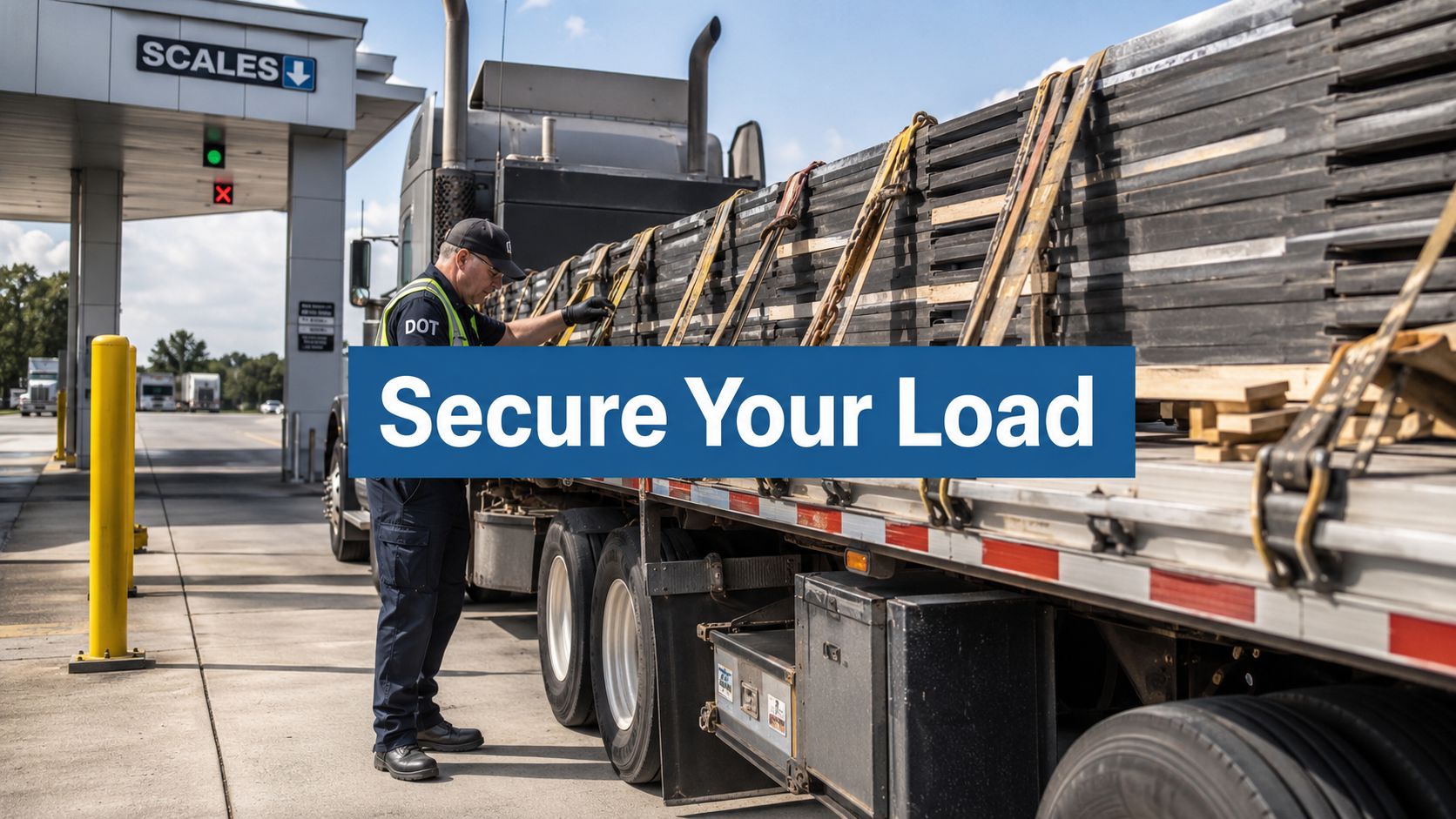
Cargo securement violations can shut your truck down before the load ever earns a dollar. If you're a fleet owner or safety manager, that means missed appointments, angry customers, and a driver parked at the scale house instead of moving freight.
Most fleets don't get burned because nobody cared. They get burned because somebody assumed the strap was still good, assumed the tiedown count was enough, or assumed the last person who touched the load got it right. That's where the trouble starts. A securement issue that looks minor in the yard can become an Out-of-Service order on the road.
What's happening is simple. Inspectors treat load securement as an immediate public safety issue, and they should. A landmark FMCSA study found that 80% of cargo securement-related violations result in an Out-of-Service order according to BigRoad's summary of FMCSA findings. If you want to keep your drivers rolling, protect your CSA profile, and avoid preventable downtime, you need a repeatable system, not just a reminder to "check the load."
Your Guide to Avoiding Costly Cargo Securement Violations
A roadside securement violation rarely stays a roadside problem. It follows you back to dispatch, into your safety file, across your insurance conversations, and into your customer relationships.
I've seen the same pattern over and over in fleets of every size. Your driver leaves the shipper with a load that looked fine. The paperwork is clean, the trailer is legal, and everyone wants that truck moving. Then an inspector finds one damaged strap, one loose tiedown, or one load that isn't restrained the way the rules require. Now your truck is parked, your delivery window is blown, and your office is scrambling.
Where fleets usually get caught
The mistake usually isn't a total lack of training. It's inconsistency.
One driver knows how to calculate tiedowns but doesn't inspect edge wear. Another checks strap condition but doesn't verify whether the load can move forward under braking. A loader places dunnage quickly and moves on. A dispatcher assumes the pre-trip included cargo securement when it really focused on lights, tires, and paperwork.
Practical rule: If your securement process depends on memory, speed, or "common sense," it will fail at the worst possible time.
That failure doesn't need to be dramatic to be expensive. A frayed web strap, a weak anchor point, or unsecured dunnage can put a truck out of service just as fast as a major defect.
What works in the real world
The fleets that avoid repeated cargo securement violations don't rely on reminders alone. They build a system around three habits:
- Pre-load planning: Match the securement method to the freight before the trailer is loaded.
- Hands-on inspection: Check tiedowns, anchor points, edge protection, and movement risk before the truck leaves.
- Post-violation discipline: When a violation happens, document the root cause and fix the process, not just the truck.
You don't need a fancy safety slogan. You need clear expectations, commodity-specific securement rules, and supervisors who know what "good" looks like in the yard and on the road.
Understanding the Core Principles of FMCSA Securement
A securement violation usually starts before the truck leaves the yard. The load looks fine, the paperwork is clean, and nobody stops to ask the two questions that matter. What forces will this freight see on the road, and does the securement method control them? If your team misses either one, you can end up with a roadside citation that damages your CSA profile, puts the unit out of service, and turns a routine run into a preventable insurance and downtime problem.
The rule set is built around load movement. Freight has to stay controlled during braking, acceleration, cornering, bumps, and lane changes. That means your securement decision has to match real operating forces, not just what looked tight in the yard.
The first principle is Working Load Limit, or WLL. Your securement system has to provide enough rated capacity for the load and the way it is restrained. FMCSA uses an aggregate WLL standard, so your team needs to total the capacity of the tiedowns being used and confirm the system meets the requirement for that load.

What aggregate WLL means on your trailer
Aggregate WLL is a shop-floor issue, not a theory problem. You add the rated capacity of the tiedowns that are securing the cargo, then verify those tiedowns are still serviceable. A strap with cuts, burns, worn stitching, or damaged hardware does not give you the same margin it had when it was new. The same goes for chains, binders, anchor points, and anything else in the system.
That is where fleets get exposed. A load can look square, balanced, and tight, yet still fail inspection because the math does not hold up or the equipment condition does not support the rating your driver assumed.
For a practical reference your supervisors and drivers can use in the yard, review these FMCSA load securement regulations for fleets.
The tiedown count matters as much as the rating
WLL alone does not keep you compliant. Minimum tiedown count still applies, and inspectors cite carriers that have enough rated capacity on paper but not enough tiedowns for the article length, weight, or configuration.
That trade-off matters in the field. One heavier chain does not automatically replace proper tiedown count. A stronger strap does not fix poor securement angles. Blocking, bracing, edge protection, and tiedown placement all affect whether the system can control forward, rearward, and lateral movement.
Commodity matters too. Machinery, lumber, pipe, coils, concrete products, and general freight do not get secured the same way. If your operation hauls more than one freight type, your standard has to account for those differences instead of relying on one generic trailer checklist.
Securement failures usually start with bad assumptions about capacity, tiedown count, or freight behavior under braking.
What your managers should enforce
Give your team a repeatable process they can apply under time pressure:
- Identify the commodity and movement risk. Check how the freight could shift forward, rearward, sideways, or upward in transit.
- Match the method to the load. Use the right combination of tiedowns, blocking, bracing, dunnage, and edge protection for that commodity.
- Verify minimum tiedown count. Confirm the number of tiedowns fits the load length, weight, and configuration.
- Calculate aggregate WLL with serviceable gear only. Use the capacity of the equipment on the trailer that day, not what it was rated for before damage or wear.
- Inspect the full securement system. Look at anchor points, contact points, trailer condition, and anything that could cut, loosen, or weaken the restraint in transit.
Fleets that stay out of trouble make these checks routine, documented, and easy to verify. That is how you prevent a single securement mistake from turning into an inspection hit, a delayed delivery, a hard conversation with your insurer, and another mark against your CSA score.
The Most Common Violations and OOS Triggers
Your driver pulls into a routine roadside inspection with a load that looked fine leaving the yard. Ten minutes later, the truck is parked, the delivery is slipping, and your safety team is fielding calls because an inspector found one securement issue that should have been caught before dispatch.
That is how cargo securement violations usually hit a fleet. The load does not have to be on the ground. Inspectors write these violations when the securement system shows a clear risk of cargo shifting, spilling, blowing, or falling. Once they see an immediate hazard, an Out-of-Service order follows fast.
J. J. Keller's review of 2024 FMCSA cargo securement violations found that the most common citation was 393.100(b), cargo not secured to prevent leaking, spilling, blowing, or falling, with 10,959 incidents and a 99.6% Out-of-Service rate. The same source also identified 392.9(a)(2)C, failure to secure vehicle components or dunnage, at 7,295 incidents and a 99.2% Out-of-Service rate, along with frequent violations for insufficient tiedowns to prevent forward movement and loose or unfastened tiedowns in its 2024 FMCSA cargo securement violation summary.

What inspectors hit most often
The pattern is consistent across fleets. Inspectors cite the obvious failures, but they also cite the small misses that show your process breaks down under real operating pressure.
Focus your yard checks on these four areas:
- Primary cargo restraint. The load can shift, shed material, or move under braking because the securement method does not match the freight.
- Dunnage and trailer-related items. Loose blocking, tarps, spare securement gear, and vehicle components create their own hazard, even if the main cargo stays in place.
- Tie-down condition. Cuts, fraying, edge damage, stretched chains, bent hooks, and worn hardware reduce working strength and draw inspector attention fast.
- Tie-down tension and closure. Loose ratchets, unlatched binders, or mechanisms that can release in transit are common inspection failures.
If you want a wider enforcement picture beyond securement alone, review this DOT Out-of-Service violations list for carriers.
Why these violations put trucks out of service
Cargo securement defects get treated differently from paperwork issues or slower-developing maintenance problems because the risk is immediate. A weak strap, loose binder, or unsecured dunnage piece can fail before the truck gets back on the highway.
I see the same trade-off trip fleets up. Operations wants trailers loaded and rolling. Drivers want to leave the shipper before the schedule gets worse. Safety assumes the basics were handled because the freight looks stable. That is exactly where violations happen. A load can look acceptable from ten feet away and still fail inspection because one anchor point is damaged, one tiedown is loose, or one piece of dunnage is free to move.
What your team should catch before the inspector does
Use a short pre-dispatch screen that matches how inspectors look at the trailer:
| Inspection focus | What usually goes wrong | Why it gets cited |
|---|---|---|
| Main cargo restraint | Load can move or shed material | It violates 393.100(b) |
| Dunnage and components | Loose blocking, loose equipment | It creates an immediate hazard |
| Tie-down condition | Cuts, burns, fraying, weak hardware | Rated strength cannot be trusted |
| Tie-down tension and closure | Loose, unfastened, or releasable mechanisms | Securement can fail in transit |
The practical standard is simple. If one defect would make an inspector stop the truck, your team needs to catch it in the yard, document the correction, and keep that trailer from becoming a CSA problem before the day even starts.
The True Cost of a Cargo Securement Violation
A cargo securement violation isn't just a line item on an inspection report. It creates a chain reaction inside your business.
First, the truck stops moving. That means delayed delivery, missed reload opportunities, dispatch disruption, and a customer who now sees your fleet as unreliable. Then the back office gets involved. Safety has to document the event, operations has to rework the day, and someone has to explain why a preventable securement failure turned into service failure.

How one defect becomes a bigger business problem
The part many fleets underestimate is how quickly one hardware issue can expand into a safety record problem. Kinedyne notes that a single compromised anchor point can lead to a cascade failure, resulting in a 7-point severity weight addition to the carrier's CSA score for that violation in its cargo securement compliance guidance.
That matters because securement violations don't stay isolated. They shape how enforcement sees your fleet. They influence how underwriters view your risk. They affect how often your trucks get scrutinized.
And the cost isn't only external. Repeated securement failures also signal internal weakness:
- Training weakness: Your people don't all use the same standard.
- Equipment weakness: Damaged gear stays in service too long.
- Supervision weakness: Yard checks and release procedures aren't catching defects.
- Documentation weakness: You can't prove what was inspected or corrected.
The insurance and customer angle
Insurance carriers care about patterns. Shippers do too.
A fleet with recurring cargo securement violations looks unpredictable. Even when no crash occurs, the violation tells a story. It says your controls broke down before the truck hit the highway. That's not the kind of story you want showing up in underwriting or customer vetting.
Field lesson: The cheapest securement fix is the one you make in the yard before the truck moves.
Why prevention pays back fast
When you spend money on better tiedowns, edge protection, trailer inspections, and supervisor training, you aren't adding bureaucracy. You're protecting truck availability.
That is the return. More trucks moving. Fewer roadside interruptions. Fewer ugly calls from customers asking why their freight is sitting at an inspection site. Good securement work rarely gets celebrated, but it protects revenue every day.
Your Action Plan to Prevent Violations
The best prevention plan is boring in the right way. It works every time, on every load, with every dispatcher, loader, and driver following the same playbook. If your process changes depending on who's on shift, you're still vulnerable.
One detail gets missed constantly in routine checks. Every tie-down has to be attached in a way that prevents it from becoming loose, unfastening, opening, or releasing while the vehicle is in transit, as explained in Avatar Fleet's cargo securement inspection guidance. A strap that's tight at the dock but can release from vibration is not compliant.

Build your pre-trip securement routine
Use a written routine your team can repeat without guessing.
- Start with the load plan: Confirm what the commodity is, where weight will sit on the trailer, and what securement method fits that freight.
- Inspect the gear by hand: Look at straps, chains, binders, ratchets, winches, hooks, and anchor points. If anything is questionable, remove it from service.
- Check edge contact: Protect webbing and contact points anywhere a corner, lip, or rough surface can damage the tiedown.
- Verify closure points: Make sure hooks are seated, ratchets are locked, and nothing can shake loose during transit.
- Walk the whole trailer: Look for loose dunnage, trailer-mounted items, and anything else that can move independently.
For a fleet-ready form your team can adapt, this truck driver pre-trip inspection checklist is a practical starting point.
Standardize what your supervisors approve
Don't release a truck because the load "looks okay." Release it because it passed a standard.
A useful approval process includes three separate signoffs in practice, even if one person handles more than one role:
- Loader confirms placement
- Driver confirms securement
- Supervisor or lead confirms final readiness on higher-risk loads
That doesn't have to slow the yard down. It prevents the kind of rushed decision that creates repeat violations.
Support securement outside the trailer
A strong securement program also depends on yard control. Unauthorized access, rushed loading zones, and poor site visibility all create preventable mistakes. Fleets reviewing optimizing terminal security often find that better access control and yard oversight improve load integrity before the truck ever reaches the gate.
Good cargo securement starts before the first strap goes over the freight.
Train for actual freight, not generic theory
Classroom training matters, but hands-on practice matters more. Train your team around the freight you move. Machinery, palletized freight, steel, building products, and mixed LTL-style loads all create different failure points.
Your best training sessions usually come from recent problems. Pull the defective strap. Show the worn hook. Walk the team through why the mechanism could have released in transit. People remember what they can touch and see.
Responding to a Violation with Corrective Action
Even strong fleets get hit sometimes. What matters next is whether you treat the violation as a one-off irritation or as evidence that something in your process failed.
The wrong response is simple. Replace the bad strap, tell everyone to be more careful, and move on. That might get the truck rolling again, but it won't stop the next violation.
Use a corrective action format that shows control
A useful corrective action plan includes five parts:
Violation summary
Record what was cited, where it happened, and what condition the inspector found.Immediate fix
Document what was repaired, replaced, tightened, or re-secured before the vehicle returned to service.Root cause
Identify why it happened. Was the tiedown damaged in service, missed in inspection, improperly selected, or incorrectly installed?Preventive change
Update the process. That may mean retraining, adding a checklist step, changing yard release procedures, or removing certain equipment from use.Verification
Assign someone to confirm the change happened and stayed in place.
A formal FMCSA corrective action plan process helps you document that response in a way that holds up during audits, insurance reviews, and internal follow-up.
Turn roadside data into management action
One violation can reveal a pattern. If the same terminal keeps producing tiedown issues, look at loading supervision there. If one trailer type keeps showing loose dunnage problems, inspect how that equipment is being used. If one group of newer hires struggles with edge protection or binder security, retrain that group specifically.
You don't need to overreact. You do need to prove that your fleet learns.
How My Safety Manager Keeps You Compliant
Managing cargo securement, inspection follow-up, training records, and CSA exposure takes steady attention. For many fleets, that workload grows faster than the office can keep up with it.
That's where DOT compliance management support from My Safety Manager fits. Instead of piecing together spreadsheets, paper files, roadside inspection emails, and scattered training records, you get a more organized way to manage compliance tasks across your fleet.
Where fleets usually struggle
Most fleets don't fail because they lack effort. They fail because the process is fragmented.
- Training records live in one place
- Inspection follow-up lives somewhere else
- Corrective actions depend on whoever remembers to chase them
- CSA concerns surface after they've already become a pattern
That kind of setup makes cargo securement violations harder to control. Problems don't always get escalated quickly, and the same mistakes can reappear at different terminals or with different personnel.
Why outside support helps
A managed compliance program gives you consistency. It helps you monitor issues, document responses, and keep training aligned with what your fleet is seeing on the road.
If you're trying to reduce preventable downtime, protect your safety profile, and keep your office from getting buried in compliance work, structured support makes a real difference. It gives you a better chance of catching weak points early instead of reacting after another truck is parked at an inspection site.
Your Top Cargo Securement Questions Answered
A driver gets stopped for one loose piece of securement gear. The load gets inspected more closely, the truck is delayed, the violation lands on your CSA record, and your office spends the rest of the day answering calls, documenting corrective action, and figuring out whether the same problem exists on other trucks. That is why fleet managers keep asking the same cargo securement questions. One mistake rarely stays isolated.
| Question | Answer |
|---|---|
| What is the most common cargo securement violation? | A frequent citation is failing to secure cargo so it cannot leak, spill, blow, or fall from the vehicle under 49 CFR 393.100(b). |
| Why are cargo securement violations taken so seriously? | Because cargo movement creates an immediate hazard. Inspectors will often treat serious securement defects as Out-of-Service conditions, which turns a preventable issue into downtime on the spot. |
| What does aggregate WLL mean? | It is the combined Working Load Limit of the tiedowns and devices actually restraining the cargo. |
| How much WLL do you need? | The aggregate WLL must be at least half the weight of the article or group of articles being secured. |
| Can a tight strap still be a violation? | Yes. A strap can look tight and still fail inspection if it is cut, worn, misrouted, or connected to hardware that can slip or release in transit. |
| Do inspectors look at dunnage and trailer components too? | Yes. Loose dunnage, damaged winches, bad anchor points, and unsecured trailer components all draw attention during inspections and can support an Out-of-Service decision. |
| Is one bad anchor point really that serious? | Yes. Securement works as a system. One failed anchor point can shift force to the rest of the setup and cause the load to move. |
| What's the best way to reduce repeat violations? | Use a written securement standard, train drivers and loaders on the freight your fleet actually hauls, inspect gear before it gets issued, and document every defect and corrective action. |
| Should your fleet rely on driver judgment alone? | No. Good drivers matter, but consistent results come from clear company standards, supervisor oversight, and control over the condition of securement equipment. |
Quick answers fleet managers ask all the time
How often should your team inspect securement equipment?
Before each trip, during use when conditions change, and whenever gear shows wear, cuts, broken stitching, bent hardware, or any sign that it cannot hold rated force.
Should you keep worn straps in the truck "just in case"?
No. That is how bad equipment gets used at the end of a long day or on a rushed reload. Remove it from service and make that rule easy to enforce.
Do cargo securement violations affect more than roadside operations?
Yes. One violation can raise CSA pressure, create more internal review work, complicate insurance conversations, and put the next load at risk if the same equipment or process failure is still in circulation.
What's the biggest operational mistake fleets make?
Treating cargo securement as a driver-only task. Dispatch sets timing pressure, the shipper affects loading, maintenance affects trailer condition, and safety has to verify the standard is being followed. If one part breaks down, the driver inherits the risk at the scale house.
What makes a prevention program work?
A system your team can execute. That means load-specific procedures, serviceable equipment, hands-on coaching, supervisor spot checks, and a requirement to close the loop after every violation or near miss.
Regulatory References
- 49 CFR § 392.9 Inspection of cargo, cargo securement devices and systems
- 49 CFR § 393.100 General rules for cargo securement
- 49 CFR § 393.102 What are the minimum number of tiedowns
If you want help turning cargo securement into a real compliance system instead of a recurring fire drill, take a look at My Safety Manager. Their program helps you stay on top of DOT compliance, training, corrective action, and fleet safety oversight so your trucks spend more time moving and less time sitting at roadside inspections.
