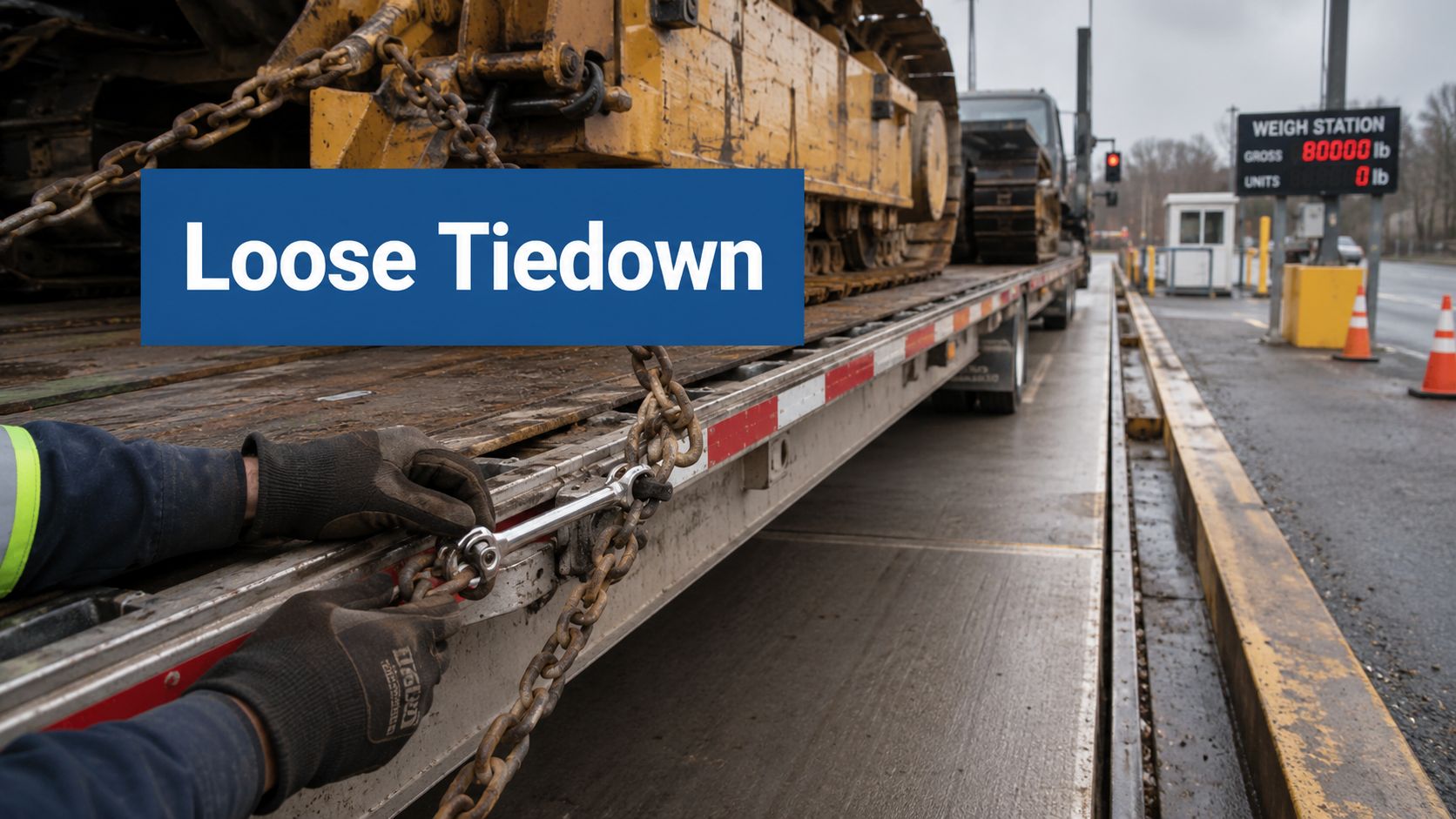
Loose tiedown DOT violation hits when you least need it. Your driver is at the scale house, the officer is walking the trailer, and one chain that looked fine at loading now has slack and your whole day is about to get expensive. If you own a fleet or manage safety, you already know this isn't just a driver problem. It turns into downtime, customer calls, paperwork, and a record that follows your business.
Most fleets get this wrong in one of two ways. They either treat a loose chain like a minor fix that won't matter, or they panic and assume one loose tie-down means the entire securement system is automatically failed. Both mistakes cost you. The reality sits in the middle, and that's where most bad decisions happen during inspections.
The situation is simple. DOT looks at whether your cargo securement system still meets the rules, still controls movement, and still has enough effective working load limit to stay legal. You need to know the trigger points, the out-of-service scenarios, and the exact steps your team should follow before an officer finds the problem for you.
Your Guide to Loose Tiedown DOT Violations
You've probably had this call before. Your phone rings, your driver says they got pulled in for an inspection, and now an officer is checking chains, binders, anchor points, and cargo movement by hand. If you run flatbeds, heavy haul, or equipment moves, that moment gets your attention fast.

A lot of owners assume a loose tiedown means the driver just needs to crank the binder and move on. Sometimes that does solve it. Sometimes it doesn't. If the officer can move the securement device or the cargo, you're not dealing with a harmless detail anymore. You're dealing with a compliance failure that can stop the truck right there.
The part that catches fleets off guard
A loose tiedown can unravel your whole securement setup. It can create a count issue, a working load limit issue, or both. That's why your team needs more than a basic “tighten your chains” reminder. You need a repeatable process for loading, rechecking, documenting, and correcting.
If your current program is mostly verbal reminders and hoping experienced drivers figure it out, that's not a program. It's exposure.
Practical rule: If an officer can grab a chain, strap, or piece of cargo and show visible movement, you should assume you have a real enforcement problem, not a technicality.
Your operation gets more stable when you treat cargo securement the same way you treat brakes, tires, and driver qualification files. That means written procedures, consistent inspections, and fast correction when something is off. If you want a stronger baseline process, start with a practical cargo securement compliance resource and make sure every load type in your fleet has a documented standard.
What Exactly Is a Loose Tiedown Violation
A loose tiedown DOT violation is not just “a little slack.” It becomes a violation when your securement system no longer meets the legal standard for controlling the cargo and maintaining enough aggregate Working Load Limit, or WLL.

The clearest way to think about it is this. DOT doesn't care that you attached several chains if one or more of them isn't doing its job. A tiedown only helps you if it is applying restraint.
The WLL math you need to understand
Federal cargo securement rules require the aggregate WLL of all securement devices to equal at least 50% of the cargo weight. For a 30,000 lb piece of heavy equipment, your tiedowns must provide a combined minimum of 15,000 lbs of WLL, as explained in this heavy equipment tie-down requirement reference.
Here's why that matters in the field:
| Load situation | What DOT looks at | Why it matters |
|---|---|---|
| Chain is attached but loose | Effective restraint | A loose device may not count the way you think |
| Enough devices are present | Aggregate WLL | Count alone doesn't make the load legal |
| Cargo can shift or lift | Actual securement performance | Movement creates immediate inspection trouble |
Why one loose point can break the system
With heavy equipment, DOT rules also require enough independent securement at the correct locations. If one corner loses tension, you haven't just lost neatness. You may have lost structural control of the load.
That's where fleets get trapped. They count hardware instead of counting effective securement.
If your tiedown isn't maintaining tension, the officer won't give you credit for intention. They'll judge what is actually restraining the cargo at that moment.
You also need to watch load length requirements and equipment-specific rules. Under FMCSA load securement regulations, your dispatch team and your loading crew should know before the truck leaves whether the load requires extra tiedowns, special positioning, or corner-specific securement.
What officers are really evaluating
An officer is asking three basic questions:
- Is the cargo restrained against movement?
- Do the tiedowns still meet the legal WLL requirement?
- Are the securement devices placed and tensioned correctly?
If any of those answers is no, you're exposed. The chain can look impressive. The binder can be expensive. None of that matters if the tiedown is loose enough to stop performing.
The Inspection Process and Immediate Consequences
Officers usually don't need a complicated test. They walk the trailer, look at tiedown placement, check for damaged hardware, and pull on chains, straps, and binders. If they can move the device by hand or show that the cargo is not firmly restrained, your inspection just got serious.
For your driver, this often feels sudden. For the officer, it's routine. Cargo securement is one of the easiest problems to verify on the roadside because it's visible and physical. It doesn't require guessing.
What can trigger an out-of-service order
The overlooked trigger is the 25% rule. A vehicle can be placed out of service when 25% of tie-downs are loose, missing, or defective, according to this 2018 CVSA training document.
That matters because many fleets think in absolute terms. They assume either the load is fine or the whole load is failed. Roadside enforcement is more specific than that. The officer may look at the percentage of defective securement devices and make the out-of-service call from there.
Here's a practical example. If you have four required tiedowns and one is loose or defective, you're already at that threshold. That's the kind of math your drivers need to understand before they leave the shipper.
What happens right after the violation
The consequences stack up fast:
- The truck can be delayed on the spot: Your driver may need to correct the issue before moving.
- The load may need rework: Retightening may be enough, or the tiedown may need replacement.
- Delivery problems start immediately: Your customer doesn't care that the issue was “just a chain.”
- Your safety team inherits the paperwork: Inspection reports, internal review, and possible challenge work all follow.
If you've seen a cargo not secured against shifting violation, you know how quickly one visible securement issue can expand into a broader discussion about your training and loading discipline.
Warning versus citation
Not every inspection ends the same way. Sometimes the officer lets your driver correct it and move on with limited fallout. Other times the finding sticks as a formal violation. The deciding factors usually come down to severity, visible cargo movement, condition of the equipment, and whether the load can be made safe immediately.
The difference between a quick roadside fix and a major operational problem is often the condition of the tiedown equipment before the truck ever left the yard.
If your safety department waits until inspection day to discover stretched chains, bad binders, or weak anchor points, you're already late. Inspection outcomes usually reflect what your fleet accepted at dispatch.
How to Correct a Violation and Document Everything
Once your driver is cited for a loose tiedown, speed matters. So does discipline. The goal is to make the load safe, get the vehicle back in service if possible, and create a clean record of what was wrong and how it was corrected.

What your driver should do first
Your driver should stay professional and avoid arguing on the shoulder or in the inspection lane. Then handle the load in a controlled order.
- Secure the area first. Don't start adjusting equipment until it's safe to do so.
- Identify the exact failure. Was the chain loose, the binder damaged, the anchor point questionable, or the load settled?
- Correct with the right hardware. If a binder or strap is damaged, replace it. Don't try to “make it work.”
- Ask for reinspection if appropriate. If the issue is corrected on site, your driver should be prepared for the officer to recheck it.
What to document before and after correction
Most fleets are weak here. They fix the problem and forget the evidence. That's a mistake.
Use this documentation checklist:
- Before photos: Show the tiedown the officer identified, plus a wider shot of the full load.
- After photos: Capture the corrected chain, binder, strap, or replacement hardware from multiple angles.
- Inspection paperwork: Save the inspection report and any notations about corrective action.
- Driver notes: Record time, location, what failed, and what was done to fix it.
- Equipment notes: If a component was defective, tag it out and record it for maintenance review.
A solid DOT trailer inspection checklist helps because it gives your team a standard way to capture the same evidence every time instead of relying on memory.
Build a post-violation file every time
Your safety office should open a file on every cargo securement violation, even if the correction was simple. Keep the photos, inspection document, dispatch notes, and any training follow-up in one place.
Good documentation won't erase a bad securement decision, but it can protect you from a bad record that you can't support or challenge later.
You also need to inspect the rest of the securement gear on that trailer. One loose chain often points to a bigger issue. Maybe the load settled. Maybe the driver rushed. Maybe the binder is worn. Maybe the loading crew used the wrong attachment point. Fix the root problem, not just the one citation.
Preventive Best Practices for Your Fleet
If you want fewer loose tiedown violations, stop treating cargo securement as a driver-only skill. It's an operating standard. Dispatch affects it. Loading affects it. Equipment maintenance affects it. Your safety culture affects it.
The rule is straightforward. Each tiedown attachment point must prevent becoming loose, unfastening, or releasing while the vehicle is moving, and for loads longer than 10 feet, the regulation requires one additional tie-down for every subsequent 10 feet or fraction thereof, as stated in 49 CFR Part 393 Subpart I.
The habits that actually prevent violations
Most securement failures start before the truck rolls. Your prevention plan should be built around the moments where fleets usually rush.
- At loading: Verify anchor points, tiedown count, tie-down angle, and tension before the driver leaves.
- At dispatch release: Require a second set of eyes for heavy equipment or unusual freight.
- At the first recheck: Make retightening mandatory after the load settles.
- At equipment issue reporting: Remove worn chains, bad binders, and suspect trailer attachment points immediately.
A simple fleet standard that works
Use this as your internal rule set for every load:
| Checkpoint | Standard | Owner takeaway |
|---|---|---|
| Tiedown count | Meets minimum by cargo type and length | Count before departure, not at roadside |
| Tension | Every device is holding firm | “Attached” is not the same as “working” |
| Hardware condition | No damaged chains, binders, hooks, or anchor points | Defects travel with the truck |
| Recheck process | Driver reinspects after the load settles | Most preventable slack shows up after departure |
What your pre-trip should focus on
A cargo securement pre-trip should not be a rushed walk-around. It needs to answer specific questions:
- Can any chain or strap be moved too easily by hand?
- Do all binders seat and hold tension properly?
- Are D-rings, rub rails, or anchor points visibly damaged?
- Does the cargo sit stable on the deck with no sign of shift risk?
If your team needs a more structured process, use a load securement checklist for truck drivers and make it part of dispatch release, not just a suggestion handed to new hires.
This is business protection. A secure load avoids roadside delays, protects your customer's freight, and keeps your fleet out of avoidable enforcement trouble.
Training Your Team on Proper Cargo Securement
You can buy new chains, new binders, and new trailers, and still get nailed for a loose tiedown if your people don't understand what they're looking at. Training is where compliance becomes real.
One detail your team needs to understand is this: a loose chain does not automatically void the entire WLL of the whole system. A loose section reduces the effective WLL of that specific chain segment, and the load may still be compliant if the remaining aggregate WLL is sufficient, as discussed in this cargo securement training video. That's a technical point, but it matters because bad assumptions lead to bad roadside decisions.

What your training should include
A useful program goes beyond reading regulations aloud. Your team needs scenario-based training with real hardware and real inspection logic.
Teach these points:
- How to identify a true loose tiedown: Not every concern looks dramatic. Slack, poor angle, and shifted hardware all matter.
- How to think in aggregate WLL: Your drivers should understand when the system still works and when it doesn't.
- How to inspect hardware under tension: Chains, hooks, binders, rails, and anchor points need to be checked as a system.
- How to respond roadside: Correction, communication, and documentation should be drilled, not improvised.
Train for the what-if moments
The best fleets train around situations, not just rules.
Ask your team questions like these:
- One binder backs off after departure. What do you do first?
- The load settled and one corner is loose. Is the load still legal?
- An officer says the securement can be moved by hand. What should your driver document?
- A chain is present, but not contributing enough restraint. Does it still help the aggregate WLL calculation?
That kind of training changes behavior because it matches what happens on the road.
If you want one system that combines mobile training, compliance tracking, qualification oversight, and safety follow-up, My Safety Manager is one option to evaluate. The point is not the brand. The point is having a process your team uses consistently.
Frequently Asked Questions About Cargo Securement
What is a loose tiedown DOT violation
A loose tiedown DOT violation happens when a tiedown fails to maintain proper tension and your cargo securement system no longer meets DOT requirements for restraining the load.
Can one loose chain put your truck out of service
Yes, it can. The important trigger is whether enough tiedowns are loose, missing, or defective to meet the out-of-service threshold discussed earlier, and whether the load can still be safely restrained.
Does a loose chain always mean the whole securement system fails
No. A common misconception is that one loose chain wipes out the whole system automatically. In practice, the remaining tiedowns may still keep the load compliant if the aggregate WLL is still sufficient and the cargo remains properly restrained.
How many tiedowns do you need for short heavy cargo
When your cargo is 5 feet or shorter and weighs over 1,100 pounds, you must use a minimum of 2 tie-downs to prevent forward movement and shifting, as described in this cargo securement violation guide.
What should your driver do during the inspection
Your driver should stay calm, listen carefully, avoid arguing, correct the issue if allowed, and document the condition before and after the fix.
Can you challenge a cargo securement violation
Yes, in some situations you can challenge inspection data or supporting details if your records, photos, and corrective documentation show the violation was recorded incorrectly or does not match the facts.
What equipment problems lead to loose tiedown violations
Common causes include worn binders, stretched chains, damaged straps, bad anchor points, poor tiedown angles, and load settling after departure.
Should dispatch be involved in cargo securement
Absolutely. Dispatch should know the cargo type, expected tiedown count, trailer type, and whether the load needs extra review before release.
What is the fastest way to reduce these violations in your fleet
Use a written checklist, require a recheck after departure, remove questionable hardware immediately, and train your team with real examples instead of generic reminders.
Regulatory References
For direct review, keep these federal cargo securement rules bookmarked in your safety system.
- 49 CFR § 393.102 Minimum number of tiedowns
- 49 CFR § 393.104 General requirements for cargo securement
- 49 CFR § 393.110 Aggregate working load limit
- 49 CFR § 393.130 Securing heavy vehicles, equipment and machinery
These are the rules your officers use, your safety team should know, and your drivers need translated into practical load-by-load decisions.
If you want help turning cargo securement rules into daily fleet process, training, documentation, and follow-up, take a look at My Safety Manager. It gives you a practical way to keep compliance organized so you can spend less time reacting to violations and more time running your business.
