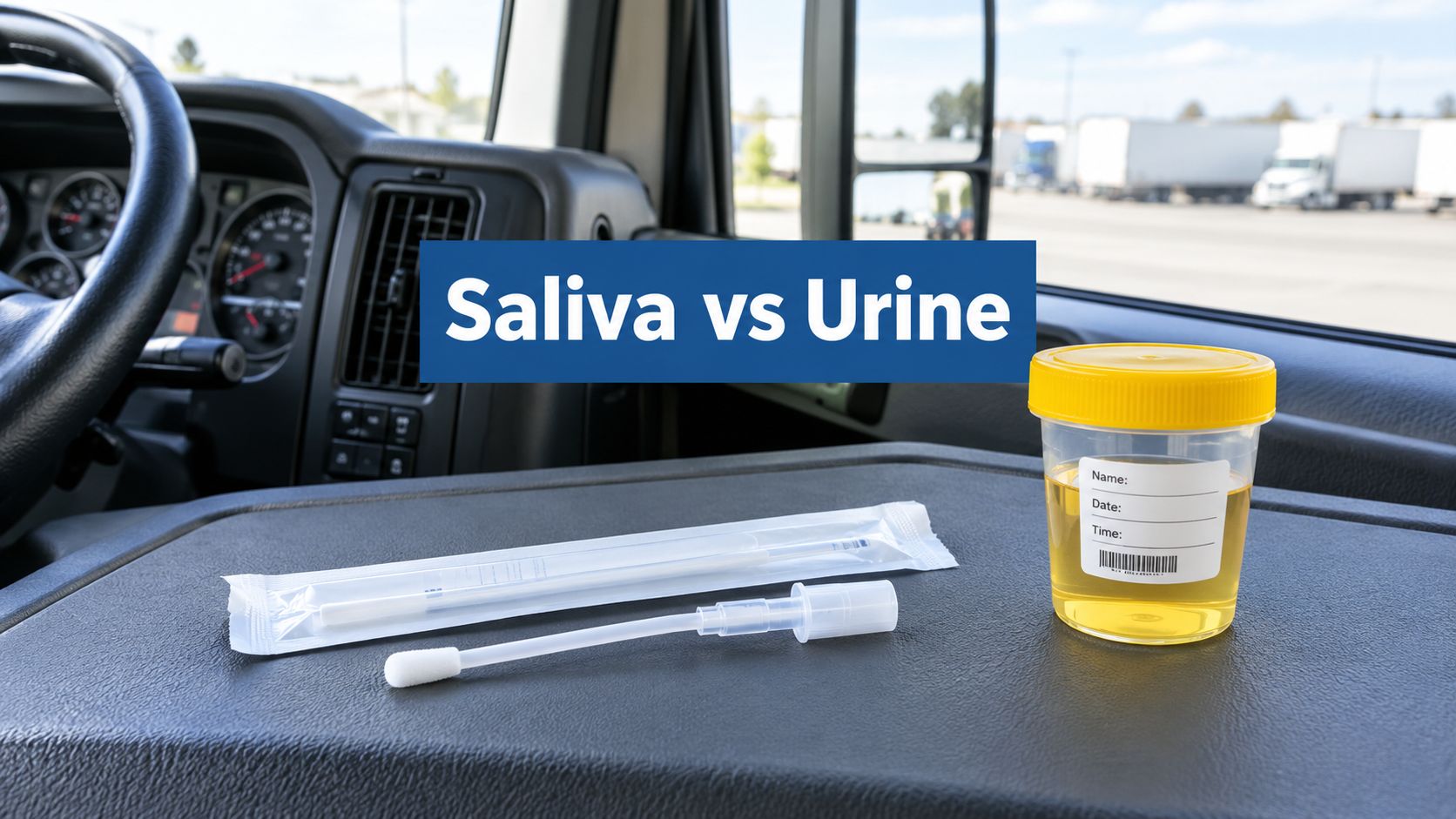
Drug testing saliva vs urine can determine whether your fleet's program catches recent exposure, supports broad deterrence, and stays inside DOT rules. If you own a trucking company or manage fleet safety, you may still be renewing a urine-testing contract because it's familiar. Then oral fluid testing enters the conversation, promising easier collections and better tamper resistance, and you're left asking whether changing methods would improve safety or create a compliance problem.
The mistake is treating saliva and urine as competing tests with one universal winner. They answer different questions, use different collection workflows, and operate within specific federal requirements. The practical decision is which specimen supports your objective, whether you're monitoring long-horizon abstinence, deterring repeated use, or checking for very recent exposure after an incident. This guide gives you the operational and regulatory framework to make that choice.
Table of Contents
- Drug Testing Saliva vs Urine for Your Fleet
- Detection Windows and Analytical Sensitivity
- Collection Logistics and Chain of Custody
- DOT Regulatory Acceptance and Laboratory Rules
- Strategic Use Cases for Fleet Operations
- Frequently Asked Questions
- Is saliva or urine better for DOT drug testing?
- Does saliva testing detect more recent drug use?
- Does urine prove impairment?
- What drug classes are included in DOT oral fluid testing?
- Why are oral-fluid cutoffs lower?
- Does oral fluid eliminate chain-of-custody requirements?
- Can you use oral fluid anywhere in your fleet?
- What happens if the result needs confirmation?
- Which specimen is better for random testing?
- Should your fleet use both methods?
- Regulatory References and Compliance Support
Drug Testing Saliva vs Urine for Your Fleet
A fleet owner dealing with a roadside incident has a different testing problem than a safety manager running a routine random-testing pool. At a remote location, finding a secure restroom and preserving a controlled urine collection can slow the response. At a scheduled testing site, urine may offer the broader detection window and established laboratory workflow your policy depends on.
That distinction matters more than a general claim that one method is “more accurate.” Urine generally gives you a longer look back, while oral fluid focuses more closely on recent exposure. Neither result, by itself, proves impairment. Your policy must connect the specimen type to the safety question you're authorized and prepared to answer.
| Decision factor | Oral fluid testing | Urine testing |
|---|---|---|
| Primary signal | Recent exposure | Prior use over a broader window |
| Collection setting | Directly observed, no restroom required | Controlled restroom or collection facility |
| Adulteration concern | Lower vulnerability to substitution or adulteration | Requires stronger collection controls |
| Detection window | Usually shorter | Usually longer |
| Best operational fit | Field, post-incident, or reasonable-suspicion situations | Pre-employment, random, and broad compliance programs |
| DOT use | Authorized alternative when federal implementation conditions are met | Established federal specimen type |
If you're building broader middle-mile fleet compliance strategies, specimen selection belongs in the same conversation as policy language, collection-site coverage, random-pool administration, and post-incident response. A test that's easy to collect but poorly matched to your objective can create false confidence. A test with a strong historical detection window can still be impractical if your team can't collect it correctly when an incident occurs.
Your written policy also needs to match the testing category and the governing rules. Before changing vendors, collection procedures, or specimen types, review your DOT drug testing requirements and confirm that your service providers can support the required chain of custody, laboratory confirmation, Medical Review Officer review, and split-specimen process.
Practical rule: Choose the specimen based on what you need to know, not on which collection process sounds easier.
Detection Windows and Analytical Sensitivity
Urine and oral fluid don't reveal the same biological evidence. Urine typically contains higher concentrations of drug metabolites, which remain after the body processes the parent drug. Oral fluid more often reflects the parent drug and a shorter-lived exposure period. That difference explains why urine is usually stronger for identifying prior use, while oral fluid can be more relevant when recent consumption is the concern.

In workplace and clinical review literature, urine detection commonly spans about 1 to 4 days for many drugs, with cannabis potentially extending to weeks in chronic use. Oral fluid is usually detectable for about 5 to 48 hours and rarely beyond 72 hours for most analytes. The comparison is documented in this review of urine and oral fluid detection windows.
What the window means for marijuana
For marijuana, oral fluid can help you identify relatively recent use because the specimen is closer in time to consumption. Urine detects metabolites that can remain after the immediate effects have passed, which makes it more useful when your program is designed to identify use over a wider period.
That doesn't mean either test tells you exactly when someone used marijuana or whether that person is impaired at the moment of collection. It means the specimen changes the time horizon of your policy. If your objective is recent exposure around a safety event, oral fluid may align better. If your objective is a broad abstinence or deterrence program, urine may provide more useful coverage.
Cocaine and methamphetamine require the same decision discipline
Urine is often better suited to identifying cocaine and methamphetamine use over days rather than hours, while oral fluid is more focused on recent exposure. Your testing category should determine which window matters. A random program intended to discourage use between work assignments may benefit from urine's broader look back. A post-incident response may place more value on a specimen that can be collected promptly in a controlled field process.
Federal adoption also reflects the difference in maturity between the methods. The U.S. federal system launched urine-only Mandatory Guidelines on April 11, 1988, while the first oral-fluid Mandatory Guidelines became effective January 1, 2020. SAMHSA's oral-fluid rules became effective October 10, 2023, giving urine more than three decades of regulatory lead time. The timeline appears in SAMHSA's federal workplace drug-testing FAQ.
For a deeper look at the practical time horizon, review how far back a DOT drug test goes. Then decide whether your program is built primarily for deterrence, recent-use detection, or longer-term compliance monitoring.
Collection Logistics and Chain of Custody
Collection problems often create more risk than the laboratory method itself. Your safety team needs a process that protects specimen integrity, documents each handoff, and works at the location where the test occurs.
Urine collection normally requires a controlled facility with restroom access and procedures designed to identify dilution, substitution, or adulteration. The collector must verify the specimen, secure the containers, complete the chain-of-custody documentation, and send the specimen through the laboratory process. That workflow is familiar, but it can be difficult to manage after an incident at a remote terminal, roadside location, or unfamiliar medical facility.
Oral fluid collection happens under direct observation and doesn't require a restroom. That makes it easier to control the collection environment and reduces opportunities for substitution. It also gives your response team a specimen option when locating a suitable urine facility would delay the process.
Where urine creates operational work
Your dispatch and safety teams need to plan for:
- Collection-site access: Confirm that the facility can accept the person promptly and follow the required federal procedure.
- Specimen integrity: Make sure the collector completes the required checks, seals the specimen, and documents the transfer.
- Split-specimen handling: Preserve the employee's ability to request testing of the split specimen through the appropriate process.
- Remote response: Maintain a current list of collection locations across your operating territory instead of relying on one terminal.
A urine program can work very well when your fleet has predictable terminal coverage and established relationships with compliant collection sites. It becomes less convenient when an incident occurs far from those locations.
Where oral fluid helps, and where it adds complexity
Oral fluid can reduce restroom dependence and make observed collection more practical. It's also less vulnerable to adulteration or substitution than urine. However, the analytes occur at lower concentrations. Expert guidance notes that oral fluid concentrations can be 10 to 100 times lower than urine for some analytes, so laboratories need more sensitive assays. That technical difference is addressed in the DOT oral-fluid specimen collection procedures.
You also need to confirm that your collection network and laboratory partners can handle oral fluid correctly. A collection kit alone doesn't create a compliant program. Your administrator must support the custody documents, laboratory confirmation, Medical Review Officer review, and split-specimen procedures that apply to the test.
Your team should also understand split-specimen collection before adopting any new workflow. The right question isn't only whether a collector can obtain the specimen. It's whether your entire process can defend the result from collection through final review.
DOT Regulatory Acceptance and Laboratory Rules
You can't switch to oral fluid because the collection appears faster. DOT permits oral fluid as an alternative specimen type for DOT-required drug tests, but the federal framework imposes conditions on implementation.
The DOT final rule authorizing oral fluid testing was published on May 2, 2023, and became effective on June 1, 2023. The regulatory timeline is available through the DOT Office of Drug and Alcohol Policy and Compliance final-rules page. Authorization does not mean every fleet can immediately use oral fluid at every location.
Verify the laboratory condition first
Oral fluid testing couldn't be implemented until HHS certified at least two laboratories, one primary laboratory and one split-specimen laboratory. That requirement makes laboratory availability a central compliance checkpoint, not a minor purchasing detail.
Before you revise your written policy, ask your testing administrator:
- Can the program use oral fluid for the DOT testing categories you operate?
- Which certified laboratory will perform the primary analysis?
- Which certified laboratory will handle split-specimen testing?
- Does the collector have the required training and supplies?
- Can the administrator maintain the complete custody and review workflow?
- What happens if the selected laboratory or split-specimen laboratory isn't available?
If your administrator can't answer those questions clearly, don't treat oral fluid as ready for your fleet. A compliant urine program is more useful than an oral-fluid program that your service network can't execute consistently.
Understand the federal testing boundary
DOT testing uses federal procedures and defined cutoff concentrations. For urine testing under 49 CFR 40.85, the initial screen and confirmation process depend on whether the measured result reaches the applicable cutoff. A result below the cutoff is reported negative, while a confirmatory result at or above the cutoff is reported positive. The rule also requires quantitative reporting for morphine or codeine at 15,000 ng/mL or above, as stated in 49 CFR 40.85.
Your written program should identify the applicable specimen type, testing category, collection procedure, laboratory pathway, and review process. Use the DOT drug testing requirements resource as a planning reference, then verify the current federal rule and your administrator's implementation capability before making a change.
Strategic Use Cases for Fleet Operations
The strongest program treats specimen selection as a safety decision. Urine supports broad deterrence and longer-horizon monitoring. Oral fluid supports recent-use assessment in situations where collection speed and direct observation matter.
A 2026 review of random testing found that urine screening identified 8.9% of samples as requiring further confirmation testing, compared with 3.4% for oral fluid. A large workplace comparison reported substances in 3.7% of urine samples versus 0.5% of oral-fluid samples. Those results, reported in the 2026 review of random-testing data, illustrate that the methods can produce different visibility into use because their detection windows differ. They don't establish that one specimen is universally superior.
Match the specimen to the objective
For pre-employment and random testing, urine often fits a program designed to identify use over a broader period and maintain a strong deterrence net. The longer window can be valuable when your policy isn't limited to suspected use immediately before a test.
For post-incident or reasonable-suspicion testing, oral fluid may fit better when you need a directly observed collection without locating a secure restroom. You still need objective, documented grounds for reasonable suspicion and a process that follows the applicable rule. Oral fluid doesn't replace supervisor training or eliminate the need for careful incident documentation.
| Testing Category | Primary Objective | Recommended Specimen |
|---|---|---|
| Pre-employment | Identify prior use within a broader window | Urine, where permitted by the governing program |
| Random testing | Support deterrence and identify use over time | Urine for broad historical coverage |
| Post-incident | Assess recent exposure after a safety event | Oral fluid where authorized and operationally available |
| Reasonable suspicion | Support recent-use investigation | Oral fluid where authorized, with documented observations |
| Return-to-duty or follow-up | Follow the specific testing plan and rule | Use the specimen type required by the governing program |
A hybrid policy can make sense if your third-party administrator, laboratories, collectors, and written procedures support both methods. Don't create a hybrid program informally. Define which specimen applies to each category, train supervisors and designated employer representatives, and make sure the selection remains consistent with your policy.
For incident workflows, review your post-incident drug testing process and map it against your actual terminal coverage. The test that works on paper must also work when your vehicle is damaged, your dispatch team is coordinating recovery, and your safety manager is trying to preserve the testing timeline.
Frequently Asked Questions
Is saliva or urine better for DOT drug testing?
Neither is universally better. Urine remains the established federal benchmark, while DOT allows oral fluid as an alternative when the required regulatory and laboratory conditions are met.
Does saliva testing detect more recent drug use?
Yes. Oral fluid generally reflects a shorter and more recent exposure period, while urine usually detects metabolites over a longer window. That makes oral fluid more relevant when recent use is the specific concern.
Does urine prove impairment?
No. A positive urine result shows that the tested analyte reached the applicable reporting threshold. It doesn't establish the exact time of use or prove impairment at the time of collection.
What drug classes are included in DOT oral fluid testing?
DOT oral fluid testing uses the same five drug classes as urine testing. The cutoff concentrations can differ because oral fluid contains lower analyte concentrations. For example, marijuana is reported at 4 ng/mL in oral fluid versus 50 ng/mL in urine, as described in this DOT five-panel cutoff comparison.
Why are oral-fluid cutoffs lower?
Oral fluid can contain substantially lower concentrations of some analytes than urine. Laboratories therefore use more sensitive analytical methods and lower cutoffs for certain substances.
Does oral fluid eliminate chain-of-custody requirements?
No. Direct observation can reduce substitution and adulteration risk, but the collector still must follow the applicable custody, sealing, documentation, laboratory, and review procedures.
Can you use oral fluid anywhere in your fleet?
Not automatically. You need an authorized testing program, qualified collection procedures, and access to the required certified primary and split-specimen laboratories. Your administrator should confirm availability before you change the policy.
What happens if the result needs confirmation?
The laboratory performs the required confirmation analysis when the initial result reaches the applicable cutoff. A Medical Review Officer then handles the result review and communication under the governing process.
Which specimen is better for random testing?
Urine is often the better operational fit when your objective is broad deterrence and detection of prior use over a longer window. Your written policy and applicable federal requirements still control the final selection.
Should your fleet use both methods?
A hybrid approach can work when each specimen has a defined purpose and your administrator can support both workflows. Use urine for the categories where long-horizon detection matters and consider oral fluid for authorized categories where recent exposure and collection logistics matter more.
Regulatory References and Compliance Support
Your safety team should keep the governing rules close at hand rather than relying only on a vendor summary. Review the current text before changing your specimen policy, collection instructions, or administrator agreement.
- 49 CFR Part 40, Procedures for Transportation Workplace Drug and Alcohol Testing Programs: Review the current Part 40 text on eCFR.
- 49 CFR 40.85, What are the cutoff concentrations for drug tests: Review the urine cutoff rule on eCFR.
- 49 CFR 40.67, When must a direct observation collection be conducted: Review the direct-observation requirements on eCFR.
The practical position is straightforward. Keep your program centered on the objective, verify the specimen rules for each testing category, and confirm that your collection and laboratory network can execute the process without gaps. The right testing strategy is one part of a broader system that also includes driver qualification files, supervisor training, incident response, and ongoing compliance monitoring.
My Safety Manager helps you manage DOT drug and alcohol program responsibilities, driver qualification records, CSA BASIC monitoring, training, and fleet compliance workflows through an online dashboard. Visit My Safety Manager to connect your specimen-testing decisions with the rest of your safety program.
