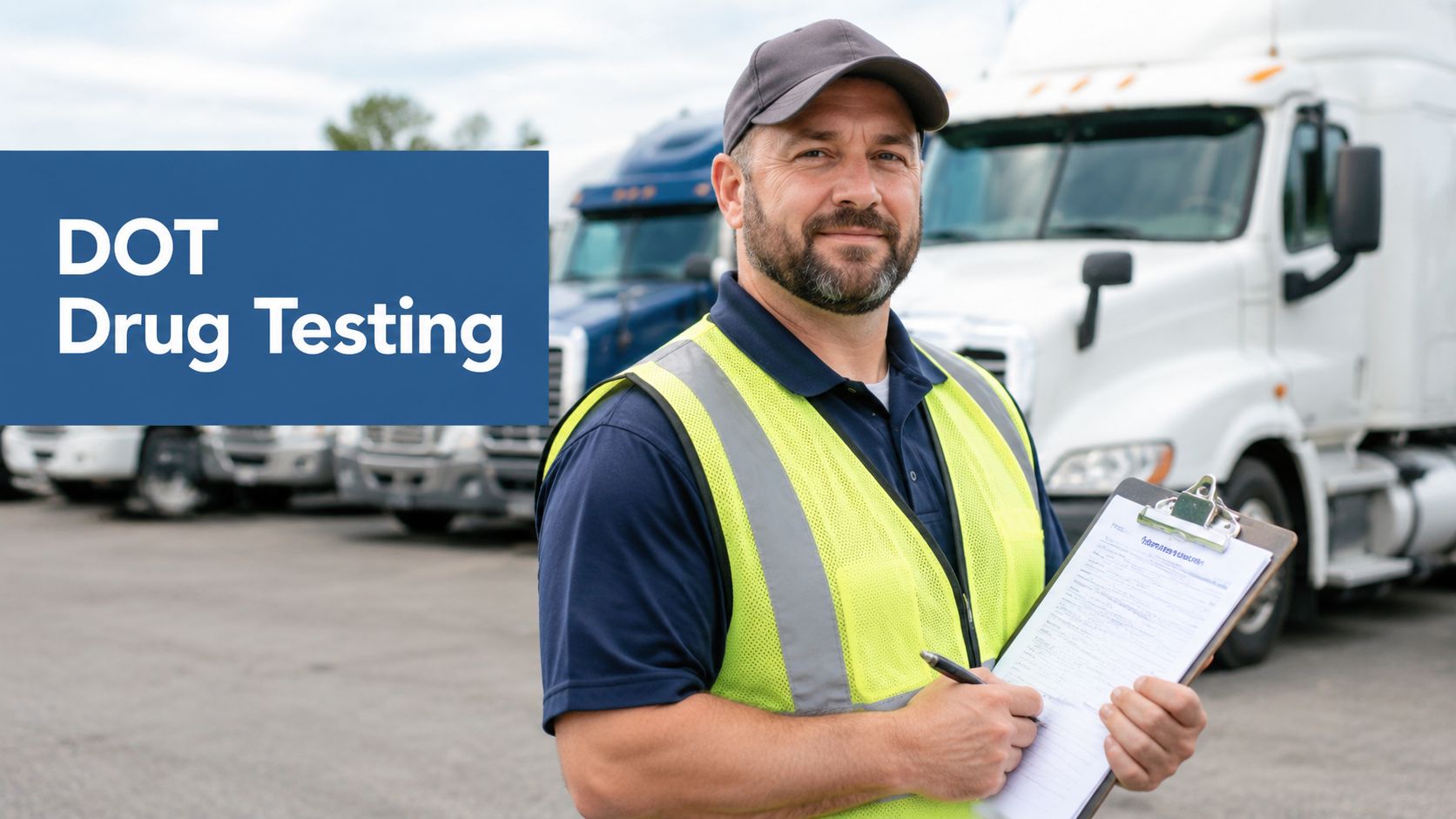
What is DOT drug testing? If you manage a trucking fleet, you may be trying to clear a pre-employment test, schedule random selections, answer a Clearinghouse question, and close out paperwork before your next dispatch deadline. You need a process that keeps your fleet compliant without slowing operations.
The trouble usually starts with small gaps. A required test gets scheduled late, a negative pre-employment result isn't received before dispatch, or your team assumes oral-fluid testing is already available. Confusion around the five-panel test, split specimens, and changing federal proposals can leave your records incomplete even when everyone is acting in good faith.
DOT drug testing is a structured safety-control program, not a single urine screen. This guide explains the legal framework, required test events, laboratory process, recordkeeping duties, and practical testing choices. If you also manage broader workforce health policies, this practical UK employee health guide offers useful context on organizing employee screening programs.
Table of Contents
- Introduction to DOT Drug Testing
- Understanding DOT Drug Testing
- DOT Drug Testing Regulations
- Required Testing Circumstances
- Specimen Collection and Lab Process
- Employer Responsibilities and Recordkeeping
- Compliance Best Practices and My Safety Manager
- Common Questions and Regulatory References
Introduction to DOT Drug Testing
A fleet manager can start the morning with an open position, a driver waiting for dispatch, and a testing file that still needs one missing signature. The safety team may also be tracking a random selection, checking whether a post-accident test applies, and responding to a rule question from an owner or insurance contact. When those tasks live in separate folders and calendars, compliance becomes dependent on memory.
The common mistake is treating DOT drug testing as an event that ends when the collection site hands over paperwork. In reality, you must coordinate eligibility, test type, timing, laboratory review, Medical Review Officer handling, and final documentation. A test that happens at the wrong time, or a result that isn't properly recorded, can create a serious operational gap.
You also need to distinguish federal DOT requirements from general workplace testing policies. Your supervisors need to know when observable behavior supports reasonable suspicion, your dispatch team needs a clear release rule, and your compliance staff needs a reliable way to see open actions.
This guide gives you that operating view. You'll learn what the rules require, when each test applies, how the specimen process works, why urine remains the active method today, and how a centralized dashboard can help you keep qualifications, testing schedules, and status information together.
Understanding DOT Drug Testing
A driver is ready for dispatch, but the fleet still needs to confirm which test applies and whether the result clears the person for safety-sensitive work. That decision depends on more than sending someone to a collection site. DOT drug testing is a federally regulated process for people performing safety-sensitive transportation work. In commercial trucking, it addresses prohibited drug and alcohol conduct, public safety, hiring, monitoring, and continued eligibility.
The legal foundation reaches back to the Omnibus Transportation Employee Testing Act of 1991, which required DOT agencies to establish drug and alcohol testing for safety-sensitive transportation employees. FMCSA says these requirements have governed CDL truck and bus drivers since the early 1990s. The current framework joins DOT-wide testing procedures with FMCSA employer requirements, so a fleet must manage both the specimen process and CMV-specific operating decisions. DOT's history of random testing rates explains how random-testing requirements developed and how national results affect the applicable rate.

A data-driven compliance system
Random testing requirements can change as industry results change. A 2016 Federal Register notice lowered the minimum annual random controlled-substances testing rate from 50% to 25% after a third consecutive year in which industry positive rates stayed below 1.0%. The notice reported an estimated 2013 positive random controlled-substances rate of 0.7%, with a 95% confidence interval of 0.6% to 0.8%, based on FMCSA's random testing rate information.
That history gives fleet managers a practical lesson: the annual rate is not a number to set once and forget. Maintain an unbiased random pool, check the current requirement, document each selection, and record whether the test was completed correctly. Oral-fluid testing also creates a planning gap when operations need another collection option, because urine remains the active DOT method today. Track method, status, deadlines, and follow-up in one dashboard so testing choices and open compliance actions remain visible together.
DOT Drug Testing Regulations
Your program rests on two connected rule sets. 49 CFR Part 40 establishes the DOT workplace testing procedures, including collection, laboratory, Medical Review Officer, and result-handling requirements. 49 CFR Part 382 applies those requirements to commercial motor vehicle operations and outlines employer duties for people performing safety-sensitive functions. FMCSA summarizes this relationship in its overview of drug and alcohol rules for employers.
The operating rules you need to map
Part 40 controls the testing chain. It addresses how a collector identifies you, completes the custody-and-control process, sends the specimen to an authorized laboratory, and handles review of the result. Your collection site and testing partners must work within this federal structure, including the applicable laboratory certification requirements.
Part 382 supplies the trucking-specific triggers. The most important dispatch control is the pre-employment negative-result gate. You must receive a negative controlled-substances result before you allow a new hire to operate a CMV in a safety-sensitive role. A completed collection alone doesn't clear that person for operation.
Your organization should also appoint a Designated Employer Representative, commonly called a DER. That person needs authority to receive testing information, coordinate required actions, communicate with the MRO and service providers, and prevent an ineligible person from performing regulated work.
Practical rule: Treat the final verified result as an eligibility decision, not just a document to file.
Write your internal policy so a manager can answer four questions quickly: which rule applies, what triggered the test, who owns the next action, and whether dispatch is permitted. A centralized DOT drug testing requirements resource can help you organize those policy points, but your written procedures still need to match the regulations and your operating locations.
Required Testing Circumstances
DOT testing follows the event that creates the obligation. Your DER should be able to identify the trigger, arrange the correct test, document the timing, and keep you from assigning safety-sensitive work before the required clearance is complete.

Use this practical checklist:
- Pre-employment: Before you let a new hire operate a CMV, obtain and review the required negative controlled-substances result. Also complete the required prior-employer and Clearinghouse inquiry steps that apply to the hiring decision.
- Random: Place eligible people in a random pool and make selections without allowing supervisors to choose favorites or avoid particular individuals. The current FMCSA random drug-testing benchmark is 50% of average driver positions per year, while random alcohol testing remains 10%, as reported in the current FMCSA rate summary.
- Post-accident: First determine whether the incident meets the federal criteria. If it does, protect the evidence, notify the responsible manager, and arrange the required testing within the applicable time limits.
- Reasonable suspicion: A trained supervisor must document specific, contemporaneous observations that support the decision. General rumors, personality conflicts, or a vague feeling aren't a substitute for observable facts.
- Return-to-duty: If a violation removed someone from regulated work, you must complete the substance-abuse-professional process and obtain the required negative return-to-duty result before assigning safety-sensitive duties.
- Follow-up: After return to duty, complete the unannounced follow-up testing plan established by the SAP. Your DER must track each required event rather than waiting for the person to volunteer a reminder.
Scheduling support for post-incident drug testing can help you respond consistently after a qualifying event. The key is to document the trigger before the paperwork becomes difficult to reconstruct.
Specimen Collection and Lab Process
A driver arrives for a DOT test, presents identification, follows the collector's instructions, and provides the specimen under the applicable procedure. The collection site protects the specimen's identity and condition from that moment. The collector divides it into a primary bottle and a split bottle, seals and labels both, then completes the custody-and-control documentation.

The laboratory tests the primary bottle first. It performs the required initial screen and, when needed, confirmation testing. Make that sequence clear in driver and supervisor instructions. A preliminary screen is not automatically the final verified result.
What the five-panel process measures
The current FMCSA substance list includes five classes: marijuana metabolites, cocaine metabolites, amphetamines, opioids, and phencyclidine, or PCP. Each substance has its own laboratory cutoffs, so one threshold does not apply across the entire panel.
For marijuana metabolites, the initial cutoff is 50 ng/mL, followed by a 15 ng/mL confirmatory cutoff, according to DOT's Part 40 laboratory cutoff table. For amphetamines, the initial cutoff is 500 ng/mL and the confirmatory cutoff is 250 ng/mL. The table also lists methamphetamine and MDMA under the same 500 ng/mL initial and 250 ng/mL confirmatory framework, as shown in the federal regulation table for laboratory cutoffs.
The MRO reviews the laboratory findings and considers any legitimate medical explanation under the DOT process. If the MRO verifies the primary specimen as positive, adulterated, or substituted, the employee has 72 hours after notification to request testing of the split bottle at a second laboratory. If that bottle does not confirm the finding, the test is cancelled. If it does confirm the finding, the original verified result stands. Keep instructions for the split-specimen collection process available to staff. As oral-fluid testing develops, confirm which specimen method the applicable rule and your collection setup permit before scheduling, then track the selected method and result in one dashboard.
Employer Responsibilities and Recordkeeping
A compliant program needs an owner for every action. Start by naming your DER and documenting that person's authority. Then identify approved collection locations, laboratory and MRO contacts, supervisor-training requirements, and the internal rule that prevents dispatch until a required result is received.
Your records should let an auditor follow one event from trigger to closure. Keep the selection record for a random test, the collection and custody forms, MRO communications, final result, Clearinghouse activity, and any return-to-duty or follow-up documentation in a controlled file. Access should be limited because testing records contain sensitive information.
A useful file audit
Review your program on a recurring schedule rather than waiting for an audit notice. Check that:
- Every selection has an outcome: Confirm that each selected person completed the test or that you documented the reason and required follow-up for noncompletion.
- Dispatch controls are visible: Verify that no one was assigned safety-sensitive work before a required negative pre-employment or return-to-duty result.
- MRO records match your roster: Reconcile final results against the people listed in your active driver records.
- Clearinghouse actions are complete: Track required queries, violation entries, and status changes in a restricted-access workflow.
- Supervisors can support decisions: Confirm that reasonable-suspicion training records remain current and that observation forms are available.
Record retention periods and access rules depend on the specific record and applicable DOT requirement. Don't create a single blanket retention rule without checking the governing provision. Use the FMCSA Clearinghouse compliance resource to structure your review, then verify the exact retention obligation for each record category before you purge anything.
Compliance Best Practices and My Safety Manager
Good compliance programs remove avoidable decisions from busy shifts. Build a written calendar for random selections, train supervisors to recognize and document observable signs, give dispatch a clear release rule, and assign one person to reconcile open tests every day.
Your testing method also needs a current operational decision. DOT authorized oral-fluid testing in 2023, but the method cannot be used until at least two HHS-certified oral-fluid laboratories are available. DOT and SAMHSA materials continue to point employers to urine testing as the active method, while oral-fluid implementation remains pending, as explained in the DOT oral-fluid specimen procedures guidance.
That gap creates a practical question for fleet owners: what can you use today? Unless the federal conditions for oral-fluid testing are satisfied, your process should continue using the active DOT-approved method and should not treat an authorized future option as an available present option.

My Safety Manager provides one dashboard for driver qualifications, drug and alcohol testing schedules, and Clearinghouse status. Its listed program price is $49 per driver per month with no hidden fees, and its stated services include random pool management, collection scheduling help, testing at SAMHSA-approved laboratories, MRO review, and annual Clearinghouse inquiries. Centralizing those tasks can make open actions easier to see and audit.
You may also want to align drug and alcohol procedures with your wider insurance and contractor controls. This resource on policies for contractors and fleets can help you consider how safety documentation fits into broader commercial fleet planning.
Common Questions and Regulatory References
Frequently asked questions
What is DOT drug testing?
It is a federally regulated drug and alcohol testing program for safety-sensitive transportation work.
Can employers use oral-fluid testing today?
Employers should use the active DOT-approved method until the required federal conditions for oral-fluid testing are satisfied. This gap makes it important to confirm the method before scheduling a collection.
What happens after a positive screen?
The primary specimen receives confirmatory testing and MRO review before the result is finalized.
Can an employee request a split-specimen retest?
Yes. After notice of a verified positive, adulterated, or substituted result, the employee has 72 hours to request split-specimen testing through the required process.
What does the DOT five-panel test include?
Marijuana metabolites, cocaine metabolites, amphetamines, opioids, and PCP.
Can a new hire operate before the result arrives?
No. The employer must receive the required negative pre-employment controlled-substances result before allowing CMV operation.
What happens after a violation?
The employee must complete the return-to-duty process, including SAP requirements and a negative return-to-duty test, before resuming regulated duties. Use this SAP program resource to organize those steps.
Regulatory References
- 49 CFR Part 40, DOT workplace drug and alcohol testing procedures.
- 49 CFR Part 382, controlled-substances and alcohol requirements for CMV operations.
- 49 CFR 382.301, pre-employment controlled-substances testing.
- 49 CFR 40.85, initial and confirmatory test cutoff concentrations.
A single dashboard can connect testing schedules, random pools, MRO results, driver qualification records, and Clearinghouse actions. My Safety Manager helps teams keep those records together, so dispatch staff can check current testing status instead of relying on scattered files. That setup also makes the oral-fluid testing gap easier to manage because the selected testing method and pending actions remain visible in one place. Visit My Safety Manager to review the DOT drug and alcohol program for your fleet.
