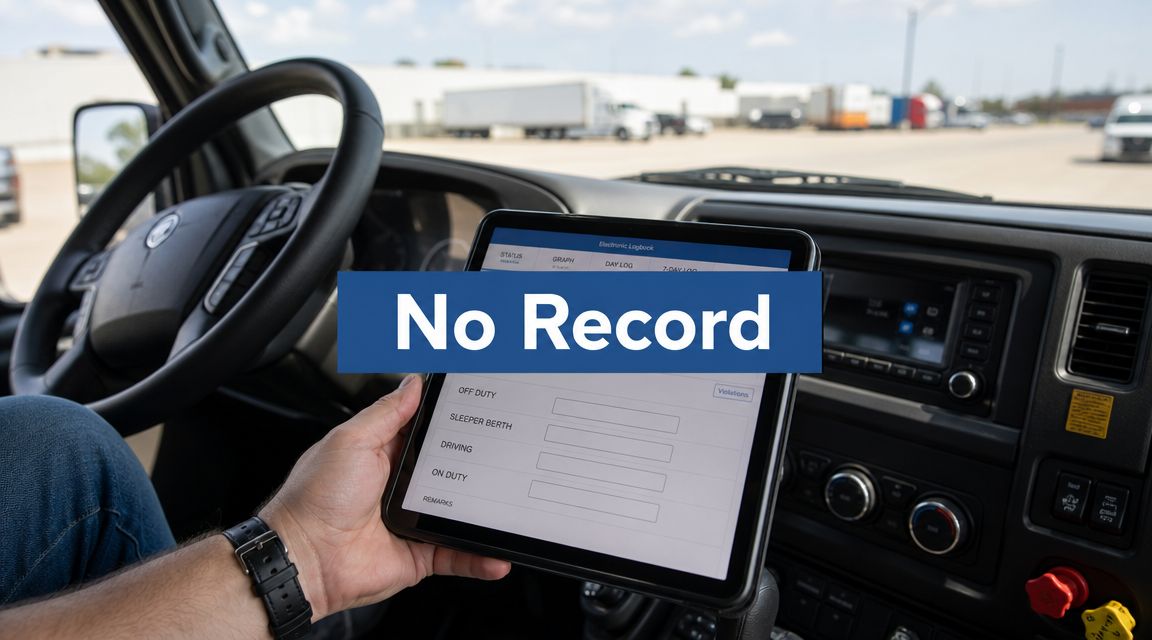
No record of duty status violation is the kind of call that can wreck your day before lunch. Your driver gets stopped, the inspector asks for logs, and suddenly a trip is dead, a customer load is late, and you're trying to figure out whether this was a real hours-of-service problem, an ELD issue, or a preventable process miss.
What usually trips fleets up is that the violation sounds simple, so people treat it like simple paperwork. They assume the log exists somewhere, the ELD has the data, or an unsigned record can be fixed later. At roadside, that thinking doesn't help you. If your driver can't produce a current and reviewable duty-status record in the way the inspector needs, you're already in a bad spot.
The problem is bigger than a missing form. It's about whether you can prove compliance at the moment it matters. If you want a broader view of how these citations fit into your safety profile, start with this guide on what a DOT violation means for your fleet. From there, the main effort is building a system that keeps your records current, retrievable, and defensible.
Introduction
A no record of duty status violation usually shows up when you thought your process was fine. The driver was logged in, dispatch had the load moving, and nobody saw a problem until the inspection report hit your inbox.
That gap is why this violation frustrates so many fleet owners and safety managers. In practice, it often comes from small failures that stack up. A driver forgets a status change. An ELD won't transfer at roadside. A backup process exists on paper but nobody knows how to use it under pressure.
You can't manage this issue well if you think of it as just a logbook ticket. It affects out-of-service exposure, your HOS compliance posture, and how convincingly you can defend your operation when a citation is wrong.
Practical rule: If your team can't recreate a clean duty timeline on demand, you have a compliance problem even if nobody intended to violate the rules.
The good news is that this is fixable. Most fleets don't need a new slogan about safety. They need a tighter roadside playbook, cleaner ELD procedures, stronger supervision, and a repeatable way to challenge bad data when the inspection doesn't match what occurred.
What No Record of Duty Status Really Means
A no record of duty status violation isn't limited to a driver having no logbook in hand. Under 49 CFR 395.8 requirements for records of duty status, you must maintain a duty-status record for each 24-hour period. The record has to be current, and the rule requires submission to the motor carrier within 13 days after the 24-hour period covered by the record.
What matters at roadside is whether your driver can show a usable, current, continuous record. The legal backbone is in 49 CFR § 395.8, and FMCSA guidance says enforcement action can still be taken even if the record isn't signed because the primary concern is whether the record is current to the last duty-status change and maintained as required.

What an inspector is actually checking
Inspectors don't just want proof that your ELD exists. They want a reconstructable timeline. That means your record needs to show the driver information and the duty-status history in a way the officer can review at roadside.
Common trouble spots include:
- Current status not updated: The record isn't brought forward to the last duty-status change.
- Prior history missing: The current day plus the previous seven consecutive days can't be produced.
- Supporting details are incomplete: Basic trip and equipment details don't line up cleanly with the duty record.
- ELD access fails: The data may exist in the platform, but the driver can't transfer, display, or print it for review.
FMCSA guidance makes this point clearly in its guidance on unsigned records of duty status and enforcement action. The citation can stand even when the debate is about whether the log was signed, because the core obligation is keeping the record current.
Why fleets misread this violation
Many fleets hear "no record" and assume the officer is saying there was absolutely nothing there. That's often not how it plays out. A driver may have partial records, an ELD may have some data, or the log may exist in the back office. If the inspector can't review a complete and current duty-status record at the scene, your operation can still face the same violation.
The roadside standard is practical, not theoretical. If the officer can't verify the duty timeline in the required format, your internal belief that the data exists somewhere won't carry the day.
That distinction matters because your fix has to match the actual failure. If the problem was login discipline, you coach differently than you would for an unsupported device, a transfer failure, or a missing paper reconstruction process.
The High Cost of a Logbook Violation
The direct hit is operational. If your property-carrying vehicle has no record of duty status when one is required, the driver is placed out of service for 10 consecutive hours, and FMCSA 2022 data cited in industry reporting showed 40,061 violations for “no record of duty status (ELD required)” in this summary of FMCSA e-log rules and consequences.
That should change how you think about the citation. This isn't a back-office nuisance you clean up later. It can stop a trip immediately, disrupt delivery windows, burn driver time, and force dispatch to solve a problem under pressure.

The business effect goes beyond the inspection
A no-record citation rarely stays isolated. It tends to trigger follow-up questions about your supervision, your ELD workflows, and whether your team catches log exceptions before enforcement does. That affects shipper confidence, broker confidence, and the way underwriters view your controls.
Safety and HR processes often overlap more than many fleets realize. If you manage recurring coaching, policy enforcement, and documentation inconsistently, compliance problems become employment problems too. A practical read on that crossover is this expert HR advisory from Paradigm, which is useful when you're tightening accountability without creating avoidable internal disputes.
Why missing and false logs stay on enforcement radar
Historically, false or missing log violations have remained a major enforcement focus. Industry reporting on CVSA International Roadcheck data shows false logs accounted for 16.4% of all driver out-of-service violations in 2017, 14.7% in 2019, 16.6% of U.S. drivers placed out of service in 2021, and 42.6% in 2022 in the cited Roadcheck reporting. The same report also noted longitudinal reporting where false report of driver's record of duty status violations increased from 3.25% in 2018 to 5.91% in 2022. Those figures appear in this industry summary on false logs and out-of-service violations.
If you're trying to separate a no record of duty status violation from a false-log issue, this primer on the false log book violation category helps clarify the difference. One is often about absence or inability to produce a compliant record. The other turns on inaccurate or false reporting. In practice, both point back to weak controls.
| Cost area | What it looks like in real operations |
|---|---|
| Dispatch disruption | Rescheduling freight, customer updates, and service failures |
| Driver downtime | Lost utilization and frustration after an out-of-service order |
| Compliance exposure | More scrutiny on logs, supervision, and roadside readiness |
| Business reputation | Questions from brokers, shippers, and insurance partners |
Your Action Plan After a Violation
When the citation happens, your first job is not to argue theory. Your first job is to preserve facts. If your driver gets emotional, guesses, or tries to improvise explanations, you can lose evidence that might have helped you later.
What your driver should do at roadside
Tell your driver to stay professional and stick to what can be documented.
- Follow the officer's instructions exactly. Arguing at roadside usually doesn't help.
- Document the situation immediately. Have your driver note what the officer said was missing or unavailable.
- Capture device details. If the ELD froze, failed to sync, wouldn't transfer, or showed an error, write that down while it's fresh.
- Save screenshots or photos if allowed. Focus on error messages, display issues, or records visible on the screen.
- Call your safety contact before details get fuzzy. You need the timeline while everyone still remembers it.
At roadside, facts beat opinions. A clean note that says "ELD transfer failed after multiple attempts" is useful. "The officer was wrong" isn't.
What you should do back at the office
The office response should start the same day. Build a file before memories fade and system data rolls over.
Gather:
- ELD event records
- Back-office log data
- GPS or telematics history
- Dispatch messages
- Bills of lading or shipping references
- Driver statement with time sequence
- Any malfunction notices or support tickets
Then answer one question: was this a true no-record event, or was it a roadside production problem? Those are not the same thing, and your response should reflect the difference.
How to approach DataQs
If the inspection record is wrong, you can challenge it through FMCSA's DataQs system. The strongest requests are specific, organized, and tied to evidence. They don't complain. They reconstruct.
A solid challenge usually includes:
- A narrow request: Identify the exact citation or data element you want reviewed.
- A clear timeline: Show duty status, movements, and relevant events in sequence.
- Supporting records: Attach the records that back your timeline.
- A plain explanation: Describe the failure mode without drama. Transfer issue, login issue, duplicate profile, malfunction reconstruction, or misread record.
If you need a working reference for the process, review this guide to FMCSA DataQs and how fleets use them.
Don't oversell your case. If your driver really didn't have a current record and nobody followed the malfunction procedure, own that internally and fix it. DataQs work best when you're correcting bad inspection data, not trying to wish away a valid enforcement event.
Building a Bulletproof Prevention Strategy
Most fleets don't get into trouble because they lack technology. They get into trouble because nobody built a routine for what happens before the roadside stop, during a device issue, and after a log exception appears in the portal.

Historically, false or missing log violations have remained among the most common driver out-of-service outcomes, and a no-record issue often arises when the carrier can't produce a complete current-day plus prior-seven-days duty-status history. That can happen during an ELD malfunction if the driver can't reconstruct the records on paper, as explained in this ELD mandate FAQ covering malfunctions and record reconstruction.
Start with repeatable pre-trip controls
Your prevention strategy should begin before the truck moves.
Use a short pre-trip compliance check that answers these questions:
- Is the driver logged into the correct profile
- Does the device show the current day correctly
- Can the driver display or transfer records
- Are prior days visible
- Does the driver know where the backup instructions are
This shouldn't be a long meeting. It should be a short habit. Fleets that skip this step usually discover device, login, or certification issues at the worst possible time.
Train for failure modes, not just for normal days
Many driver orientations cover how to use the ELD when everything works. That's not enough. You also need training for what happens when the system doesn't cooperate.
Build training around scenarios such as:
- Transfer failure at roadside
- Driver forgot to certify a prior day
- Wrong vehicle or wrong co-driver profile
- Device replacement mid-trip
- ELD malfunction and paper reconstruction
- Missing current status update after yard movement or fuel stop
A good HOS program doesn't assume the device will save the day. It assumes people will need to prove compliance under stress.
You should also refresh training after exceptions, not just annually. The best coaching happens when the mistake is still recent and the example is real.
Audit logs before inspectors do
Weekly review catches what roadside enforcement catches later. That includes unassigned driving events, inconsistent on-duty transitions, unsupported edits, and missing prior-day continuity.
A practical internal audit process often includes:
| Audit focus | What you're looking for |
|---|---|
| Current-day continuity | Gaps between movement and duty-status changes |
| Prior seven days | Missing or incomplete lookback history |
| Exception handling | Whether drivers followed malfunction or backup procedures |
| Supervisor follow-up | Evidence that log problems were corrected quickly |
If your team needs more structure, tools and outside support can help. Resources like this guide on how to prevent ELD violations are useful for building standard operating procedures, especially if you're formalizing manager reviews, malfunction response, and coaching workflows.
Prevention works when policy, training, and audit all match. If one is missing, the other two usually can't carry the load.
Let My Safety Manager Handle the Headaches
A fleet usually feels the strain from log compliance after the inspection, not before it. The citation hits the inbox, the driver says the device was acting up, dispatch wants the truck back on schedule, and someone in the office has to pull records, verify what happened, and decide whether the violation should be challenged through DataQs.

That work falls apart fast if it lives in different inboxes, spreadsheets, and memory. A managed compliance program gives the fleet one process for reviewing records, collecting support after a roadside stop, tracking repeat issues by driver or terminal, and making sure a citation gets handled before it becomes a pattern in your safety profile.
My Safety Manager is one option built around day-to-day DOT compliance operations. The service is described as offering support for $49 per month per driver, along with CSA monitoring, driver qualification support, compliance workflows, and dashboard visibility. For a fleet manager, the practical value is simple. Someone is helping keep the log issue from turning into a bigger supervision problem.
That matters most in the first few days after a violation. The right support can help your team pull the ELD output file, compare it to fuel receipts, dispatch records, and driver statements, and decide whether the facts support a DataQs challenge or whether the better move is corrective action and tighter follow-up. I have seen fleets waste time arguing weak cases while stronger disputes sat untouched. Process matters.
When outside support makes sense
Outside help usually makes sense when:
- Your safety manager spends more time chasing documents than reviewing risk
- The same log violations keep showing up across different drivers
- Roadside citations are not being documented and closed out in a consistent way
- No one owns the DataQs follow-up from start to finish
- Your audit process depends on one person who is already overloaded
Outside support does not remove responsibility from the carrier. It gives the carrier a repeatable system. That is often the difference between fixing one no-record violation and preventing the next five.
Frequently Asked Questions
Common Questions about Record of Duty Status Violations
| Question | Answer |
|---|---|
| What is a no record of duty status violation? | It means your driver could not provide a required, current, and reviewable record of duty status when one was required. |
| Is this just a paperwork issue? | No. Enforcement treats it as a core hours-of-service compliance problem because the record is how you prove the duty timeline. |
| Can you be cited if the log exists but can't be shown at roadside? | Yes. If the record can't be produced in an acceptable way during the inspection, that can still create exposure. |
| Does an unsigned log avoid the violation? | No. FMCSA guidance says enforcement can still occur because the main issue is whether the record was maintained and current. |
| What if your ELD malfunctions? | A malfunction doesn't automatically excuse the problem. You still need to follow the required backup and reconstruction process. |
| How much history should your driver be able to show? | Your operation should be able to produce the current day plus the previous seven consecutive days of duty-status history. |
| What happens if your property-carrying vehicle has no required record? | The driver can be placed out of service for 10 consecutive hours, as noted earlier in the article. |
| Is this the same as a false log violation? | No. A no-record issue is about missing or unavailable compliant records. A false-log issue is about inaccurate or false reporting. |
| Should you file a DataQs request every time? | Only when the inspection data is inaccurate and you have evidence to support a correction. It isn't a substitute for fixing a valid violation. |
| What's the best way to prevent this? | Combine pre-trip ELD checks, malfunction training, weekly log audits, and fast supervisor follow-up when exceptions appear. |
Regulatory References
The citation usually traces back to one core rule. 49 CFR § 395.8 sets the duty-status record requirement, and the related ELD sections control how that record must be created, displayed, transferred, and reconstructed if something goes wrong. If your safety team is reviewing an inspection or preparing a DataQ challenge, use the regulation text itself. That keeps the discussion tied to what the officer cited, not a summary that leaves out the operative language.
Official FMCSA Regulations
| Regulation | What it covers | Link |
|---|---|---|
| 49 CFR § 395.8 | Driver record of duty status requirements for each 24-hour period | View 49 CFR § 395.8 in the eCFR |
| 49 CFR § 395.22 | Motor carrier and driver responsibilities for proper ELD use | View 49 CFR § 395.22 in the eCFR |
| 49 CFR § 395.24 | How required ELD information must be presented and made accessible during enforcement | View 49 CFR § 395.24 in the eCFR |
| 49 CFR § 395.34 | ELD malfunction and data diagnostic procedures, including backup record handling | View 49 CFR § 395.34 in the eCFR |
Keep these four sections together in your compliance file.
In practice, they answer the questions that matter after a no-record violation. Was the driver required to have a record? Was the ELD working and accessible? Did the carrier follow the backup process after a malfunction? Those are the points I check first before I tell a fleet to accept the citation and fix the process, or contest the inspection through DataQs with supporting records.
