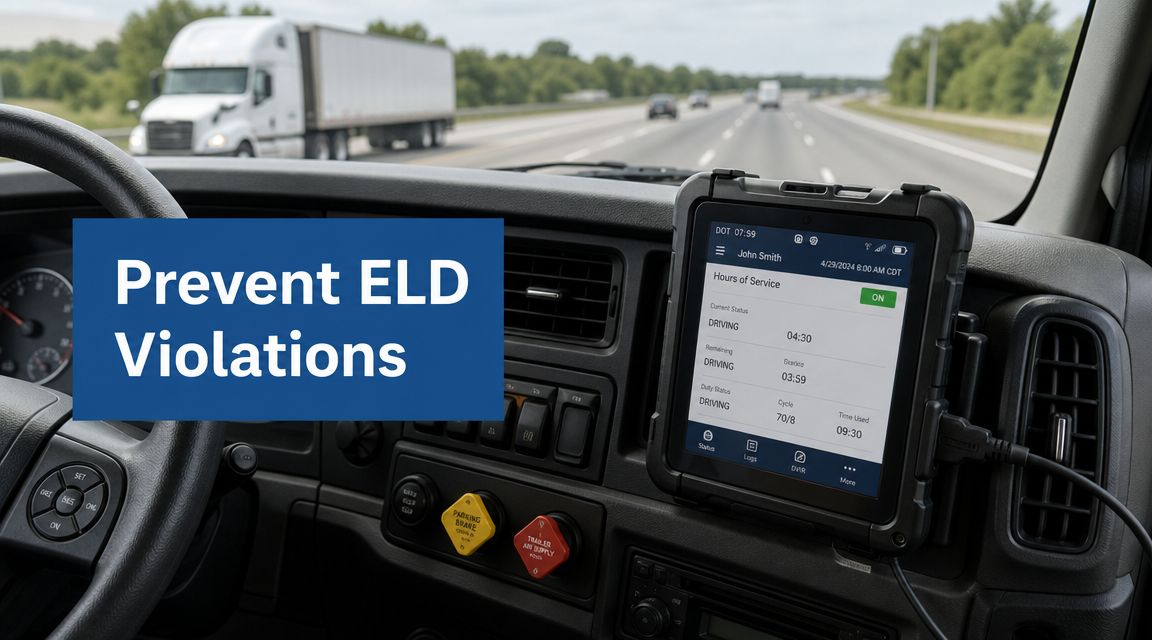
How to prevent ELD violations starts with one hard truth. Most fleets don’t get burned because the rule is mysterious. They get burned because a truck leaves the yard with one missing document, one untrained operator, or one unresolved log issue that turns into a roadside problem.
If you own a fleet or manage safety, you’ve probably dealt with the same pattern. The device is installed, everyone assumes the vendor handled compliance, and then an inspection exposes something simple. The data transfer doesn’t work. Unassigned driving time sits untouched. The cab is missing the instruction sheet. Your team thought the problem was driver behavior when the actual issue was the system around the driver.
That’s the gap. ELD compliance is not just a training topic. It’s an operations topic, a maintenance topic, and a documentation topic. If you want fewer surprises, you need a repeatable process that starts before dispatch and keeps running every day after.
A good place to start is tightening how you handle e-logs for trucks, especially the parts tied to inspections, exception handling, and back-office review. The playbook below focuses on what effectively prevents violations in the field, not what looks good in a policy binder.
Check out this short video on preventing log falsification, a critical HOS violation:
Introduction
A roadside ELD violation usually starts hours earlier, in the yard or at a desk. The truck leaves with a missing instruction sheet, unresolved unassigned drive time, a driver who was shown the login screen but never practiced a transfer, or a malfunction that nobody documented correctly. By the time enforcement sees it, the mistake looks like a driver problem. In practice, it is often an operations and documentation failure.
That is why fleets get into trouble with ELDs. Many fleets do not get burned because the rule is hard to read. They get burned because small control failures stack up across dispatch, maintenance, safety, and the back office. I see the same pattern over and over. The device is installed, the rollout gets treated like a completed project, and nobody owns the daily checks that keep logs inspection-ready.
The rule itself is only part of the risk. The expensive part is how routine misses turn into violations, delays, and bad inspection outcomes. A truck can be mechanically sound and still fail the ELD side of an inspection because the cab packet is incomplete, the ELD data transfer process does not work in the field, or the team has no clean process for edits, annotations, and unresolved records.
The best prevention strategy starts with risk ranking. First, control the failures that put a driver in a bad position at roadside: missing cab documents, transfer failures, unaddressed malfunctions, and unassigned driving time that sits too long. Next, tighten the daily habits that catch those issues before dispatch. If you need a practical baseline for your e-logs for trucks program, start with the parts that break during inspections, not the parts that only look good in a written policy.
That approach cuts violations because it focuses on the weak points fleets miss most often.
Build Your Bulletproof ELD Compliance Policy
Monday at 5:10 a.m., a truck is loaded, fueled, and ready to roll. Then the driver gets stopped, cannot produce the right ELD instructions, cannot complete a transfer, and the day starts with an avoidable violation. That failure usually traces back to policy. Not the rulebook on a shelf, but the written process that assigns ownership before the truck leaves the yard.
A usable ELD policy answers three questions without debate: who checks it, when they check it, and what happens if it fails. If those answers are fuzzy, the same preventable misses keep showing up at roadside, during audits, and in post-violation cleanup.

Write policy for the failures that cost you money
Start with the highest-risk breakdowns, not a generic statement to follow the rules. In my experience, the expensive problems are rarely abstract compliance issues. They are repeatable operational misses: the wrong device gets installed, the cab packet is incomplete, no one owns unassigned driving time, or edits sit unresolved until an inspection exposes the mess.
Your policy should spell out:
- Device approval: Safety or compliance verifies the exact model before installation and keeps the approval record.
- Cab readiness: Each truck leaves with the required onboard ELD materials, and one role in operations is responsible for checking them.
- Edit control: The policy defines who can suggest edits, who reviews them, how drivers respond, and when explanations are required.
- Exception response: Drivers, dispatch, and after-hours staff each have written steps for transfer failures, malfunctions, and paper-log fallback.
- Unassigned driving review: A named person checks it daily, documents follow-up, and closes aged items before they become a pattern.
One mistake I see often is treating the ELD vendor as the approval authority. Vendors can tell you what their product does. Your fleet still needs its own acceptance process, documented ownership, and proof that the setup in the truck matches the process in the policy.
Practical rule: If the policy does not tell dispatch, maintenance, safety, and the driver what to do during a bad shift, it is not ready for use.
Build an ELD cab kit that survives a roadside inspection
A truck can be dispatch-ready and still fail on paperwork and process. That is why I want the cab kit defined in policy, not left to memory.
Every unit should carry the required ELD reference materials, clear transfer instructions for the installed device, malfunction reporting instructions, and blank backup logs for paper fallback. Keep the kit in the same location in every truck. If drivers have to dig through permits, receipts, and old DVIRs to find it, the process is already weak.
Use simple trigger points so the check happens:
| Policy item | What you require |
|---|---|
| Approved device | Verify the installed unit matches your approved device record |
| Cab packet | Manual, transfer instructions, malfunction instructions, blank graph-grids |
| Responsibility | Assign one operations role and one maintenance role to verify completeness |
| Trigger events | Check at install, truck swap, PM service, and pre-dispatch |
| Documentation | Record exceptions and corrective action the same day |
That last line matters. Fleets get cited because the issue was known, discussed, and never documented as corrected.
Put pressure controls in the policy, not just discipline
A good ELD policy deals with the conditions that cause bad decisions. If dispatch plans tight runs with no margin for traffic, detention, or shipper delays, drivers feel that pressure in the log. The result is usually not one dramatic violation. It is a string of smaller choices, delayed certifications, bad status selections, skipped annotations, and disputed records that pile up.
Route planning belongs in the policy because dispatch habits affect log quality.
The same applies to documentation control. A written policy works better when the forms, exception records, and approval trail live in one place. If your team is still chasing screenshots, text messages, and handwritten notes across departments, a DOT compliance software platform for fleet documentation and workflows can help standardize the process without turning it into a paperwork drill.
Use scripted responses for common breakdowns
People usually fail the process in familiar ways. Write the response once, train to it, and keep it consistent.
If a driver says the tablet is in the truck, so the unit must be compliant, the answer should be specific: the device alone is not enough, and the truck does not leave until the required instructions and backup materials are in the cab.
If a dispatcher says the vendor told them the setup was compliant, the answer should be just as direct: vendor claims do not replace fleet verification, internal approval, and documented checks.
That is what makes a policy hold up in real operations. It gives each department a clear action, a trigger, and a record trail when the day goes sideways.
Implement Effective Driver Training and Coaching
A clean ELD rollout can still fall apart at 2 a.m. on the shoulder when a driver cannot transfer logs, the tablet freezes, and nobody is sure which paper backup form is in the cab. That is where training either protects the fleet or exposes it.
Initial orientation covers basic use of the device. Coaching has to cover the moments that trigger violations, especially the operational gaps and missing documentation that turn a small mistake into a citation.

Train for exceptions, not just normal days
While many fleets conduct initial ELD training during onboarding, the weak point is usually exception handling. Drivers may know how to log in and change duty status, but they freeze during an inspection, mishandle an unassigned segment, or fail to document a malfunction the right way.
Train those failure points on purpose.
Your coaching should include live practice on:
- Roadside transfer steps: The operator should know where the transfer function sits in the menu, which method the device supports, and what to do if the first attempt fails.
- Malfunction response: The operator should know when to notify the office, what notes to keep, when paper logs start, and what must stay in the truck until the issue is resolved.
- Daily certification habits: Logs should be reviewed and certified as part of the end-of-day routine, not days later when details are fuzzy.
- Special status use: Personal Conveyance and Yard Move need tight internal rules, because vague rules invite bad edits and bad explanations.
- Document access: The driver should be able to produce instruction sheets, blank backup logs, and any required supporting material without digging through the cab.
Inspectors rarely catch fleets on the easy day. They catch them when the process breaks.
Use a risk-first coaching checklist
Start with the items that create exposure fastest. Cosmetic log issues matter, but they usually cost less than bad hours, unclaimed driving time, or a failed inspection transfer.
A practical coaching order looks like this:
- HOS exposure first
Review drive time, on-duty patterns, and suspicious status changes that suggest someone is trying to rescue a trip after the fact. - Unassigned driving next
Check whether the operator is claiming or rejecting segments quickly, while dispatch records and trip context still match the event. - Certification and edits
Look for late certifications, vague edit notes, and corrections that do not line up with fuel, toll, or dispatch activity. - Transfer readiness and malfunction knowledge
Ask your operator to show the workflow, not just say they know it. - Supporting habit checks
Confirm they know where the paperwork is, who they call first, and what the office expects if the device stops working.
Many ELD violations start as operating problems or missing records, not deliberate log falsification.
That distinction matters. If the root cause is confusion, rushed coaching after a citation will not hold. The fix is a repeatable process, practiced enough that drivers can follow it under pressure.
Make coaching concrete
Use real examples from your own fleet, with names removed. That gets better results than generic screenshots from a vendor deck because it shows the exact mistakes your operation keeps making.
Ask direct questions:
“What should have happened here?”
“Why did this segment stay unassigned until the end of the week?”
“What record would support this edit?”
“If an inspector asked for a transfer right now, where would you tap first?”
“If the screen froze after hours, what do you do in the next five minutes?”
I also train office staff on the same scenarios. A driver can do everything right and still end up with a bad log if dispatch gives the wrong instruction, payroll changes a status without context, or nobody documents the malfunction timeline.
For fleets that want a more structured way to assign refreshers, document completion, and keep coaching consistent across terminals, driver safety training programs can support that process.
Establish Your Routine for Monitoring and Auditing
A good policy and decent training still won’t save you if nobody is watching the logs. ELD compliance lives or dies in the routine.
The fleets that stay cleaner are not necessarily the ones with the fanciest platform. They’re the ones with a rhythm. Someone looks at the right items every day, someone goes deeper every week, and exceptions get resolved while the facts are still fresh.

The daily review that actually matters
A common failure mode is not claiming or reattributing Unassigned Driving Time, which creates HOS discrepancies. Fleets should build a process to review and assign all unassigned driving time at log-in.
That should be part of your daily monitoring, not a cleanup project at the end of the week.
A strong daily review includes:
- Unassigned driving queue: Clear it fast, while trip context is still obvious.
- Open log exceptions: Investigate missing status changes, odd edits, and unexplained movement.
- HOS pressure patterns: Watch for recurring dispatch plans that push your operators into bad decisions.
- Diagnostic and malfunction events: Confirm the office knows about them and that someone owns the follow-up.
Break errors into risk levels
Not every issue deserves the same response time. If you treat everything as equal, your team will waste energy on low-impact cleanup while bigger risks sit there.
Here’s a practical way to think about common issues:
| Issue | Risk level | What you do first |
|---|---|---|
| HOS Supporting Documents gap | High | Stop and resolve immediately |
| Unassigned driving backlog | High | Investigate same day and assign correctly |
| Transfer capability issue | High | Test device and correct before next dispatch |
| Missing annotation | Lower | Correct with documentation and coach |
That kind of triage keeps your attention where it belongs.
Set a weekly audit rhythm
Daily review catches active problems. Weekly audit tells you whether your system is drifting.
Look for patterns such as repeated edits from the same operator, repeated exceptions on the same truck, or a cluster of transfer or display complaints tied to one device type. If the same issue keeps showing up, the answer usually isn’t “coach harder.” The answer is to fix the process that keeps generating it.
A weekly audit should answer four questions:
- Are the same units creating repeat issues?
- Are certain dispatch lanes causing recurring HOS strain?
- Are your operators missing the same steps after training?
- Is maintenance checking ELD readiness the way operations thinks it is?
Audit standard: If you can’t explain why an exception happened, you’re not done reviewing it.
If you need a framework for documenting these checks and preparing for broader compliance reviews, a DOT audit checklist gives you a practical structure for what to verify and how to capture it.
Correct Common Errors and Manage Malfunctions
A truck gets pulled for an inspection at 4:30 p.m. The driver knows the hours are fine, but the record on the screen is messy, a chunk of driving time is still unassigned, and nobody can say whether the transfer function will work. That is how a small office miss turns into a roadside problem.
The fleets that handle this well do not rely on last-minute cleanup. They use a repeatable response for the failures that cause the most exposure first, then clean up the lower-risk issues after the record is stable.

Fix the highest-risk failures first
The mistake I see most often is treating every ELD issue like it belongs in the same bucket. It doesn’t. Some problems create direct inspection exposure. Others mainly signal weak recordkeeping. Your response should reflect that difference.
A practical order of operations looks like this:
- Supporting documents and record availability
- Unassigned or unexplained driving activity
- Transfer and display readiness for inspections
- Form-and-manner corrections such as missing annotations
That order keeps the team focused on the failures that can shut down a clean inspection or leave you defending a bad record later. The lower-severity tidy-up work still matters, but it should not consume the time you need for the bigger risks.
Treat unassigned driving like an ownership problem
Unassigned drive time rarely sits there because the system is confusing. It usually sits there because no one has clear authority to resolve it before the day gets away from them.
Set the rule plainly:
- Review unassigned segments at login and again before the end of the shift.
- Require a claim or rejection promptly.
- If the segment is disputed, record the reason that day.
- Track repeat cases by tractor, slip-seat handoff, yard move practice, or route.
That last point matters. Repeat unassigned driving often traces back to an operational habit, not a driver attitude problem. I have seen the same issue come from rushed trailer swaps, poor yard-move controls, shared trucks with weak sign-in discipline, and dispatch changes that never made it back to the log. If you only clear the segment and move on, the same record defect comes back tomorrow.
Separate user error from system failure
Teams waste time when they send every log problem to maintenance or the ELD vendor. Start with one question. Is the device failing, or did the process fail?
Use a simple screen:
- User or process error: wrong duty status, missing annotation, late certification, bad login, unresolved unassigned driving
- Possible malfunction: display failure, transfer failure, power compliance issue, missing required data fields, repeated sync or connectivity problems that prevent normal use
That distinction keeps your response clean. Coaching fixes user mistakes. Documentation, technical support, and fallback procedures fix malfunctions.
Make malfunction response routine, not improvised
A malfunction becomes expensive when the team hesitates, gives mixed instructions, or cannot prove what happened and when. The response has to be boring. That is a good thing.
Use a written procedure that covers five actions:
- The driver reports the issue promptly and keeps that report in a form your office can retain.
- The driver switches to paper logs when required and keeps the records current and legible.
- The office records the timeline of the failure, the truck, the driver, and the steps taken.
- Maintenance or vendor support diagnoses and corrects the issue with notes your compliance team can retrieve later.
- Compliance verifies closure and checks whether the same unit, device type, or operating condition is showing a pattern.
Paper logs are where many fleets expose themselves. They have blank grids somewhere in the building, but not in the truck that breaks down. Or the driver has them, but nobody checks whether the fallback record is complete once the device comes back online. Both mistakes create avoidable trouble.
A malfunction procedure is only credible if the driver can carry it out on the shoulder with no office coaching.
Correct the process that created the error
The visible problem is usually only the symptom. A missing annotation may come from rushed end-of-day closeout. A transfer failure may trace back to poor device checks in the shop. Repeated log edits from one terminal may point to a dispatch practice that keeps forcing exceptions onto the back office.
Look for the source of the repeat failure:
- one truck with recurring power or sync issues
- one terminal with a pile of unassigned segments
- one route that keeps producing timing conflicts
- one training gap tied to co-drivers, yard moves, or Personal Conveyance
That is how you stop paying for the same mistake twice. First at the roadside, then again in cleanup time.
If you want fewer ELD violations, do not stop at correcting the record in front of you. Fix the handoff, the checklist, the maintenance step, or the documentation habit that keeps creating the same bad record.
Your Path to Proactive Fleet Compliance
A truck gets pulled in for an inspection at 6:10 a.m. The driver is calm. The log looks mostly right. Then the inspector asks for the transfer instructions, the malfunction sheet, and the blank graph-grids. One item is missing, one is outdated, and one was left in another truck after a swap. That inspection problem started in the office and the yard, not in the driver seat.
That is the point many fleets miss. ELD violations often come from small operational failures and weak document control long before anyone edits a log. The fleets that stay clean treat those failures as a ranked risk problem. They put the most attention on the issues that create roadside exposure fast, such as missing cab documents, transfer readiness, unresolved unassigned driving, and repeat equipment exceptions.
A practical path looks like this. Set a clear policy. Train for the situations drivers and dispatchers actually face. Review records on a routine. Then fix repeat failures at the process level instead of treating each violation like a one-off event.
Many citations are preventable before the truck leaves the yard. The FMCSA Safety Planner guidance is useful here because it points attention to the simple items fleets skip under time pressure. I have had better results with a short dispatch release check than with a longer form nobody finishes.
Keep that check brief enough to survive a busy morning:
- Transfer readiness: The device powers up, the screen is readable, and the driver knows how to send data.
- Cab packet control: The required instruction sheets and manual are in the truck assigned for that run.
- Paper fallback: Blank graph-grids are in the cab, not sitting in a shop drawer.
- Open ELD issues: Unassigned segments, rejected edits, and known device problems are reviewed before dispatch.
Good prevention also means answering the questions that cause delay and bad decisions in real time. If the screen freezes at a shipper, who does the driver call first? If a unit is missing instructions after a truck swap, can it leave? If one terminal keeps producing the same exceptions, who owns the fix?
Those are operating questions. They deserve operating answers. If the same ELD violation keeps appearing, trace it to the handoff, checklist, maintenance step, dispatch habit, or document process that keeps creating it.
That is how fleets get proactive. They stop treating ELD compliance as a driver-only issue and start controlling the office, yard, and equipment failures that inspectors keep finding.
Frequently Asked Questions About ELD Compliance
What should be in your ELD cab packet?
Your cab packet should include the user’s manual, the instruction sheet for supported data-transfer methods, the malfunction reporting instruction sheet, and blank RODS graph-grids for at least 8 days.
How do you prevent unassigned driving time from becoming a violation?
Make it part of your daily process. Review unassigned segments at log-in, require prompt claim or rejection, and document disputed segments the same day.
What is the biggest mistake fleets make with ELD compliance?
A common mistake is assuming installation equals compliance. In practice, many violations come from missing documents, weak transfer readiness, poor exception handling, and lack of routine review.
Should you treat every ELD violation the same way?
No. A risk-ranked approach works better. High-severity issues such as supporting document problems or unexplained driving activity should be handled first, while lower-severity form-and-manner issues can be corrected after the urgent items are under control.
What should your team do during an ELD malfunction?
Your operator should document the issue, notify the carrier in writing, follow your malfunction procedure, and use paper logs if needed while the office tracks and resolves the event.
How often should you audit ELD logs?
You should review critical items daily and perform a broader trend audit weekly. Daily review catches active exceptions. Weekly review helps you spot recurring patterns tied to equipment, routes, or specific operators.
Why do roadside inspections create so many ELD problems?
Because that’s where small preparation failures show up fast. If your operator can’t transfer data, the display is hard to use, or the required documents aren’t in the cab, a manageable internal issue becomes an enforcement issue.
What makes an ELD policy actually useful?
A useful policy tells your team exactly who verifies device registration, who checks the truck packet, how log edits are handled, how unassigned driving is reviewed, and what happens during malfunctions or inspections.
Regulatory References
- 49 CFR 395.8 Driver’s record of duty status
- 49 CFR 395.22 Motor carrier and driver responsibilities for ELDs
- 49 CFR 395.24 ELD data transfer mechanisms and required documentation
- 49 CFR 395.34 ELD malfunctions and diagnostic events
- FMCSA ELD exemptions guidance
If you want help turning this playbook into a working system, My Safety Manager offers compliance support built for trucking fleets that need practical help with driver files, training, audits, and day-to-day DOT oversight. It’s a straightforward way to take repetitive compliance work off your desk and make your ELD process easier to manage.
