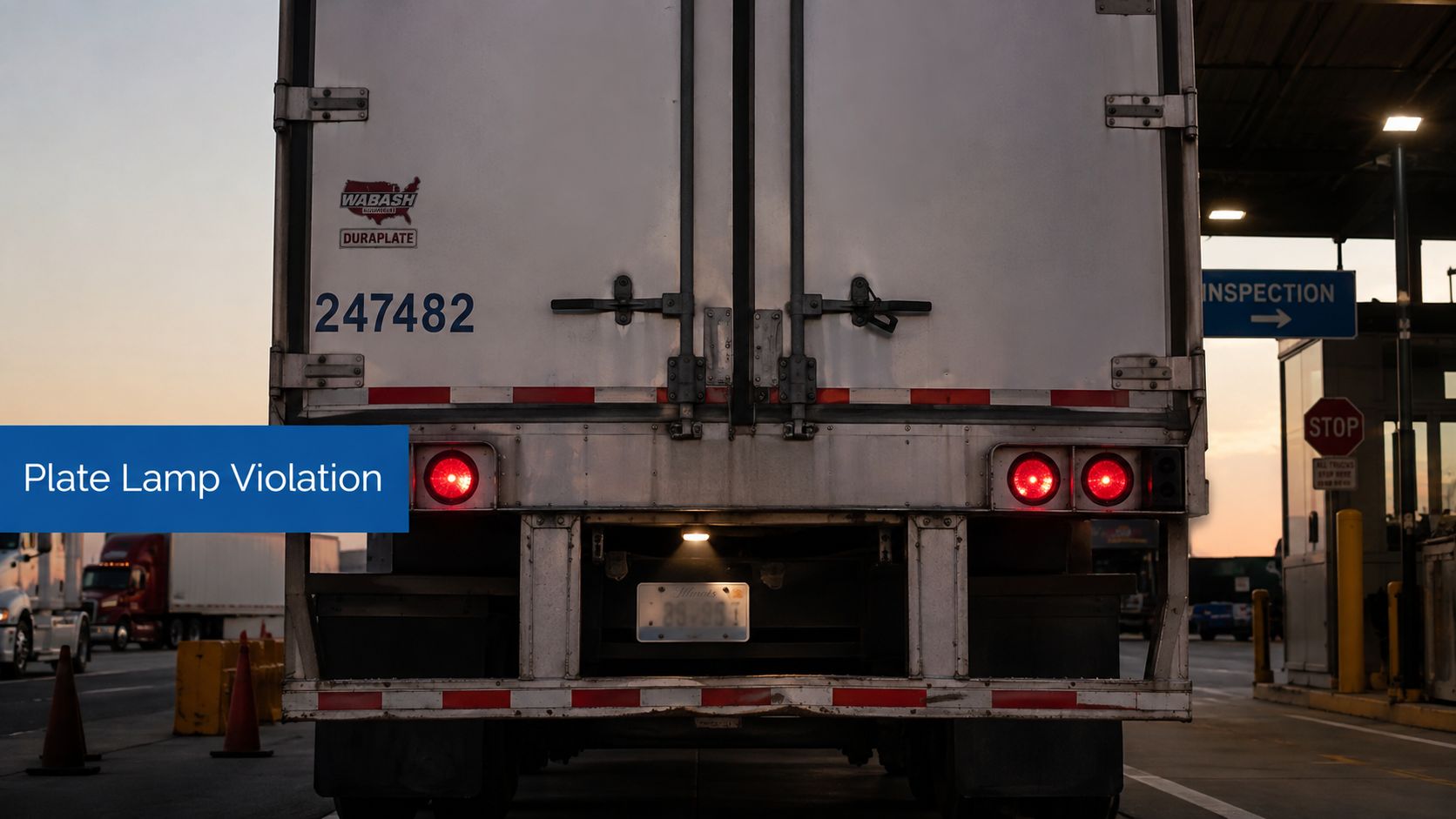
License plate lamp DOT violation concerns can turn a routine weigh-station stop into an avoidable maintenance and CSA problem for fleet owners and safety managers. Your vehicle may look road-ready, yet a burned-out bulb, corroded socket, damaged lens, or blocked plate can lead to a documented inspection finding.
The common mistake is treating the plate lamp as an optional accessory or assuming that daytime conditions make it irrelevant. Another problem is applying the same rule to every combination, even though FMCSA changed the requirement for certain truck tractors in 2026. You need to know when the lamp is required, how officers record the defect, and what your fleet should document after repair.
What Happens When You Get Flagged for a License Plate Lamp
Your driver enters a weigh station expecting a routine inspection. The officer switches on the vehicle's lamps, walks around the rear, and checks whether the displayed plate is illuminated. If the lamp fails, the officer can record the defect before the vehicle leaves the inspection lane.
The result may be a delay, a repair instruction, or a reportable inspection violation. FMCSA's Safety Measurement System tracks “Lighting – License plate lamp missing” and “Lighting – License plate lamp inoperative” as vehicle-maintenance findings. The entry can remain part of the carrier's inspection history after the bulb is replaced. The FMCSA SMS inspection data lists the missing-lamp violation with a severity weight of 2.
Federal lighting requirements connect commercial vehicle equipment to the applicable version of FMVSS No. 108 in effect when the vehicle was manufactured. A compliance finding may follow when a vehicle that must display a rear plate has a lamp that is missing, inoperative, obstructed, or unable to illuminate the plate properly.
The 2026 exemption for certain truck tractors changes the first question an inspector or fleet manager should ask: does this vehicle configuration still fall within the rear license plate lamp requirement? Applying the old assumption to every tractor-trailer combination can create unnecessary repairs, while overlooking a required lamp can produce an avoidable inspection defect.
Roadside reality: A small lighting defect may not place the vehicle out of service, but it shows that inspection and maintenance controls missed a required device.
Before disputing the report, review the inspection paperwork, confirm the recorded code, and verify the vehicle configuration. The technical violation legal definition can help distinguish a correctable equipment defect from a broader enforcement issue. Repair the actual cause, whether it is the bulb, socket, wiring, lens, bracket, or obstruction, and keep documentation showing what was corrected.
The Federal Rules Behind License Plate Lamp Requirements
FMVSS No. 108 sets the lighting baseline for newly manufactured passenger cars, trucks, and buses. It requires one white, steady-burning rear license plate light that operates with the vehicle's lamps. The light must reach the plate from above or from the sides, illuminate the full plate, and satisfy the standard's photometric requirements.
For a single-lamp arrangement, the standard specifies a minimum 8° incident angle to the plate surface and at least 8 lx at each specified test point. It also requires white light and activation with the headlamps. A lamp may glow and still fail inspection if its alignment is wrong, the frame is opaque, the bracket is damaged, or the lens blocks the plate.
Commercial vehicle requirements appear in 49 CFR 393.11, which connects required lighting devices to the applicable FMVSS provisions. For vehicles placed in operation after March 7, 1989, the equipment must meet the FMVSS No. 108 version that applied when the vehicle was manufactured. The federal text of 49 CFR 393.11 provides the technical baseline, and the federal vehicle-lighting provision explains the manufacturing-date connection.

Use the 49 CFR 393.11 lighting requirements to review original equipment and aftermarket installations. Producing white light alone does not guarantee compliance. The complete assembly must have proper mounting, coverage, activation, color, and unobstructed illumination. For truck tractors covered by the 2026 exemption, confirm the vehicle configuration before treating a missing rear plate lamp as a violation.
How Officers Identify and Code the Violation During Inspections
A roadside inspection can turn on the condition of the complete plate-lighting system. With the vehicle lamps activated, the officer checks for a displayed rear plate, verifies that it is properly affixed, and evaluates whether the lamp illuminates the plate as required.
The finding may involve a missing assembly, an inoperative lamp, damaged wiring, a corroded socket, a cracked or opaque lens, a misaligned bracket, or an obstruction that blocks light. CVSA guidance requires the license plate to be present and properly affixed to the rear of the vehicle for this violation. It also treats violations from the same regulatory section or subsection as one violation per unit. The CVSA roadside inspection operational policies set out that inspection framework.
Common report entries include 393.9(a) and 393.11(a)(1), based on the condition observed and how the inspection is recorded. Review the report before leaving the inspection area. Verify the vehicle identification, cited section, description, and configuration, particularly when the vehicle is a truck tractor that may fall under the 2026 exemption.
| Violation Code | Description | CSA Severity Weight |
|---|---|---|
| 393.9(a) | Required lamp inoperative | 2 |
| 393.11(a)(1) | License plate lamp missing or related lighting defect | 2 |
The Level II DOT inspection process can bring closer review of other equipment after an officer identifies a lighting defect. Confirm the plate is illuminated across its required area by having your shop test the circuit and document the result. A visual check alone may miss intermittent wiring or socket problems.
CSA Points and Out-of-Service Implications
The practical compliance issue is follow-through. Once a license plate lamp defect appears on an inspection report, treat it as a maintenance-control signal. A recurring finding suggests that pre-trip checks, defect reporting, repair verification, or parts control is failing somewhere in the process.
Track the finding by vehicle, component, failure cause, and repair date. Separate a one-time bulb failure from repeated corrosion, loose wiring, damaged mounts, or poor inspection habits. That record helps maintenance managers target the cause instead of repeatedly replacing the same part.
A single lighting defect may not remove a vehicle from service by itself, but the roadside response can still widen the inspection. The officer may look more closely at related rear equipment, and repeated vehicle-maintenance findings can increase scrutiny of fleet controls. The actual consequence depends on the cited condition, vehicle configuration, and inspection circumstances.
Review your carrier's current record with the CSA score lookup tool. Confirm that the inspection, vehicle, violation description, and corrective response are represented accurately. Keep the review focused on trends, since repeated defects deserve a different response from an isolated failure.
Drivers and managers should also understand how lighting findings fit within broader roadside enforcement. Resources that browse CDL traffic violations can help place equipment citations alongside other commercial-driver compliance issues, without treating every violation as having the same operational consequence.
The 2026 exemption for certain truck tractors makes configuration review especially important. A rear plate-lamp assumption may be outdated when a truck tractor is towing a trailer covered by the new rule. Before assigning fault or changing a maintenance program, verify whether the vehicle falls within that exemption and whether the cited requirement applies. For vehicles outside the exemption, prompt correction and documented monitoring remain the sound response.
Fixing the Violation and Documenting Your Response
After a violation is cited, documentation and process adjustment are as important as the physical repair. Start with the inspection report and the driver's defect notification. The driver should report the condition through your maintenance process, and the vehicle should remain out of service until the repair is completed or qualified maintenance personnel confirm that the condition is corrected.
Use a complete diagnostic check
A qualified technician should inspect the entire circuit before releasing the vehicle. Installing a bulb without finding the cause can leave an intermittent defect in service.
- Bulb or LED module: Confirm the replacement is the correct type and produces compliant white light.
- Socket and wiring: Check for corrosion, loose terminals, damaged insulation, and intermittent power.
- Lens and bracket: Look for cracks, clouding, dirt, damage, or misalignment.
- Plate coverage: Verify that light reaches the full plate area, not just one edge.
- Activation test: Confirm that the lamp turns on with the required vehicle lamps.
Record the repair order, part identification, technician findings, and final test result. Before-and-after photographs help document a damaged mount, obstruction, or opaque lens. Keep the relevant DVIR, inspection report, work order, and maintenance-log entry together so an auditor can follow the sequence from citation to correction.
If the same lamp fails repeatedly, revise the preventive-maintenance inspection instead of treating each failure as an isolated bulb problem. The post-inspection defect correction requirements provide a structure for recording corrective action. Review the guide from Blade Auto Keys when tightening fleet-control procedures involving vehicle access and maintenance handoffs.
For a tractor that may fall under the 2026 exemption, preserve the vehicle configuration and towing status in the inspection record. That information helps determine whether the cited lamp requirement applied and prevents an outdated assumption from driving unnecessary repairs.

The 2026 Rule Change That Exempts Certain Truck Tractors
FMCSA's final rule effective March 23, 2026 added an exception for rear license plate lamps on truck tractors while towing a trailer. The agency described the change as removing an unnecessary requirement without affecting safety. FMCSA's final-rule notice provides the effective date and regulatory change.
The exemption is configuration-specific. It applies to a truck tractor operating while coupled to a trailer. It doesn't erase the general lighting requirement for every commercial vehicle, and it doesn't mean your maintenance team should remove or ignore plate lamps on straight trucks, single-unit vehicles, or other vehicles displaying a rear plate.
The practical question at inspection is whether the vehicle falls within the exception and whether a trailer is being towed at the time. A tractor operating without a trailer may still need the rear plate lamp. A trailer displaying its own rear plate may have separate lighting obligations for that plate. Your inspection forms and asset records need to distinguish those configurations.
Update your fleet policy in three places:
- Preventive maintenance rules: Mark the tractor-towing-trailer configuration correctly, but retain checks for tractors operated without trailers and vehicles that display rear plates.
- Driver forms: Give your drivers a configuration-specific inspection instruction instead of a blanket “all plate lamps exempt” message.
- Inspection review: If an officer cites an exempt tractor after the effective date, preserve the inspection details and evaluate whether a DataQs challenge is appropriate.

Common Misconceptions About License Plate Lamp Violations
A plate-lamp issue often starts with a configuration mistake, not a failed bulb. The March 23, 2026 exception applies to a truck tractor while towing a trailer, so applying one blanket rule to every tractor creates bad inspection instructions. A tractor running bobtail, a straight truck, a single-unit vehicle, and another vehicle displaying a rear plate may still have applicable lamp requirements.
State and federal rules also serve different purposes. Federal requirements govern covered commercial vehicles and equipment standards, while a state may impose additional registration or operating requirements. Confirm the vehicle's configuration, location, and displayed plate before deciding that a lamp is exempt.
Mud, road film, snow, or cargo can block the lens or hide the plate from the lamp's coverage. Cleaning the lens does not correct a misaligned assembly, and replacing a bulb does not restore illumination across the full plate. A clean-looking LED replacement may still fail if the beam misses the plate or the lens is obstructed. Check white light, steady operation, activation with the vehicle lamps, mounting, and coverage as one assembly.

Use these DOT lighting violation prevention resources to make the check repeatable. Start with configuration, then inspect the lens, wiring, mounting, and plate coverage. Document the result when the requirement applies.
Frequently Asked Questions
Do state rules change the lamp requirement?
They can. Federal equipment rules do not replace state registration or operating requirements. Check the state where the vehicle is registered and operated, then compare those requirements with the vehicle's actual configuration and displayed plate. A tractor towing a trailer, a bobtail tractor, a straight truck, and a trailer may not receive the same treatment.
What should a fleet do if the inspection report appears wrong?
Start with the report, not the repair invoice. Compare the cited code and description with the vehicle configuration, displayed plate, inspection location, and inspection date. Preserve photographs, dispatch or trip records, and maintenance records that establish how the vehicle was configured at the time.
If those records support a factual correction, submit a DataQs request with a concise explanation and legible evidence. Address the specific error, identify the attached record that proves it, and keep the submission copy and agency response in the compliance file.
What documentation best supports a corrective action?
Use a dated repair record that identifies the vehicle, defect, corrective work, parts or adjustment performed, and technician or shop. Add a verification entry showing that the lamp operated correctly after repair. A driver defect report and inspection report connect the repair to the roadside finding, while photos help establish an obstructed lens, damaged mount, or alignment problem.
Does an LED replacement solve the problem?
Only when the complete assembly satisfies the applicable requirements. Confirm white light, steady operation, activation with the vehicle lamps, secure mounting, and illumination of the full plate. A brighter bulb does not correct poor alignment, damaged wiring, or blocked coverage.
When should the inspection procedure change?
Update the checklist when the vehicle changes configuration, especially when a truck tractor begins towing a trailer or operates bobtail. The 2026 exemption applies to a truck tractor while towing a trailer, not automatically to every tractor or vehicle displaying a rear plate. Keep the configuration decision with the inspection record so a later reviewer can understand why the lamp was, or was not, checked.
What records should a fleet retain?
Keep the inspection report, driver defect report, repair order, parts information, technician findings, and final verification together. A consistent file makes the corrective action easier to defend during a follow-up inspection or audit.
Regulatory References
- 49 CFR 393.9, inspection and maintenance requirements for required equipment.
- 49 CFR 393.11, lighting devices, reflectors, and electrical equipment.
- 49 CFR 396.3, inspection, repair, and maintenance responsibilities.
- 49 CFR 396.13, the driver's pre-trip inspection duty.
- 49 CFR 571.108, FMVSS No. 108 lighting requirements.
My Safety Manager helps you manage DOT compliance records, CSA BASIC monitoring, driver qualification tasks, vehicle-maintenance follow-up, and mobile safety training from an online compliance dashboard. Visit My Safety Manager to organize your lighting-defect workflow and keep repair documentation ready for the next roadside inspection or audit.
