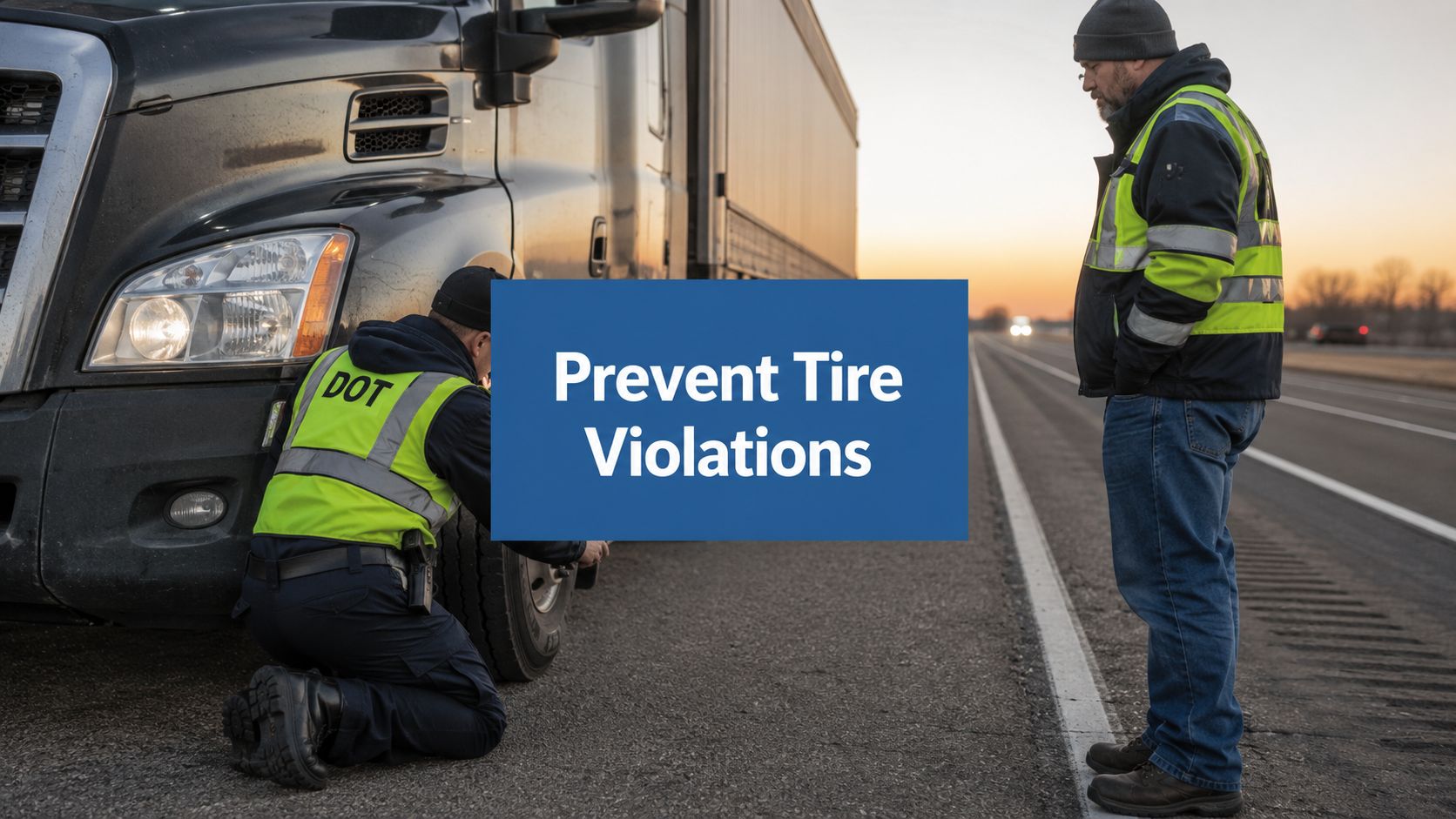
How to prevent tire violations DOT inspection starts with accepting one hard truth. If you’re running trucks today, one missed tire issue can turn an ordinary trip into a roadside delay, an out-of-service problem, and a compliance headache you didn’t need.
Most fleets don’t get burned because nobody cares. They get burned because tire compliance gets treated like a loose habit instead of a controlled process. A quick glance replaces a pressure check. A driver notes a problem, but nobody owns the repair. An inner dual gets ignored until an inspector finds it first.
This is the central problem. Tire violations are usually the result of small gaps that stack up. If you want fewer violations, better CSA protection, and less dispatch disruption, you need a system that connects inspection, maintenance, training, and documentation into one routine your team can effectively follow.
Your Proactive Plan to Avoid DOT Tire Violations
If you’re worried about the next roadside inspection, you’re not overreacting. Tires are still one of the easiest places for an inspector to find preventable defects, and one compliance source notes that tire violations account for 11% of all vehicle maintenance violations and can carry up to 8 CSA points according to CCJ Digital’s review of DOT tire inspection issues.

A lot of fleets respond the wrong way. They tell you to “check your tires better” and leave it there. That doesn’t solve much, because vague instructions don’t survive a busy yard, a late dispatch, or a worn inside tire you can’t see at a glance.
What works is a repeatable plan.
What a working tire compliance plan includes
- A real pre-trip standard that requires pressure checks with a calibrated gauge, not a boot kick or tire thump
- Position-based inspection habits so your team checks steer, drive, trailer, and inner dual positions differently
- A defect routing process that turns a reported issue into a repair order, not a verbal promise
- Replacement discipline so you don’t keep gambling on borderline tires
- Proof that shows what was found, who fixed it, and when the unit returned to service
Practical rule: If your process depends on memory, speed, or “the driver usually catches it,” you don’t have a process yet.
If you want a broader compliance framework around this issue, it helps to align your tire program with your larger DOT inspection violation prevention process. Tires don’t fail in isolation. They usually fail inside a weak maintenance system.
Know the Rules That Matter Most
You can’t prevent violations if your team only knows the rule in general terms. “Tires need to look good” won’t protect you at roadside. Inspectors are checking specific conditions, and your people need to know which ones create a basic violation versus a unit-shutting problem.

Start with tread depth
The baseline is simple, but you need your team to know it without hesitation.
| DOT Tire Violation Quick Reference | Minimum Tread Depth | Common OOS Conditions |
|---|---|---|
| Steer tires | 4/32 inch | Audible air leak, exposed ply, exposed cord |
| All other tire positions | 2/32 inch | Audible air leak, exposed ply, exposed cord |
That steer-versus-other distinction matters. A lot of preventable citations happen because someone checks a drive or trailer rule and assumes the steer axle is the same. It isn’t.
For a deeper breakdown of position-based limits, keep your team aligned with this guide to semi-truck tire tread depth requirements.
What inspectors also look for
Tread depth is only part of the inspection. FMCSA-aligned guidance also points inspectors toward conditions such as bulges, cuts, exposed fabric or cord, and proper inflation. That’s why appearance alone is a bad screening method. A tire can still look usable from a few feet away and still fail on condition or inflation.
The trade-off is straightforward. Fleets that rely on fast visual scans move trucks quicker in the yard. Fleets that use a gauge, check sidewalls, and inspect between duals usually prevent more trouble before the truck leaves.
A clean-looking tire isn’t the same thing as a compliant tire.
Know the difference between a defect and an out-of-service event
At this juncture, many fleets lose control of the situation. A general tire defect is serious, but an out-of-service tire violation changes the day immediately. One compliance source notes that conditions such as an audible leak or exposed ply carry 8 severity points in the Vehicle Maintenance BASIC and can be time-weighted to 24 points.
That distinction should shape your maintenance priorities:
- Routine defect level means you document it, schedule it, and don’t let it age out.
- OOS risk level means the truck doesn’t keep rolling until the issue is addressed.
- Gray-area conditions still need judgment. A nail in the tread isn’t automatically OOS if it isn’t leaking, and an embedded rock isn’t automatically a violation unless it’s wedged between duals.
Train to the real inspection standard
A lot of tire training is too generic to help in the field. Your team needs to know:
- What gets measured
- What gets cited
- What can park the unit
- What must be reported before dispatch
Once your drivers and shop understand those four points, “how to prevent tire violations DOT inspection” becomes less about luck and more about controlled decisions.
Mastering Your Daily Tire Inspection Routine
The best tire program usually looks boring from the outside. That’s a good sign. Boring means your team does the same things every day, in the same order, without negotiating with the checklist.

FMCSA has kept tire condition in focus for major enforcement campaigns for years. In fact, tire condition has been a recurring emphasis for more than a decade, with FMCSA publishing specific commercial tire safety tips for campaigns like International Roadcheck back in 2016, as shown on the agency’s commercial tire safety tips page.
What a strong pre-trip looks like
A proper daily check doesn’t need to drag on. It does need to be hands-on.
Start at the steer axle. Use a calibrated gauge. Check pressure cold when practical. Then get close enough to inspect the tread face and sidewall. You’re looking for low tread, damage, bulges, cuts, and anything that suggests the tire has taken a hit.
Move to drives and trailer tires with the same discipline, but don’t inspect them the same way. On dual assemblies, your team needs to look between the tires, not just at the outer sidewall.
Here’s the routine that tends to catch the most problems before roadside does:
- Gauge first: Check pressure with a calibrated gauge. Visual inspection alone misses underinflation.
- Tread next: Look at the full contact area, not just the easiest groove to see.
- Sidewalls matter: Scan and feel for cuts, bulges, cracking, or exposed material.
- Between the duals: Check for debris, spacing issues, and hidden damage.
- Listen: An audible leak changes the urgency immediately.
- Finish at the wheel end: Look for signs that point to a mounting or hardware issue, including rust streaks around lug areas.
What a useful post-trip catches
Post-trip inspection is where a lot of wear patterns first become obvious. Your driver has spent the day with that equipment. That’s when they can report a slow leak, a vibration, road debris impact, or a tire that started looking different by the end of the run.
The fleets that do this well don’t wait for the morning shift to rediscover the problem. They create a same-day handoff so maintenance can review defects before the next dispatch.
If your post-trip report doesn’t trigger action until the truck is already loaded again, the inspection happened too late to help.
Paper habits versus usable inspection workflows
A paper checklist can work if your team properly uses it and someone closes the loop. But in practice, many fleets lose consistency because the form gets completed after the fact, or the reported defect never gets tied to a repair.
That’s where digital inspection tools help. If you’re evaluating ways to tighten the process, a look at automotive shop inspections can give you practical ideas for how structured digital workflows improve accountability, photo capture, and repair visibility across inspection-driven operations.
For trucking-specific daily control, a position-based truck tire inspection checklist helps standardize what gets checked on each axle and reduces the usual blind spots around inner duals and trailer positions.
Build a System for Documentation and Maintenance
Most fleets don’t fail because nobody looked at the tire. They fail because the reported issue fell into a gap between the driver, the shop, dispatch, and safety. That’s the primary weak point.

A DVIR by itself is not a control system. It’s just a starting document. If you can’t show what happened after the defect was reported, your paperwork won’t look very convincing to an auditor, and it won’t help much after a roadside citation either.
Close the loop on every tire defect
One of the most overlooked parts of tire compliance is what happens after a defect gets written up. Many fleets struggle with the recordkeeping and verification problem, because daily inspections are emphasized but there is little guidance on combining those records with defect escalation and repair timing, as discussed in this fleet inspection documentation article.
A closed-loop process should answer five questions every time:
- What was found
- Who reported it
- Who reviewed it
- What corrective action was taken
- Who verified the unit before dispatch
If even one of those is fuzzy, your system is vulnerable.
What works in the back office
The safest fleets usually separate tire issues into categories. Not every defect gets the same response, and that’s exactly the point.
- Dispatch hold items: Anything that raises OOS concern or creates obvious safety risk
- Repair before next planned run: Issues that are not immediate OOS triggers but shouldn’t age
- Monitor with documented follow-up: Wear conditions that need scheduled review and replacement planning
That triage method keeps the shop focused without turning every DVIR note into drama.
Build records an auditor can follow
You want a file trail that makes sense to someone who wasn’t there that day. That means your records should connect the report, the maintenance action, and the release decision.
Good documentation usually includes:
- The reported condition in plain language
- The tire position so nobody has to guess which assembly was affected
- Any supporting photo
- The repair or replacement note
- The person who signed off the unit
Shop-side reality: A stack of forms proves activity. A connected record proves control.
This is one place where software can help if it’s tied to your actual process. A platform like My Safety Manager’s vehicle maintenance file checklist workflow can support document tracking and maintenance visibility, but the tool only works if your team uses it the same way every time. Software doesn’t fix an unclear chain of responsibility. It exposes it.
Maintenance schedules matter more than heroics
Some fleets wait until a driver complains, a roadside inspector finds the issue, or a tire clearly looks bad. That’s reactive maintenance, and reactive maintenance always costs more in time and stress.
A better approach is simple:
- Review tire condition during scheduled service
- Flag problem wear early
- Replace before the tire becomes a dispatch gamble
- Keep the proof tied to the unit record
When you do that consistently, tire compliance becomes defensible. That’s what you want. Not just fewer violations, but a system you can explain and verify.
Training Drivers and Handling Roadside Citations
Your drivers are still the first line of defense. If they don’t know what matters, the rest of your system starts late.
Train for judgment, not just checkboxes
A lot of fleets train tire inspection like it’s a one-time orientation topic. That’s not enough. You need short, repeated coaching that teaches your team what to look for, what must be reported immediately, and what can wait for scheduled service review.
Use real tire photos from your own operation when possible. Show examples of worn tread, sidewall damage, embedded debris between duals, and inflation-related problems. Then tie those conditions to the reporting rule. If your team sees it, hears it, or suspects it, they document it and escalate it.
Good training also explains the business side. A roadside tire issue affects trip flow, service reliability, and your compliance profile. Once people understand that a skipped inspection can lead to a parked truck, the routine gets taken more seriously.
What your drivers should do during a roadside citation
When an inspector writes a tire violation, emotion doesn’t help. Procedure does.
Tell your team to do the following:
- Stay professional: Be cooperative and answer clearly.
- Get the inspection report: Your office needs the exact violation language.
- Document the condition: If it’s safe and allowed, take clear photos of the tire and wheel position.
- Notify safety immediately: Don’t wait until the end of the shift.
- Preserve repair records: If the unit is repaired roadside or after the stop, keep every related record.
If the violation involves a flat, low-tire pressure issue, or an out-of-service determination, it helps to review a focused guide on the flat tire out-of-service violation process.
Coach after the event
Don’t waste a citation. Use it.
Review what the driver saw before the trip, what was documented, what maintenance history existed on that tire position, and whether dispatch had any warning signs. The point isn’t blame. The point is finding the break in the system so the same violation doesn’t happen again next week.
Frequently Asked Questions About DOT Tire Compliance
What tread depth do you need to avoid a DOT tire violation?
Steer tires must have at least 4/32 inch of tread depth. All other tires must have at least 2/32 inch.
Can a tire look fine and still fail a DOT inspection?
Yes. A tire can look acceptable from a distance and still have inflation, tread, sidewall, or exposed material issues that create a violation.
What’s the fastest way to reduce tire inspection failures?
Build a routine that requires a calibrated pressure gauge, a real walk-around, and defect reporting that triggers maintenance action before dispatch.
Are tire thumps enough for pre-trip inspections?
No. They may help you notice a major difference, but they don’t replace a pressure check with a calibrated gauge.
Do inner dual tires get missed often?
Yes. They are one of the most common blind spots in rushed inspections because they’re harder to see and easier to ignore.
What tire conditions can lead to out-of-service issues?
Conditions that raise serious concern include things like audible air leaks and exposed ply or cord. Those need immediate attention.
Is a nail in the tread automatically out of service?
Not always. A nail is not necessarily OOS if it isn’t leaking air, but it still needs evaluation and documentation.
What records should you keep for tire compliance?
Keep pre-trip and post-trip inspection records, defect reports, maintenance actions, replacement records, and release verification before dispatch.
How often should you train your team on tire inspections?
Often enough that the process stays consistent. Short refreshers during safety meetings usually work better than a one-time annual talk.
What’s the biggest mistake fleets make with tire compliance?
They treat inspections and repairs as separate tasks instead of one connected system.
Stay Compliant and On the Road
Tire compliance gets easier when you stop treating it like a checklist item and start managing it like a system. The fleets that prevent the most violations usually do the simple things well. They inspect the right way, document what they find, route defects quickly, and verify repairs before the truck goes back out.
If you’re trying to improve how to prevent tire violations DOT inspection problems across your fleet, focus on consistency first. Fancy tools won’t save a weak process. But a solid process, backed by clear records and regular coaching, gives you a much better shot at staying off the roadside violation report.
Regulatory References
- 49 CFR 393.75 Tires
- 49 CFR 396.11 Driver vehicle inspection report
- 49 CFR 396.13 Driver inspection
- 49 CFR 396.17 Periodic inspection
If you want help turning inspection habits, maintenance follow-up, and compliance records into one working process, take a look at My Safety Manager. It gives your fleet a practical way to manage documentation, monitor compliance tasks, and keep equipment records organized before the next roadside inspection puts your process to the test.
