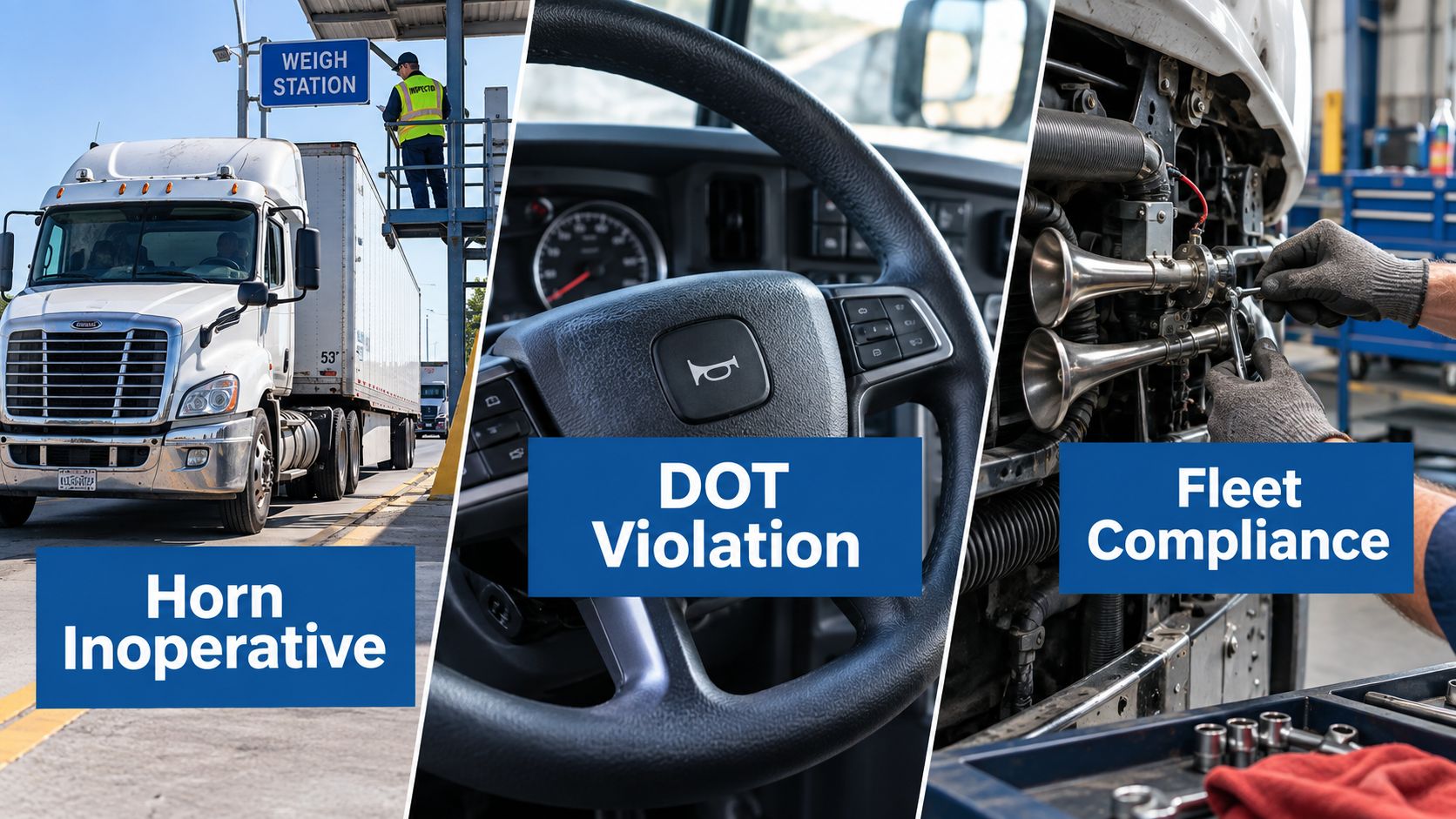
A horn inoperative DOT violation can turn a routine weigh-station stop into a repair, documentation, and CSA problem for your fleet. If you manage American-style semi-trucks, you've probably seen the familiar sequence: an inspector asks for a horn check, the driver presses the button, and the cab produces nothing but a click.
The mistake usually happens before the inspection. Your pre-trip form may say “horn checked,” but nobody confirms the air supply, electrical circuit, relay, switch, or actual warning sound from the driver's seat. A second working device can create false confidence, especially on tractors equipped with both air and electric horns.
Under 49 CFR 393.81, the issue is whether your vehicle has a horn and actuating elements capable of giving an adequate, reliable warning signal. This guide connects the roadside repair rule to 393.81-H coding, SMS vehicle-maintenance tracking, repair records, DataQs challenges, and repeatable fleet controls.
What the DOT Horn Rule Actually Requires
At a weigh station, the request is usually simple. You pull forward, the inspector checks the tractor, and someone asks you to sound the horn from the driver's seating position. That quick test reflects the practical enforcement of 49 CFR 393.81, which requires covered commercial motor vehicles to have a horn and actuating elements in condition to provide an adequate and reliable warning signal. You can review the broader federal vehicle-equipment requirements in this 49 CFR Part 393 reference.
The regulation doesn't prescribe a specific horn design or a federal minimum decibel rating. FMCSA guidance says there's no federal rule specifying a horn type or minimum sound level, while many state vehicle codes use a common benchmark requiring audibility under normal conditions from at least 200 feet. That benchmark explains why an inspector can cite an inoperative horn even if the tractor has another sound-producing device installed. See the FMCSA horn guidance and federal interpretation for the distinction between an adequate warning signal and a prescribed sound rating.
What inspectors are testing
The practical test has three parts:
- A required warning device: Your vehicle must be equipped with a horn.
- A usable control: The actuating elements must function from the driver's position.
- A reliable warning: The horn must produce an adequate audible signal when operated.
An air horn and an electric horn are different systems, but the federal rule doesn't say that one specific type must be installed. A tractor with dual horns can still have a maintenance problem if one circuit fails and the remaining sound is weak, intermittent, or unavailable during the inspection. CVSA guidance states that a horn violation shouldn't be documented if at least one air or electric horn is operable, but that doesn't eliminate the need to test both systems when your tractor is equipped with both.
Practical rule: A horn that works only after repeated button presses, comes on intermittently, or depends on a loose connection isn't ready for dispatch.
The enforcement question is functional, not competitive. The inspector isn't comparing your horn with another tractor or testing whether it's especially loud. If the warning device fails to give an adequate, reliable signal when checked, the defect can be written under 393.81.

How an Inoperative Horn Citation Gets Written
A horn citation usually starts with an operational check, not a complicated mechanical diagnosis. The inspector may ask you to use the steering-wheel button or dash control, listen for the warning signal, and observe whether the air or electrical system responds. If the horn doesn't operate reliably, the inspector records the vehicle defect rather than waiting for your shop to identify whether the cause is a fuse, relay, switch, wiring fault, compressor issue, air leak, or failed horn assembly.
The important distinction is between the inspection finding and the repair diagnosis. The inspection report records what the officer observed. Your maintenance file should later show why the horn failed and how your technician restored reliable operation.
The coding change that affects your records
FMCSA's SMS materials list both “393.81, Horn inoperative” and “393.81-H, Horn – Inoperative or defective” as countable vehicle-maintenance violations with a severity weight of 3. FMCSA notes that the 393.81-H coding update applies to citations issued on or after February 1, 2023, so historical reports may display the older and newer identifiers differently. The FMCSA SMS inspection event record provides the relevant coding context.
| Coding Element | Before Feb 1, 2023 | After Feb 1, 2023 |
|---|---|---|
| Common identifier | 393.81, Horn inoperative | 393.81-H, Horn – Inoperative or defective |
| BASIC category | Vehicle Maintenance | Vehicle Maintenance |
| SMS treatment | Countable violation where applicable | Countable violation where applicable |
| Audit concern | Historical reports may use the older code | Newer reports may use the dedicated identifier |
| Fleet action | Match the report to the repair file | Match the report and code to the repair file |
What the report does and doesn't mean
A horn defect is generally treated as a vehicle-maintenance finding rather than automatically being an out-of-service event. The inspector still controls the roadside disposition based on the condition observed and the broader mechanical picture. Federal out-of-service authority under 49 CFR 396.9 allows an authorized person to declare a vehicle out of service when its mechanical condition is likely to cause an accident or breakdown. The eCFR text for 49 CFR 396.9 is the controlling regulation.
A roadside repair may resolve the immediate defect, but it doesn't erase the inspection record. Treat the DVER, citation code, repair documentation, and any reinspection paperwork as one file.
What to Do Right After the Violation
Your first response should control the scene and preserve facts. Don't argue about how loud the horn should be while the truck is still at the scale. Ask the inspector for the exact violation code, whether the unit is out of service, whether an on-site repair or reinspection is available, and what the inspector expects before the vehicle moves.
Record the details before memory gets diluted by dispatch calls and repair coordination. A clear record helps your shop fix the right problem and gives your compliance team evidence if the citation later needs review.
Use a roadside sequence
Stay put until you understand the status. Confirm whether the inspector has placed the vehicle out of service. If the vehicle is officially out of service, don't drive it away from the inspection location. Arrange the authorized repair or tow process.
Capture the condition. Photograph the inspection report, truck number, horn button, visible wiring, air line, relay area, fuse, and any obvious damage. Don't remove components before documenting them if you may need to establish what failed.
Ask about a safe temporary repair. An inspector may allow a qualified repair if the defect is straightforward. Depending on the tractor and the approved repair process, a technician might reseat a connector, replace a failed fuse, install a known-good relay, or restore an interrupted air connection. A temporary workaround that leaves the horn unreliable isn't a compliance solution.
Coordinate reinspection or towing. If the repair is completed at the scale, ask whether the inspector will verify operation and document the correction. If the unit remains out of service, contact dispatch and arrange a qualified mobile technician or tow to a repair facility. Guidance on managing the Driver Vehicle Examination Report can help your office organize the inspection record.
Before the driver leaves the scene, write down the time, location, inspector's name, agency, exact code, unit status, repair instructions, and verbal directions. If the inspector gave permission to move the vehicle for a specific purpose, document that permission and follow it precisely.

Documenting the Repair the Right Way
A repair record should let an auditor follow the defect from discovery to correction without making assumptions. Start with the citation number, inspection date, unit number, and odometer reading. Add photographs of the failed horn, wiring, air connection, relay, switch, or other relevant components before teardown when those images are available.
Your technician's entry should identify the actual work performed. “Horn repaired” is too vague for a strong maintenance file because it doesn't show whether the failed part was replaced, a connection was restored, or the system was tested afterward.
Build a traceable maintenance entry
Include these details:
- Vehicle identity: Unit number, VIN or other internal identifier, and odometer reading.
- Inspection reference: Citation or inspection report number, violation code, date, and location.
- Failure description: The horn was inoperative, intermittent, weak, or failed at a specific control.
- Repair action: Part replaced, wiring repaired, connector secured, air leak corrected, or switch or relay serviced.
- Parts information: Part number or a clear description of the replacement component.
- Technician information: Technician name or ID, shop location, and completion time.
- Verification: Horn operated from the driver's seating position and produced an adequate, reliable warning signal.
- Approval: Mechanic certification, supervisor review, or qualified repair-facility documentation.
The next driver's DVIR should state that the horn was checked and verified operational during the pre-trip inspection. The driver should date and sign the entry according to your established DVIR process. Keep the repair invoice, technician certification, photographs, inspection report, and verification together in the unit's maintenance file. The DOT vehicle maintenance file checklist can help standardize that packet.
Audit-ready wording: “Corrected violation 393.81-H. Repaired failed horn circuit and verified reliable horn operation from the driver's seating position. Unit released after functional test.”
That wording closes the loop more effectively than a parts-only invoice. It connects the original defect to the completed repair and the final operational test.
How a Horn Citation Hits Your CSA Scores
A horn inoperative violation isn't just a shop ticket. FMCSA's Safety Measurement System tracks the violation in the Vehicle Maintenance BASIC, and the current SMS Appendix A list assigns severity weight 3 to both the older 393.81 entry and the newer 393.81-H entry. The FMCSA SMS Appendix A violations list explains the countable status and the date-sensitive treatment of the newer coding.
Your compliance team should separate three questions:
- Was the defect cited?
- Was the vehicle placed out of service?
- Did the inspection record enter SMS as a countable vehicle-maintenance event?
Those answers aren't interchangeable. A citation can affect the Vehicle Maintenance BASIC without automatically placing the tractor out of service. Conversely, a broader mechanical condition can increase the operational consequences under the out-of-service authority discussed earlier.
What gets reviewed
FMCSA's SMS system uses inspection and violation information to evaluate carrier safety performance. A single horn citation may be less important than a pattern, but repeated maintenance findings can point to weak pre-trip controls, incomplete DVIR follow-up, or delayed repairs. Your review should therefore look beyond the code and ask whether similar defects are appearing on the same unit, in the same terminal, or under the same maintenance process.
| Metric | Detail |
|---|---|
| Violation | 393.81, Horn inoperative, or 393.81-H, Horn – Inoperative or defective |
| BASIC | Vehicle Maintenance |
| Severity weight | 3 |
| SMS eligibility | Countable under the FMCSA violation list |
| Coding date issue | 393.81-H applies to citations issued on or after February 1, 2023 |
| Operational status | Tracked separately from automatic out-of-service status |
| Management response | Correct, verify, document, and monitor for recurrence |
The February 1, 2023 coding change matters during historical audits. If your safety manager compares older inspection exports with newer reports, the same regulatory subject may appear under different identifiers. Don't mistake a coding difference for proof that the maintenance issue disappeared. Match the inspection record to the vehicle file, repair date, and unit history.
Insurance reviewers may also examine inspection activity and maintenance patterns when evaluating fleet risk. For broader fleet risk controls, these auto insurance claim prevention tips offer useful context beyond the horn-specific defect.
Put the test inside existing routines
The most reliable prevention method is a short, repeatable horn check during every pre-trip inspection. Your driver should:
- Check the control: Press the steering-wheel or dash-mounted horn control from the normal seating position.
- Listen for a clear signal: Confirm that the horn produces an immediate, consistent warning sound.
- Test dual systems: If the tractor has air and electric horns, test each circuit independently rather than accepting a faint combined sound.
- Check the supply: Look for the relevant fuse, relay, wiring, switch, air connection, and sufficient air supply when the system design requires it.
- Record the result: Add a simple pass or defect entry to the DVIR and escalate any failure before dispatch.
Maintenance leads can add a horn function check to scheduled preventive maintenance, inspect contacts and relays during routine electrical work, and review recurring failures by unit. The exact interval should fit your manufacturer guidance and maintenance program. What matters is that the test has an owner, a record, and a repair trigger.
Use your CSA score lookup and monitoring resource to review whether a horn citation is isolated or part of a broader Vehicle Maintenance BASIC pattern.
When and How to Contest a Horn Ticket
A challenge makes sense when the inspection record doesn't match the facts. Examples include a citation assigned to the wrong unit, a horn that operated during a documented reinspection, or an inspection where the officer didn't complete a meaningful audible confirmation. A disagreement about loudness alone is weaker because the federal framework focuses on an adequate and reliable warning signal, not a specified federal decibel threshold.
Your case should rely on records, not frustration. Gather the inspection report, post-trip DVIR, photographs, repair invoice, technician certification, reinspection paperwork, and any written statement from the inspecting agency. A repair completed promptly doesn't automatically prove the original citation was wrong, but it can support a request to correct inaccurate or incomplete inspection data.
Use the right evidence
The strongest file usually answers four questions:
- What was cited? Identify the vehicle, code, inspection date, location, and officer or agency.
- What was the condition? Show whether the horn was inoperative, intermittent, or operational.
- What changed afterward? Provide the repair record and the final function test.
- What correction are you requesting? State whether you want the data corrected, removed, or otherwise reviewed.
The FMCSA DataQs review process is the appropriate administrative channel for submitting supporting evidence. Follow the applicable agency process and keep a copy of everything submitted.
You can adapt this language:
I request review of the vehicle-maintenance violation reported under 49 CFR 393.81. The attached inspection and maintenance records show the unit identity, the horn condition, the corrective repair, and the subsequent operational verification. Because the federal requirement addresses an adequate and reliable warning signal rather than a specified horn type or decibel level, please review the attached evidence and correct the inspection record if it doesn't accurately reflect the observed condition.
A same-day repair is useful evidence, but it isn't a guaranteed dismissal. The administrative reviewer will care more about a consistent timeline and objective documentation than an emotional explanation from the driver or fleet office.
Your Horn Compliance Game Plan
Your Monday-morning checklist should connect the driver's pre-trip, the shop's repair process, and the safety manager's SMS review. Start with the DVIR. Add a specific horn line that requires the driver to press the control and confirm a clear, reliable warning sound from the normal seating position. A generic “safety equipment checked” box won't tell you whether the horn was tested.
Assign ownership for every exception. The driver reports the defect, dispatch prevents release when your policy requires it, the maintenance lead authorizes and verifies the repair, and the compliance manager ties the repair record to the inspection report. The technician or qualified repair facility should sign the repair certification, and your office should file the invoice, photographs, test result, and reinspection record with the unit's maintenance documents for at least 12 months as an internal recordkeeping practice.
A practical operating checklist
- Pre-trip inspection: Test the horn from inside the cab and note the result on the DVIR.
- Dual-horn verification: Test air and electric systems separately when both are installed.
- Immediate escalation: Remove the unit from dispatch consideration when the warning device fails.
- Repair documentation: Record the citation code, unit, odometer, failed component, repair, technician, and final test.
- Reinspection control: Capture the inspector's direction and any clearance or reinspection paperwork.
- SMS review: Check the Vehicle Maintenance BASIC and compare the inspection code with the maintenance file.
- Pattern response: Investigate repeated horn failures by unit, terminal, supplier, or preventive-maintenance process.
- Training refresh: Demonstrate the audible confirmation procedure during a toolbox talk.
A digital compliance system can help keep DVIRs, inspection reports, maintenance records, and follow-up tasks connected. My Safety Manager provides tools for compliance tracking, CSA BASIC management, driver qualification oversight, and vehicle-maintenance monitoring, which can give your team one place to manage the records created by a horn defect. Your public-facing compliance standards should also be easy for customers and insurance partners to understand, and this trucking website design guide 2026 offers practical context for presenting safety information online.
Schedule a 15-minute toolbox talk this week. Have each driver demonstrate the horn test at the steer axle position, then add the horn verification line to tomorrow's pre-trip paperwork. A small control that happens every day is more dependable than a reminder sent after the next inspection.

Frequently Asked Questions
What is a horn inoperative DOT violation?
It's a vehicle-maintenance violation issued when a commercial motor vehicle's horn and actuating elements fail to provide an adequate, reliable warning signal under 49 CFR 393.81.
Does FMCSA require a specific horn type?
No. FMCSA guidance doesn't specify whether your vehicle must use an air horn or electric horn, and it doesn't set a federal minimum sound level.
How far away must a commercial vehicle horn be audible?
Many state vehicle codes use a common 200-foot audibility benchmark under normal conditions. The federal rule itself focuses on an adequate and reliable warning signal rather than a stated federal decibel threshold.
Is 393.81-H counted in SMS?
Yes. FMCSA's SMS violation list identifies 393.81-H, Horn – Inoperative or defective, as a countable Vehicle Maintenance violation with severity weight 3.
When did the 393.81-H coding change apply?
FMCSA states that the 393.81-H coding update applies to citations issued on or after February 1, 2023.
Does a horn violation automatically place your truck out of service?
No. The violation is tracked separately from automatic out-of-service status. An authorized inspector may use out-of-service authority when the vehicle's mechanical condition is likely to cause an accident or breakdown.
Can one working horn prevent a citation?
CVSA guidance says a horn violation shouldn't be documented if at least one air or electric horn is operable. You should still test every installed circuit because a weak or intermittent remaining horn can create an inspection problem.
What should your repair record include?
Include the inspection reference, unit number, odometer reading, defect description, parts and repair performed, technician identification, completion time, and verification that the horn worked reliably from the driver's seating position.
Can you challenge a horn citation?
You can request review when the report appears inaccurate, the wrong unit was cited, or objective records show a mismatch between the reported condition and the inspection evidence. Submit the inspection report, repair documentation, photographs, DVIRs, and reinspection records through the applicable DataQs process.
Regulatory References
- [49 CFR 393.81, Horns](https://www.ecfr.gov/current/title-49/subtitle-B/chapter-III/subchapter-B/part-393/subpart G/section-393.81)
- 49 CFR 396.9, Inspection of motor vehicles and intermodal equipment in operation
- 49 CFR 396.3, Inspection, repair, and maintenance
My Safety Manager helps you organize DOT compliance, monitor CSA BASIC activity, manage driver and vehicle records, and keep repair documentation connected to the inspection history. Visit My Safety Manager to build the horn check, DVIR follow-up, and maintenance review into one repeatable fleet safety process.
