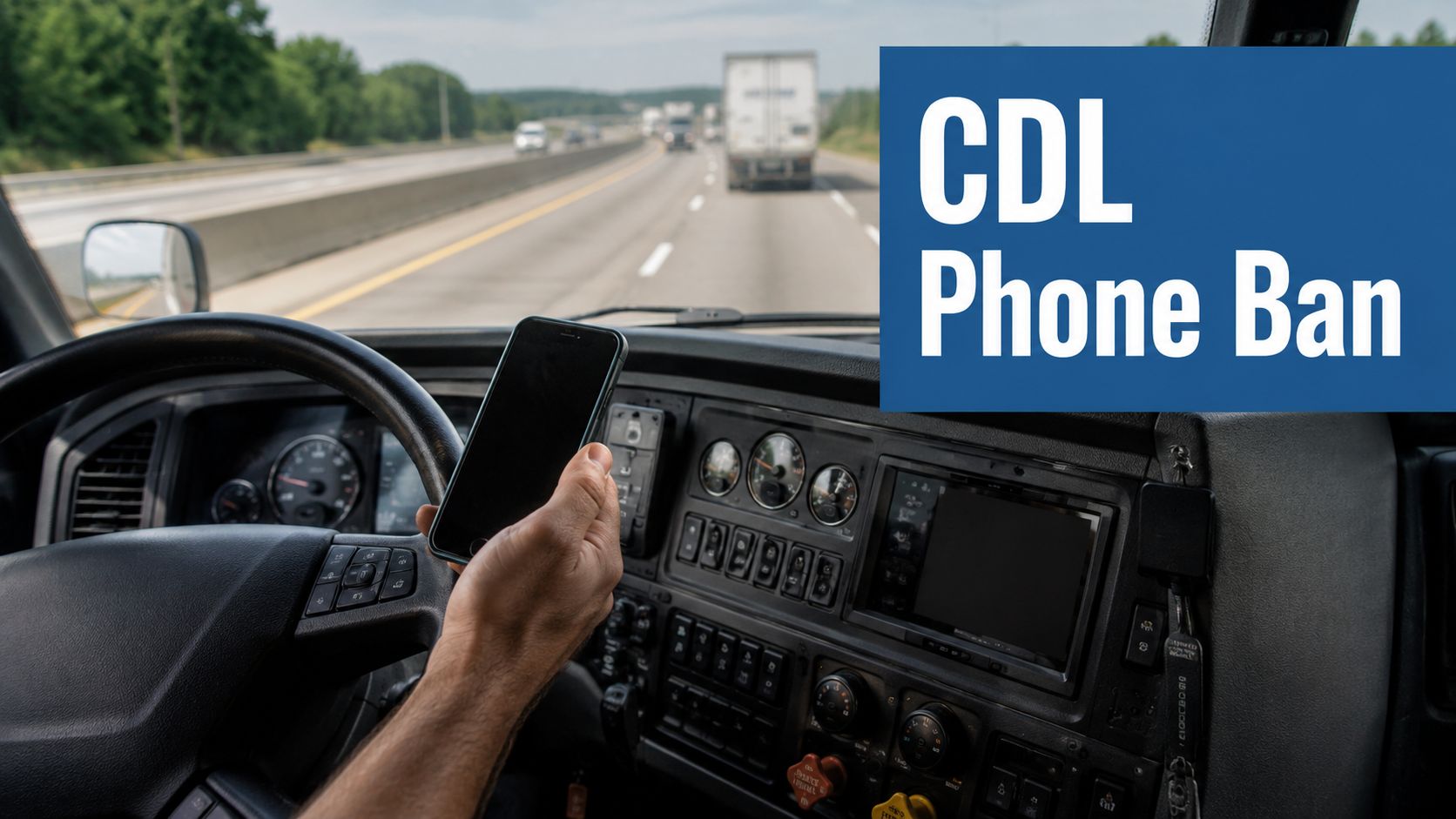
Handheld mobile phone CDL violations usually show up at the worst time, right when you’re trying to protect your CSA score, your insurance file, and a driver’s job at the same time. If you’re a fleet owner or safety manager, the pain isn’t just the ticket, it’s the chain reaction that follows when a roadside stop turns into a recordable compliance event.
The common mistake is treating it like a simple distracted-driving issue and stopping there. You get the citation, hope it stays small, and don’t map the driver, the carrier, and the insurance exposure together. That’s how one phone mistake turns into a bigger business problem than it needed to be.
A handheld mobile phone CDL violation is narrower than general distraction, but the consequences are tighter and more expensive to manage. You need to know what the federal rule bans, where state law can add pressure, how FMCSA penalties and disqualification work, and what to do fast when a citation lands on your desk.
What Counts as a Handheld Mobile Phone CDL Violation
A handheld cell phone CDL violation usually starts with a simple mistake at the roadside. A CDL holder gets into trouble when a phone is in the hand and the driver uses it while operating a commercial motor vehicle in interstate commerce, and the carrier can also face exposure if it allowed, encouraged, or required that behavior. The federal rule has been in place since January 3, 2012, and FMCSA treats this conduct seriously because it connects directly to crash risk, enforcement history, and what ends up on the carrier’s record.

What the violation usually looks like
In the field, this often means the driver is holding the phone, making or receiving a call by hand, or reaching for the device in a way that pulls attention and control away from driving. Intent does not save the stop. If the phone is in the hand while the CMV is moving, the compliance problem is already there, and that is usually where the citation, the CSA impact, and the insurance questions begin.
A roadside event like that can also change how a carrier’s file is viewed internally. Safety managers who have to clean up the aftermath know that one citation can trigger review of training, supervision, and whether dispatch practices created the problem in the first place.
The narrow exceptions that matter
There are only a couple of practical carve-outs. A driver may use a handheld phone to communicate with law enforcement or emergency services, and the ban also does not apply when the vehicle is off the highway and safely stationary. Those exceptions are narrow, so a fleet policy should spell them out in plain language and train to them the same way every time.
That consistency matters because drivers often remember the exception, but forget the conditions attached to it. A parked truck in the wrong place, or a call made after the vehicle is still rolling, can still create enforcement trouble.
For a carrier-facing overview of how these violations get classified and tracked, see DOT violation guidance for fleets. The phone citation is only the start. It can also feed into federal penalties, CSA exposure, insurance friction, and employment decisions that a fleet has to handle without drift or inconsistency.
The Federal Rule and What It Prohibits
A handheld phone citation is not a small paperwork issue. Under the federal baseline, it can sit on top of driver discipline, CSA cleanup, insurance review, and even hiring decisions if the same driver keeps showing poor judgment behind the wheel. FMCSA treats mobile phone restrictions as a roadside enforcement issue, and carriers feel the aftereffects long after the stop is over.
What counts as use
The rule reaches more than voice calls. In plain fleet language, it covers conduct where the driver is using the phone by hand, and that is where many roadside disputes begin. A call handled through hands-free equipment is a different compliance question than a call made with the phone in the driver’s hand, so the policy has to make that line easy to understand.
The federal rule also connects to disqualification authority under 49 CFR 391.15, which is why repeated conduct can move from a citation to a career issue. That is the part fleet managers cannot afford to treat as an ordinary ticket, because the employment and retention questions show up fast once the file has a second event.
When the rule applies and when it doesn’t
The rule applies in interstate commerce. That matters because many carriers run mixed operations, and state rules can sit on top of the federal baseline in ways that are stricter, not looser. If a driver is operating a CMV under interstate authority, the federal standard should be treated as active even when the state has its own distracted-driving language.
There are two practical exceptions that come up again and again. A driver may use the phone for law enforcement or emergency services. The rule also does not apply when the vehicle is off the highway and safely stationary. That parked-vehicle exception matters during staging, pre-trip paperwork, and secured pull-offs, but it does not protect a driver who is still effectively moving with traffic or handling the phone while the truck is in motion.
A pre-trip call to dispatch is a common example. If the driver is parked safely off the roadway, the compliance risk is different. If the truck is still rolling, stopped in traffic, or the driver reaches for the phone while moving, the event moves toward a violation quickly.
Practical rule: if your compliance team has to ask whether the driver was stationary, the call should have waited.
For a carrier-level breakdown of how these issues are handled under FMCSA-related rules, see this compliance reference for §392 issues. The classification matters because it shapes coaching, documentation, CSA cleanup, and how much exposure the carrier carries after the roadside stop.
State Rules That Go Beyond the Federal Baseline
State law can make a handheld phone event worse, not better. Some states mirror the federal baseline closely, while others add stricter definitions, primary enforcement, or broader distracted-driving language that catches reaching, dialing, or other phone handling behavior. For CDL holders, the safest assumption is that the stricter rule controls whenever it applies to the trip.
That’s why a clean federal policy isn’t enough by itself. If you run into routes across multiple states, your drivers need to know that what passes under one state’s distracted-driving language may still be a problem for a CDL holder under federal enforcement or another state’s approach. California is a good example of why fleets keep state overlays in their compliance playbook, which is why a route-specific legal review matters in addition to your core fleet policy (California trucking regulations reference).
Quick comparison of how exposure changes
| State Category | Typical Fine Range | Key Variation |
|---|---|---|
| Federal interstate baseline | Civil penalties can reach $2,750 for drivers and $11,000 for employers | Handheld use is banned, and carrier allowance or pressure can create its own exposure |
| States mirroring the federal rule | Varies by state | Often track the federal standard for CDL holders, with local enforcement differences |
| States with stricter distracted-driving laws | Varies by state | May broaden what counts as use, or enforce hands-held behavior more aggressively |
| States with hands-free allowances | Varies by state | Hands-free may be allowed generally, but CDL operations can still be governed by stricter federal or state conduct rules |
What you should tell your team
Don’t train to the most permissive rule in the route. Train to the strictest rule that applies to the driver’s trip. That approach avoids the mistake where a driver thinks a state hands-free allowance protects them everywhere, then gets stopped under a stricter CDL enforcement standard.
The other trap is assuming a hands-free device fixes everything. It might solve one part of the problem, but it doesn’t help if the driver still reaches, grabs, or manipulates the phone in a way that looks like handheld use. If your policy only says “use Bluetooth,” you’ve left too much room for interpretation.
Penalties, CSA Points, and Insurance Fallout
A roadside citation is only the first layer of exposure. The problem is how fast it spreads into driver qualification, CSA history, insurance review, and retention. A handheld mobile phone CDL violation can start as a single stop and end up as a staffing and underwriting issue at the same time.

What the record does to the driver file
FMCSA treats handheld mobile phone use while driving a CMV as a serious traffic violation, and that classification matters long after the stop is over. A repeated violation can put CDL status at risk, and fleets that miss the pattern often find out only after the file is already damaged. That is why managers should treat the first citation as a file event, not just a ticket in the glove box.
The risk is not limited to the citation itself. State action, employer discipline, and follow-up training can all stack on top of the roadside event, which makes early intervention important. A driver who keeps making the same mistake creates a much harder employment decision for the carrier, especially when the same behavior has already been documented.
Safety research explains why enforcement stays strict. Analysts at IIHS have reported that crash risk rises sharply when drivers manipulate a cellphone, and FMCSA says commercial drivers who use mobile phones while driving are far more likely to experience a safety-critical event such as a crash or near-miss. That behavioral pattern is also the reason these violations can hurt your CSA profile, not just the driver’s record.
Why insurers care
Truck insurance underwriters read a handheld phone violation as a signal about control, not as an isolated ticket. It raises questions about how dispatch is managed, whether supervisors are checking the road for compliance gaps, and whether the carrier is letting unsafe habits continue. Once a file shows repeat distracted-driving behavior, renewal talks get tighter and broker interest can narrow.
That is where the downstream cost becomes real. A carrier may be dealing with a worse safety file, a driver who is no longer insurable on the same terms, and a customer who asks harder questions about what happened. For fleets trying to understand how a citation shows up in the scorecard, this CSA points guide for fleets is a useful reference.
How to Build a Prevention Program That Actually Works
Prevention fails when fleets treat handheld phone control as a one-line policy instead of a system. The carriers that hold the line do four things together, they write a clear rule, train to actual scenarios, use in-cab controls, and review behavior continuously. If one layer is missing, the driver eventually finds the gap.

Start with the policy, then make the driver sign it
A good policy says exactly what the driver can’t do, what counts as handheld use, and when the emergency exception applies. It should also tell the driver what happens after a violation, because vague consequences invite inconsistent enforcement. If you don’t have a signed acknowledgment on file, you don’t really have a policy the driver has absorbed.
Train with scenarios, not slogans
The useful training is the kind that walks through dispatch calls, missed exits, restroom-station pull-offs, and pre-trip phone checks. Drivers remember examples better than abstract reminders. If your coaches only say “don’t use the phone,” the message fades the moment the load gets late or traffic starts backing up.
Use technology to close the gap
ELDs, phone-blocking apps, inward-facing cameras, and telematics all help, but only if someone reviews the data. A system that records unsafe behavior and nobody looks at it just creates expensive evidence after the fact. The best fleets tie the alert to a coaching conversation the same week it happens.
Run this quick checklist against your program
- Policy clarity: Does your rule define handheld use, emergency use, and parked-vehicle exceptions in plain language?
- Training cadence: Do drivers get recurring coaching tied to real route situations, not just an annual memo?
- Technology coverage: Are ELD alerts, telematics, and camera reviews connected to corrective action?
- Follow-through: Do supervisors document counseling, retraining, and consequence steps the same way every time?
For a deeper fleet playbook, this distracted driving prevention resource is worth keeping in your internal toolkit. The fleets that do this well don’t chase one-time reminders, they build habits that hold under pressure.
What to Do Right After a Driver Gets Cited
When a driver gets stopped at a weigh station or on the interstate for handheld phone use, speed matters more than emotion. The first move is to pause the safety-sensitive assignment and gather facts while they’re still fresh. If you let the event drift for a week, you lose detail, and the file gets harder to defend.
The first 24 to 72 hours
Start with a direct interview. Ask where the phone was, whether the truck was moving, whether the call was emergency-related, and whether any device or camera data supports the driver’s account. Then secure ELD records, dashcam footage, telematics logs, and any dispatch messages tied to the trip.
If the citation looks credible, remove the driver from safety-sensitive duty pending review and follow your internal discipline rubric. That protects the carrier from inconsistency, and it signals that the violation is treated as a real safety event, not office noise. If the facts are disputed, keep the chain of custody tight and preserve everything before you decide how to challenge it.
Who gets notified
Your insurance carrier should hear about it if the event could affect claim posture, underwriting, or renewal discussion. If the violation creates a DOT reporting issue beyond a straightforward traffic citation, evaluate whether any clearinghouse or employer-notification step is required under your procedures. Don’t shotgun notifications without confirming the obligation, but don’t sit on a material event either.
The safest internal posture is calm and documented. One manager handles the facts, one person handles the driver conversation, and one person owns the paper trail. That keeps the story consistent if the same event later shows up in a CSA review, an insurance file, or a hiring decision.
Operational rule: collect the evidence first, decide the discipline second, and don’t let a roadside citation turn into a loose-ends file.
Remediation That Rebuilds Your CSA Score
A citation starts the remediation process, it does not finish it. If the violation was entered in error, you may be able to challenge it through the DataQ process. If the record stands, the carrier still needs to show that the driver’s behavior changed and that the control gap was closed. Reviewers pay close attention to that paper trail, because promises without records do little for CSA history.
Build the remediation record
The file should show what happened, what the driver was told, what retraining took place, and what policy changes followed the event. A strong record can include a revised acknowledgment form, route-specific coaching, and a supervisor note that explains how future calls must be handled. If the file contains only the citation and a generic counseling memo, it looks thin and will not help much when the event is reviewed again.
That record also needs to show follow-through. If the same problem could come back in dispatch, routing, or driver habits, document the fix at that level, not just at the discipline level. Fleets that keep this kind of detail are in a much better position when a hiring manager, insurer, or safety auditor asks what changed after the violation.
Talk to underwriters with facts, not excuses
Insurance carriers want to know whether the event was isolated, whether the driver was disciplined, and whether the fleet changed anything afterward. They are looking for proof that your program caught the weakness before it became a pattern. A carrier that can show structured correction looks more stable than one that only says the violation will not happen again.
That same mindset matters for employment and CDL exposure. A carrier that handles a handheld phone case carefully, documents the corrective steps, and keeps the facts straight is in a better position if the incident later affects renewal, claim discussion, or a driver’s ability to stay on the road. The practical lesson is simple, treat the violation as part of a broader risk file, not just a roadside ticket.
If you want ongoing help keeping violations from turning into score problems, My Safety Manager can help your team stay organized with compliance tracking, BASIC score management, and policy support.
Frequently Asked Questions About Handheld Mobile Phone CDL Violations
A roadside stop is only the beginning. The questions that follow usually have less to do with the citation itself and more to do with what it means for a driver’s job, the fleet’s CSA profile, and the next insurance renewal.
How should a fleet read a handheld phone citation in practice? Treat it as a signal that the driver crossed a line that regulators and insurers both notice. A single event may be manageable, but repeated behavior can change how dispatch, safety, and management evaluate that driver.
What is the biggest mistake employers make after a citation? They focus on the ticket and ignore the paper trail. The better move is to collect the facts, note what the driver was doing, record the supervisor response, and keep the file consistent if the event gets reviewed later.
Do state rules still matter after a federal violation? Yes, because state enforcement can shape how the stop is handled and how aggressively a carrier needs to respond. Some states are stricter in day-to-day enforcement, so fleets that run across state lines should train to the tighter standard on the route instead of assuming one rule fits everywhere.
How should employers handle a driver who says it was work-related? Separate the reason from the conduct. A call to a dispatcher, a customer, or a manager does not erase a handheld violation if the device was being held in the cab, and the response should stay focused on policy, coaching, and documentation.
What should be in the employer notification checklist? The basic file should show when the stop happened, who was notified, whether the driver was removed from duty, and whether any coaching or discipline followed. Add dashcam, ELD, and phone records if they help confirm what happened, because memory fades fast after a roadside event.
Can a company use the same response for every driver? The policy can be standard, but the review should not be lazy. A first-time event, a repeat event, and a case that involved risky driving all call for different levels of follow-up, and that difference matters if you are trying to protect CSA performance and show underwriters that the fleet is serious.
What about employment decisions? Carriers often look at whether the driver accepted coaching, whether the violation repeated, and whether the person can be trusted around a phone in the cab. That is a practical workforce issue, not just a legal one, because one bad habit can raise the cost of keeping a driver on the road.
How should a fleet document the fix after the fact? Write down what changed, then make sure training, discipline, and supervisor notes all match. If the same weakness shows up again, the record should make it easy to prove that management addressed it earlier and did not just hope it would go away.
Where does insurance fit into all of this? Underwriters care about patterns, not excuses. A carrier that can show a clean response, a clear policy, and real follow-through looks better than one that only reacts after the violation is already part of the claim or renewal discussion.
Regulatory References
- 49 CFR 392.80, texting while driving a commercial motor vehicle, eCFR text
- 49 CFR 392.82, use of a hand-held mobile telephone, eCFR text
- 49 CFR 391.15, disqualification of drivers, eCFR text
- 49 CFR 383.51, disqualification of drivers, eCFR text
- 49 CFR 390.5, definitions, including mobile telephone use references, eCFR text
