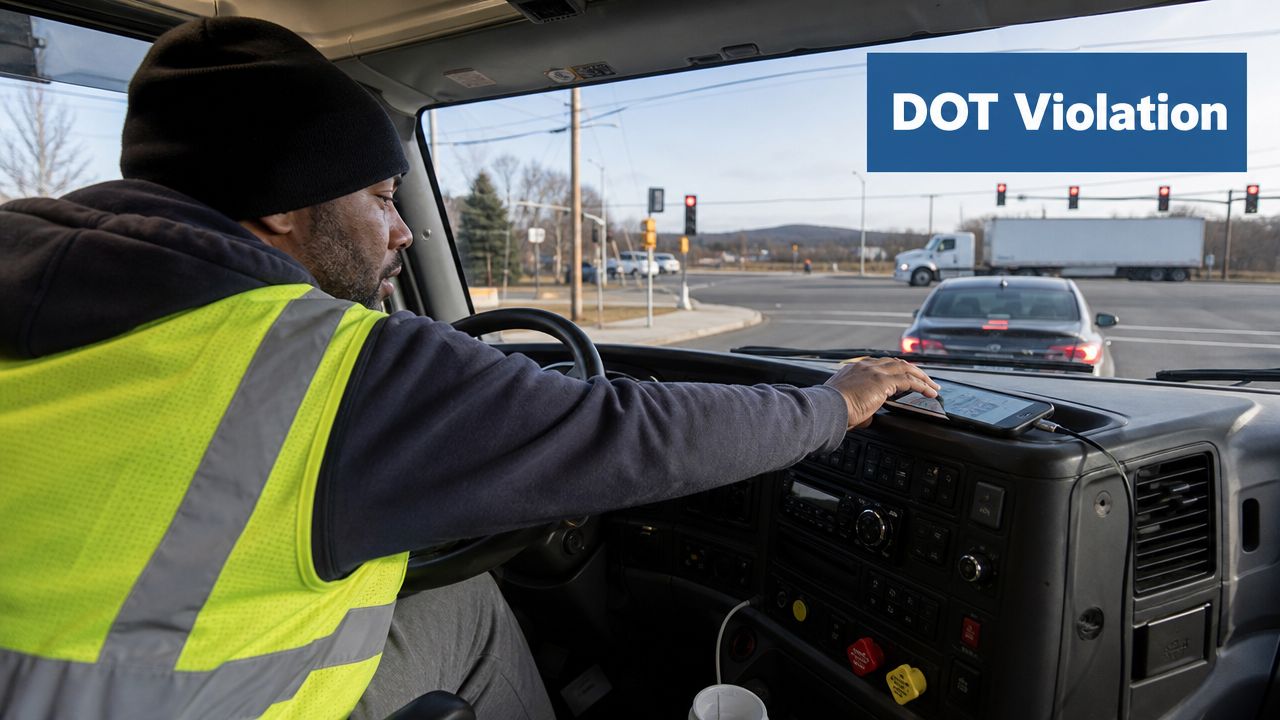
Cell phone use DOT violation is the kind of problem that starts with one quick glance at a screen and ends with a stack of paperwork you didn't want. If you manage a fleet, you already know that the red-light phone check, the “I was just answering a text” excuse, and the clipboard conversation after a roadside stop all lead to the same headache.
That's where most operations get caught off guard. A phone in your hand at a stoplight feels small, but under FMCSA rules it can turn into a federal compliance issue, a CSA blemish, and a file problem for your driver's record. The issue isn't just the citation, it's how one habit travels through safety policy, insurance review, and employer liability.
You need the rule in plain English, not legal fog. You also need to know what counts as a violation, what happens after a ticket, and what you can tighten up this week so the next roadside stop doesn't become a bigger problem than it has to be.
What a Cell Phone Use DOT Violation Actually Means
You can be sitting at a red light, thinking the truck isn't moving, and still create a cell phone use DOT violation the moment you pick up the phone. For a fleet owner or safety manager, that's the core issue. The behavior looks casual, but the compliance consequences are not.
The federal concern is bigger than a distraction complaint. NHTSA reported 3,208 deaths in 2024 in motor vehicle crashes involving distracted drivers, and the FCC cited 2022 crash data showing 8% of fatal crashes, 12% of injury crashes, and 11% of all police-reported crashes were distraction-affected. In those 2022 distraction-affected fatal crashes, at least one driver was using a cell phone in 368 fatal traffic crashes, and 402 people died in those crashes. That's why this violation sits inside the DOT safety conversation, not just the “bad habit” conversation. NHTSA distracted driving data
Why the red-light moment matters
The trap is simple. A lot of people think a stoplight, stop sign, or traffic delay creates a safe window for a phone check. Under the federal commercial rule, that's not how it works.
If you want a practical comparison point for policy writing, it helps to look at how a proper end-of-life device process reduces risk across the board. For example, a corporate cell phone disposal guide can be a useful reminder that phone control is a fleet issue, not just a driver habit issue. Internally, the same mindset should show up in your own policy, training, and enforcement records, especially in your DOT violation tracking process.
Practical rule: if the phone is the thing making the decision for you, you're already in the danger zone.
The point is straightforward. Cell phone use DOT violation enforcement exists because the federal system treats hand-held phone use as a safety risk with legal consequences, not a minor distraction you can wave away after the fact. If your drivers understand that one red-light grab can matter, your prevention work gets a lot easier.
The FMCSA Rules That Define the Violation

A driver at a red light may feel parked, but the federal rule still treats that phone grab as part of the driving task. That is why this topic belongs in 49 CFR Part 392 regulatory overview discussions, not just in a reminder about bad habits or poor judgment. The standard is built to remove gray areas before they turn into roadside citations, audit findings, or a bad day for the motor carrier. 49 CFR Part 392 regulatory overview
The two big prohibitions
FMCSA draws the line in two places. First, a commercial driver may not text while driving a commercial motor vehicle. Second, a driver may not hold a mobile device to make a call, dial by pressing more than a single button, or reach for a phone in a way that leaves the seated, seat-belted driving position. The rule is specific because fleets need a standard they can coach, document, and enforce. FMCSA mobile phone restrictions fact sheet
That language matters on the road. If a driver is holding the phone, thumbing through contacts, or leaning out of position to make the call happen, the federal line is crossed. The same applies when someone turns a quick voice call into a multi-step phone maneuver, even if the truck is already stopped at a signal.
If you coach policy from a plain-English angle, the test is easy to remember. Single button, normal seated position, seat belt fastened, or no hand-held use. If it takes more than that, it is outside the rule.
What is allowed and what isn't
The exception is narrow. Federal guidance allows communication with law enforcement officials or emergency services. Outside that, hand-held calling and texting are restricted while driving a CMV. FMCSA safety planner guidance
Hands-free use is different, but it still has limits. The rule allows hands-free use only if the driver can control the phone from a normal seated position with the seat belt fastened, such as by using a wired or wireless earpiece, speakerphone, or a single-button control near the steering wheel or dashboard. For a plain-language reminder that helps drivers understand how these rules play out in daily driving, see BDISchool cell phone safety tips. Federal hand-held phone ban overview
If your policy says “hands-free only,” spell out what that means. Do not leave it as a feel-good phrase that nobody can audit.
For a quick side-by-side policy check, compare your written rule against the federal standard and ask whether a supervisor, a driver, and an auditor would reach the same conclusion from the same facts. You are looking for the same thing the roadside officer will look for, whether the device was hand-held, mounted, or used in a way that required more than a single button press.
The bottom line is simple. Your policy should mirror the federal standard closely enough that a supervisor, a driver, and an auditor all reach the same conclusion from the same facts. If they do not, the policy is too loose.
Penalties, Disqualification, and CSA Score Impact

What the fine exposure really looks like
A driver reaches for a phone at a red light. The truck is still stopped, but the compliance problem has already started if that reach involves prohibited use. FMCSA treats that kind of violation seriously, and the penalty exposure can reach up to $2,750 for drivers and up to $11,000 for employers who allow or require the behavior. The enforcement rule is set out in 49 CFR § 392.82.
Those numbers matter because they show how the government views the conduct. A cell phone violation is handled more like a safety breach than a routine traffic inconvenience, and the company can get pulled in when dispatch habits, pressure, or weak supervision make the behavior feel normal.
The employer exposure is the part many fleets miss. If drivers feel they have to answer, text, or check loads while the truck is in motion or stopped in traffic, the citation risk does not stop with the person holding the device. It can reach the carrier's safety record, training program, and liability story.
Why repeat behavior becomes a bigger problem
Repeat violations raise the stakes again. FMCSA says multiple violations can lead to driver disqualification, which turns a roadside ticket into a staffing problem, a coverage problem, and sometimes a renewal problem for the driver. A driver who cannot legally keep working creates a much larger operational gap than a short delay at the shoulder or shipper gate.
Key takeaway: one phone citation is a safety event. A pattern of them becomes a business risk.
The problem also sits inside broader enforcement attention, which is why fleets should treat it as a standing issue instead of a one-time mistake. The same habits that lead to a citation at a red light can also show up during inspections, post-crash reviews, and supervisor ride-alongs. If your policy and coaching do not stop the behavior in the cab, the enforcement pressure will usually do it later.
How safety teams should read the risk
CSA is where the impact becomes visible to the business. A citation does not stay in the cab, it enters the compliance record inspectors and underwriters review later. This violation typically loads under the Unsafe Driving BASIC, so one phone event can affect the same bucket that carriers are judged against for other road safety problems.
That is why fleet managers need to read these events the way they read brake wear or logbook errors. One event can be explained. A pattern suggests weak supervision, weak training, or both. For California routes, that risk deserves extra attention, so a fleet can compare its policy against California trucking regulations before a state stop turns into a larger problem.
When several drivers in the same fleet get phone-related violations, the pattern matters more than any single citation. It can affect insurer confidence, raise questions during audits, and make the carrier look like it tolerates distraction in the cab.
State Laws That Stack on Top of the Federal Rule
Federal rules set the floor, but state enforcement can still hit your driver personally. That means you can have one set of consequences from the federal side and a separate ticket from a state trooper if the stop happens in a jurisdiction with tougher distracted-driving enforcement.
Here's a quick scan of how to think about state exposure in the field:
| State | Primary Enforcement | Max Fine for CMV Driver | Notes |
|---|---|---|---|
| California | Yes, when the officer can stop the phone use on its own | Not specified in the verified data provided | California enforcement is worth special coaching for your interstate routes. See California trucking regulations for broader fleet context. |
| Other high-enforcement states | Varies by state law and officer discretion | Not specified in the verified data provided | Some states stack their own penalties, points, or local enforcement practice on top of federal concerns. |
Why this matters on the road
Your driver doesn't need to be “caught by FMCSA” to have a bad day. A state officer can write a ticket under state law even if the federal inspection log stays clean. That's why route planning, driver coaching, and state-by-state awareness all matter.
The practical takeaway is not that every state works the same way, because they don't. The point is that your policy has to assume the stricter rule will apply whenever your truck crosses a border. That mindset keeps your team from treating state lines like a compliance reset button.
If your fleet spends a lot of time in California, that state deserves its own training note, not a one-line mention in a handbook. The same is true anywhere the roadside enforcement culture is active and phone use is easy to spot.
What Employers Must Do to Stay on the Right Side

Build the policy, then prove you enforced it
Your first job is a written policy that mirrors the federal rule in plain language. It should say what hand-held use means, what hands-free use means, and what happens when someone violates it. A vague “no distracted driving” memo is too loose for real enforcement.
Then document training. You need proof that your people were told the rule, told why it matters, and told what happens next if they ignore it. Keep attendance records, acknowledgment forms, and the training date together so they're easy to pull during a review.
Discipline and reporting need to be consistent
A policy without a discipline path turns into a suggestion. Set the sequence now, before the first citation lands. First offense, second offense, repeat offense, each one should have a known response.
Also, don't bury violations. If your internal culture hides them, your compliance file becomes less trustworthy. The investigators and insurers who look at your records later will care more about honesty than about perfection.
When a crash is involved and phone use is suspected, preserve the records quickly. Save ELD data, dispatch logs, and any available onboard video before routine retention windows move on. If phone records are relevant, preserve them through counsel or your normal incident protocol so nothing useful disappears.
The fastest way to create a bad audit trail is to wait until everyone's memory has faded.
For a structured prevention framework, your team can cross-check internal practices against distracted driving prevention guidance. The point is to make the policy usable on a Tuesday afternoon, not just impressive in a binder.
What to Do After a Cell Phone Citation

Act before the paper trail hardens
The first move is to gather the facts while they're still fresh. Pull the roadside details, the driver's statement, dispatch notes, and any relevant ELD or dashcam event as soon as possible. If you wait too long, the incident turns into guesswork.
Then decide who needs to be involved. Some citations are simple administrative issues, while others need legal review right away, especially if the stop could affect the driver's future record or create a pattern. A clean file is easier to defend than a rushed one.
Clean up the record the right way
If the citation entered CSA or another safety record incorrectly, use the DataQs process to challenge the entry. That's the formal route for correcting inaccurate information, and it's better than hoping the error disappears on its own. Keep your supporting documents organized so the challenge is easy to validate.
Document first, debate second. The better your file is, the faster your review can move.
You also need a practical decision on the citation itself. In some cases, paying the fine may feel easy, but it can lock in the record. In others, a contest may be the better path if the facts are weak or the documentation is incomplete.
The important thing is to treat the citation as the beginning of a file review, not the end of an inconvenience. When your team has a standard response checklist, nobody wastes the first day wondering what to do next.
Prevention That Actually Works in a Real Truck
A policy only works when it survives a long day, a late dispatch, and one more call home. The highest-risk moments are usually predictable. Pre-trip, traffic delays, weigh stations, and the end-of-day “I'll call them back right now” moment are where your prevention plan has to do real work.
Start with the cab. A proper mount, a pre-set Do Not Disturb setting, and a dispatch rule that keeps non-urgent calls out of driving time all help remove the impulse to reach for the phone. Telematics and dashcams can flag events, but the goal isn't to create a surveillance culture. It's to catch problems early enough to coach them out of the routine.
If you use video, pair it with a calm review process. The conversation should be short, factual, and consistent. Ask what happened, where the pressure came from, and what the driver will do differently next time.
For a truck-side perspective on event review and coaching, dash cameras for trucks can help you think through how to use footage without turning every correction into a fight. The best fleets use the data to prevent repeat behavior, not to pile on after a mistake.
A good coaching script sounds like this, “Walk me through the moment. What pulled your attention? What will you change before the next run?”
Common Questions About Cell Phone Use DOT Violations
Is hands-free phone use legal in a CMV?
Yes, if the setup stays within the federal hands-free rule and the driver does not need to hold the phone, reach for it, or leave a normal seated, seat-belted position to use it. That matters because the rule is aimed at reducing the kind of momentary attention shift that starts with a simple tap and can turn into a roadside violation.
Does a red light make phone use okay?
No. A stoplight does not change the federal commercial driving rule, and it does not make hand-held use safe just because the truck is momentarily stopped. The practical lesson is simple, a driver who picks up the phone at red lights can still create the same compliance problem they would have had in moving traffic.
Can you use a phone to contact emergency services?
Yes, the federal rule allows that narrow exception. In plain terms, the rules are written for ordinary communication and distraction, not for a true emergency call for help.
Can your employer be fined too?
Yes. If an employer allows or requires prohibited mobile phone use, FMCSA can treat that as a separate compliance problem and civil penalties can apply under the federal hand-held phone rule and texting prohibition, including 49 CFR § 392.80, Prohibition on texting and 49 CFR § 392.82, Using a hand-held mobile telephone. For a fleet manager, that means the citation does not stop with the driver, because weak policy, poor training, or tolerance from dispatch can become part of the employer file too.
Can one violation lead to disqualification?
A single citation does not always trigger disqualification by itself, but repeated violations can. That is why repeat behavior matters so much, because the issue can move from a one-time roadside citation to a driver qualification problem under 49 CFR § 383.51, Disqualification of drivers.
Should you preserve dashcam or ELD records after a citation?
Yes, if they relate to the event, preserve them right away. The safest approach is to treat the citation like a paper trail that may be reviewed later by the carrier, counsel, or a safety investigator, because deleted footage or overwritten logs can leave the company with only the officer's version.
How can a citation affect an annual DOT review?
It can show up in the driver's file before the annual review is complete, which means the review may reflect a newer problem instead of an old one. If the violation happened close to the review date, a fleet manager should gather the citation, coaching notes, and any corrective action before signing off, so the file tells a complete story rather than a partial one.
What happens if the state violation and federal rule do not match exactly?
The state citation still matters, even if the wording is different from the federal rule. State enforcement can trigger the same attention inside the carrier's safety program, and the event may still need to be tracked in the qualification file, reviewed for pattern behavior, and addressed under the employer's own policy. In other words, the driver does not get a pass just because the ticket was written under state law instead of the FMCSA rule.
Where do you challenge a bad safety record entry?
Use the DataQs process. It is the formal path for asking a review when a record does not reflect what happened, or when the supporting details were incomplete.
What should you change first in your fleet?
Start with the written policy, then training, then enforcement, then documentation. That order works because the rule has to be clear before a driver can follow it, and the company has to be consistent before a correction will stick.
Regulatory References
- 49 CFR § 392.80, Prohibition on texting
- 49 CFR § 392.82, Using a hand-held mobile telephone
- 49 CFR § 383.51, Disqualification of drivers
- 49 CFR § 390.5, Definitions
If you want a cleaner way to track training, document violations, and keep your compliance file organized, My Safety Manager can help your team stay ahead of problems before they turn into roadside surprises. Visit My Safety Manager to see how the program supports DOT compliance, driver monitoring, and safety documentation for fleets like yours.
