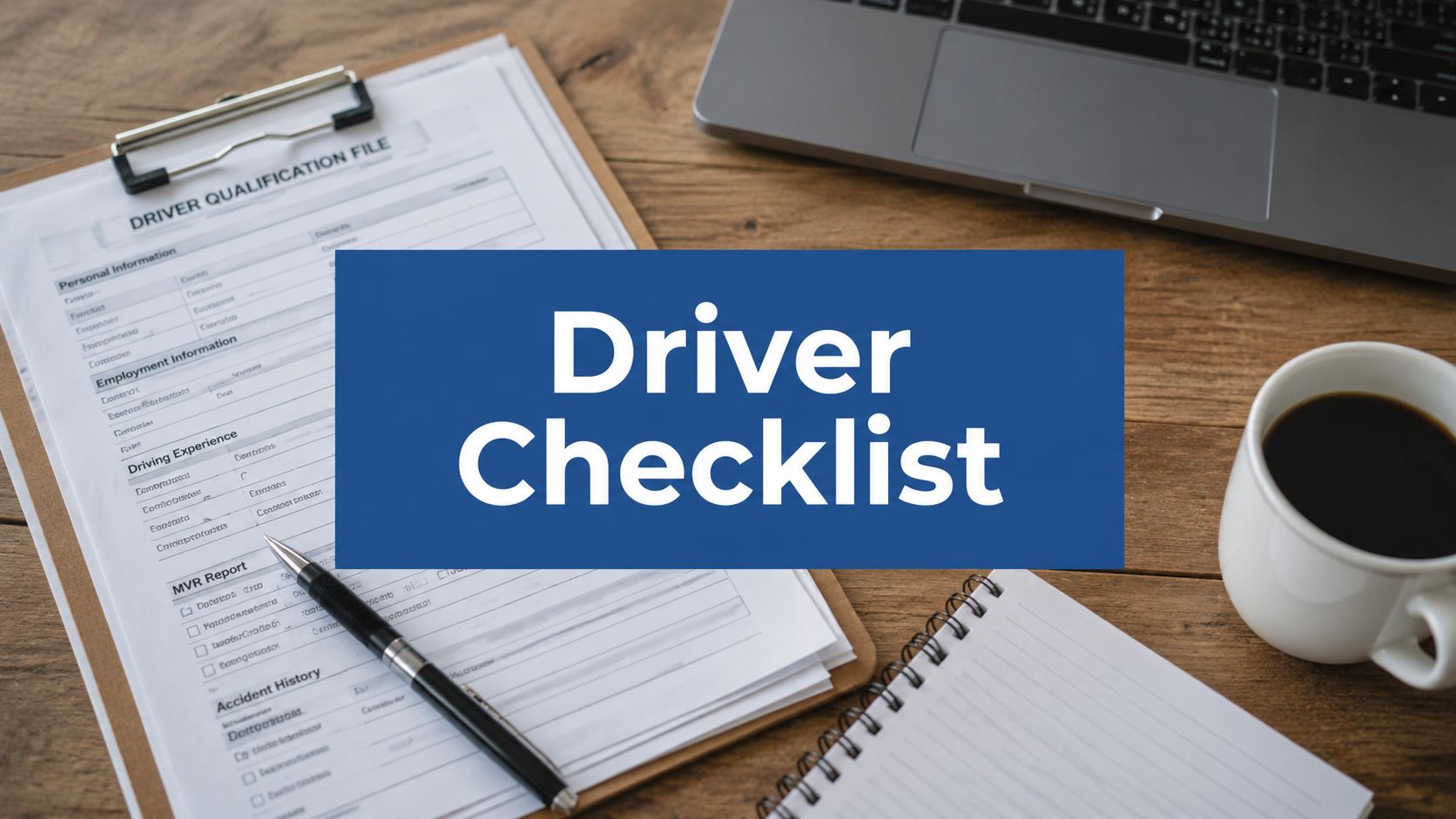
Driver qualification checklist work starts with a simple reality that catches many fleet owners and safety managers off guard: a signed form doesn't prove that your qualification decision was sound. You need a repeatable process that confirms your driver is qualified before operation, then keeps the file current throughout employment. The common failure is treating the DQ file as a completed onboarding packet, even though FMCSA guidance requires recurring reviews, updated records, and documented decisions.
This guide organizes the process into eight DOT steps, from CDL verification and medical certification through MVR checks, previous employment research, accident review, training, road testing, and drug and alcohol records. You'll also get practical timing guidance for pre-employment checks, annual reviews, expiration tracking, confidentiality, retention, and audit preparation. Related terms such as DQ file, MVR check, CDL verification, medical certification, and FMCSA compliance all point to the same operational need, prove qualification and maintain it.
A signed document isn't enough unless you can show when you verified it, who reviewed it, and what decision you made.
Use this checklist alongside your broader hiring controls, including a criminal background check for volunteers when that type of screening applies to your organization. My Safety Manager can also help centralize qualification monitoring, training support, and follow-up so a missed renewal doesn't remain hidden in a paper folder.
Table of Contents
- 1. Valid Commercial Driver's License
- 2. Medical Examiner's Certificate
- 3. Driving Record and Motor Vehicle Report
- 4. Previous Employment and Road Experience Verification
- 5. Accident and Violation History Review
- 6. Training and Certification Records
- 7. Road Test and Skills Assessment Documentation
- 8. Drug and Alcohol Testing Records
- 8-Point Driver Qualification Checklist Comparison
- Turn the Checklist Into a Compliance System
1. Valid Commercial Driver's License
Your first check is the license that authorizes your driver to operate the commercial motor vehicle assigned to the job. The CDL must be current, match the vehicle class, and include the endorsements required for the equipment or cargo. A tractor-trailer assignment may require a Class A CDL, while a tanker or hazmat operation may require additional endorsements and restrictions review.
Don't rely on a photocopy alone. Compare the license details with the job assignment, confirm that restrictions won't prevent the planned operation, and verify the license through the appropriate state or CDLIS process. The result should be a dated record showing what you checked and whether you approved the driver for that equipment.
Match the license to the work
A license can be valid and still be unsuitable for a particular assignment. Review:
- License status: Confirm the CDL hasn't expired, been suspended, revoked, or otherwise limited.
- Class and endorsements: Match the credential to the vehicle and cargo your driver will handle.
- Restrictions: Check air brake, corrective lens, automatic transmission, or other restrictions before dispatch.
- State information: Record the issuing state, verification date, and reviewer name in your DQ file.
Use a renewal alert early enough to allow for state processing and appointment delays. Keep the verification record and a legible copy in your secure driver file. For a plain-language review of the details that can affect an assignment, see CDL restrictions and endorsements explained.

A practical example is a fleet that assigns American-style semi-trucks with air brakes to every linehaul driver. The safety manager shouldn't mark the license as approved until the class, endorsements, restrictions, and current medical status all support that assignment.
2. Medical Examiner's Certificate
Your driver must complete the required medical examination before beginning covered CMV work unless a qualifying examination was completed within the previous 24 months. The driver must then be reexamined at least every 24 months, or sooner when you or the driver's physician has reason to believe the driver no longer meets the medical standards. See the medical examination rule at 49 CFR 391.45.
The medical examiner's certificate gives you evidence that a certified examiner assessed the driver's ability to perform safety-sensitive driving duties. It isn't a general health form. It connects the examination to the driver's qualification status, so you need to confirm the examiner's information, certificate date, expiration date, and any limitations or variance documents.
Track the certificate, not just the appointment
Enter the certificate expiration into your compliance calendar when you receive it. Follow up before expiration, ask your driver for updated documentation after the examination, and keep the certificate or a legible copy in the DQ file. FMCSA guidance identifies the medical examiner's certificate as part of the required file contents and provides for retention of the certificate under the DQ file rule.
A certificate may be issued for less than the maximum period when medical monitoring is needed. That creates a different follow-up schedule, so never assume every medical card has the same end date.

Practical rule: If the certificate is expired, unclear, incomplete, or inconsistent with your records, pause the qualification decision and resolve the issue before dispatch.
A fleet manager might receive a new certificate with a shorter validity period than the prior one. The correct response is to update the alert date, document the review, and confirm that the driver remains authorized under the new certification terms. Use DOT physical expiration tracking to support that recurring review.
3. Driving Record and Motor Vehicle Report
An MVR check shows the licensing history available from the relevant state records. You need an MVR during the pre-employment process, and you must obtain and review an updated MVR at least once every 12 months for each driver you employ. The annual review must determine whether your driver still meets minimum safe-driving requirements or is disqualified under 49 CFR 391.15. The timing and review duties appear in 49 CFR 391.25.
The MVR itself isn't the complete decision. Your reviewer must assess the record, identify violations or disqualifying offenses, and record the conclusion. Keep the MVR in the DQ file with a note naming the reviewer and stating the review date.
Make the review auditable
Use the same review form for every driver, but don't use a purely mechanical approval process. Look for patterns, license status changes, serious offenses, and information that conflicts with the application or prior employer responses. Give your driver a chance to explain an entry, then document whether the explanation changed your decision.
Your workflow should include:
- Pre-hire ordering: Obtain the initial MVR before your driver operates for your company, and place it in the file within the required timing.
- Annual scheduling: Set the next review from the completed review date, not from memory.
- Decision notes: Record the reviewer, date, findings, and qualification decision.
- Escalation: Route questionable records to the person responsible for safety decisions before dispatch.
A current MVR that lacks a review note leaves an important gap. You may have performed the check, but an auditor can't see what you concluded. For help organizing the screening process, see the driver background check service.
4. Previous Employment and Road Experience Verification
Your application should account for the employment and commercial driving history required by 49 CFR Part 391. The federal file standard includes inquiries to previous employers covering the last 3 years, so your process must do more than accept the references listed by your driver. Contact each relevant prior employer, request the required information, and preserve the response or your documented attempts.
This step tests whether the claimed experience matches the work your driver performed. It can reveal unexplained gaps, inconsistent equipment experience, prior safety concerns, or a work history that doesn't support the assignment. It also gives you context that an MVR can't provide, such as the type of equipment operated and the nature of previous duties.
Document every contact attempt
Create one verification record for each employer. Include the employer's name, contact information, date of each attempt, person contacted, information requested, response received, and your follow-up action. If an employer won't respond or is no longer operating, retain evidence of your reasonable attempts and document how you handled the unresolved information.
Don't let a completed application substitute for verification. A driver may describe prior work, but your file still needs evidence that you checked it.
The useful question isn't only whether your driver worked somewhere. It's whether the claimed experience supports the vehicle, cargo, and conditions you plan to assign.
For example, a driver may have substantial commercial experience but no documented history with liquid tankers. That doesn't automatically answer the qualification question, but it should trigger an assignment review, skills assessment, or additional training before the first dispatch. Review the requirements in 49 CFR 391.23 as you build your verification workflow.
5. Accident and Violation History Review
An MVR review and an accident history review answer different questions. The MVR shows recorded licensing information. The accident review examines the incidents your driver reports, your company records, and information obtained during previous employment verification. You need to evaluate the circumstances, severity, frequency, preventability, and corrective action associated with each event.
Your written decision should explain why the history supports hiring, conditional assignment, additional training, or non-qualification under your company policy. Avoid vague notes such as “looks fine.” State what you reviewed and what conclusion you reached.
Evaluate patterns and response
A single backing incident with documented retraining may call for a targeted skills check. Several similar incidents may show a pattern that requires a more restrictive decision. A weather-related event may require a different analysis from a preventable lane-change crash, but your file should show the reasoning rather than assume the label speaks for itself.
Use a consistent evaluation form with fields for:
- Incident details: Date, location, vehicle, event type, and available description.
- Preventability assessment: Explain the basis for your classification.
- Driver response: Record the explanation and any responsibility accepted.
- Corrective action: Note training, discipline, coaching, or other follow-up.
- Qualification decision: State whether your driver is approved, restricted, deferred, or not qualified.
Review the history before hire and include it in the recurring safety review process. The point isn't to punish a driver for every event. It's to make a defensible decision based on the information available and to identify training needs early. Keep related incident documentation organized through an accident register process.
6. Training and Certification Records
Training records should prove that the driver received instruction for the work assigned, completed it, and met the required standard. Depending on the cargo, vehicle, route, and role, the file may include hazardous materials training, tanker-related qualification support, passenger-related instruction, entry-level requirements, and company-specific orientation.
Separate regulatory qualifications from internal policy. Defensive-driving instruction or equipment orientation may be required by your company even when the course itself does not establish federal qualification. Record the subject, provider, instructor, completion date, attendance, and any test, demonstration, or sign-off used to confirm understanding.
Start with an assignment-to-training map. For each role and equipment type, identify the required course or certification, the applicable trigger, and the record that proves completion. Keep the certificate with the driver qualification file, restrict access to sensitive information, and retain the version that supported the assignment decision.
Before dispatch, check the matrix against the planned work. Hazardous materials assignments require training records and endorsements that match the materials handled. Tank equipment assignments require documented preparation before the load is assigned. A missing record should pause the assignment until the gap is resolved or the decision is documented.
Use these control points:
- Assignment mapping: List required instruction for each role, cargo, and equipment type.
- Pre-operation review: Confirm completion before the driver operates that equipment.
- Knowledge confirmation: File test results, demonstrations, or supervisor sign-offs.
- Ongoing reinforcement: Schedule company safety instruction and retain attendance records.
- Renewal monitoring: Track credentials and courses that require later review or renewal.
Document exceptions clearly. If training is incomplete, identify the missing requirement, the responsible person, the due date, and whether the driver may perform limited work meanwhile. Review this status with the qualification record at recurring intervals. A compliance platform can link certificates to driver status and alert staff before a renewal or review is missed, while controlled permissions keep records available only to authorized users.
7. Road Test and Skills Assessment Documentation
A CDL confirms that your driver passed the licensing authority's tests. Your road test or equivalent certification confirms whether the driver can operate the equipment and perform the duties your fleet assigns. Match the assessment to the vehicle, configuration, routes, and operating tasks rather than using a generic evaluation.
Set the test conditions before the driver arrives. Name a qualified evaluator and use a consistent form. Record the date, location, vehicle type, examiner, observed skills, deficiencies, corrective action, and final result. A failed or incomplete assessment should pause the assignment until you document the required improvement and approval.
Test the work you assign
Evaluate duties the driver will perform. Cover vehicle control, backing, coupling, turning, lane management, braking, hazard recognition, mirror use, traffic compliance, and safe decisions as applicable. Give more weight to the skills demanded by the assigned equipment and routes. A driver operating American-style semi-trucks may need a different focus from one operating a straight truck.
Make the decision traceable:
- Pass: File the signed certificate and approve the defined vehicle type or duties.
- Conditional result: Identify the missing skill, assign retraining, and schedule a follow-up assessment before expanding the assignment.
- Fail: Secure the record, withhold the planned operation, and document the qualification decision.
For example, a driver may show strong highway control but weak backing technique. Record both findings, assign backing instruction, and avoid tight delivery assignments until a follow-up assessment supports that work.
File the completed form with the qualification record, including evaluator notes and any follow-up result. A compliance platform can track open corrective actions, connect the assessment to approved assignments, and alert staff when a scheduled review is due.
8. Drug and Alcohol Testing Records
Drug and alcohol testing records must prove two things: the required test occurred, and the driver was handled correctly afterward. Build the file around the testing events that apply to the role and DOT program, including pre-employment, random, reasonable suspicion, post-accident when applicable, return-to-duty, and follow-up testing. Assign an administrator to each step, state where records are stored, and keep the policy and employee acknowledgments with the program documentation.
Receive and verify the pre-employment result before the driver begins covered CMV operation. For current employees, use a controlled random-selection and notification process that limits confidential information to authorized personnel. Store testing results separately from an open personnel folder. Record the date, provider, status, reviewer, and operating decision so an auditor can follow the sequence without accessing unnecessary medical information.
For every event that is pending or requires action, record:
- Event details: Test type, collection date, provider, and person responsible for coordination.
- Status: Pending, verified, refused, positive, negative, or requiring further review.
- Operating decision: Whether the driver was held from operation, referred, or returned under the applicable process.
- Outstanding work: Evaluations, testing, training, or records still required.
- Review trail: Who handled the information and the protected location of the record.
Supervisors need practical instruction on recognizing possible reasonable-suspicion situations. Require factual observations, preserve them with the testing documentation, and prohibit speculation or routine email distribution of results. If you conduct screening beyond DOT testing, keep the related screening tag for workplaces separate from the DQ file when appropriate.
A compliance platform can restrict access, track unresolved follow-up actions, and alert staff before a required review is missed. For assistance with commercial truck insurance requirements, see the Copeland Insurance Agency commercial auto help resource. At audit time, retain the policy, acknowledgments, test documentation, decisions, and follow-up closure together in an organized record.
8-Point Driver Qualification Checklist Comparison
| Item | Implementation complexity | Resource requirements | Expected outcomes | Ideal use cases | Key advantages |
|---|---|---|---|---|---|
| Valid Commercial Driver's License (CDL) | Low, verify class and endorsements | Minimal admin time, CDLIS access, renewal tracking | Legal authorization to operate; baseline competence | All commercial vehicle operations; hiring baseline | Legally required, easy verification, reduces liability |
| Medical Examiner's Certificate (DOT Physical) | Low–Moderate, schedule certified exam | Medical examiner appointments, exam fees, recordkeeping | Assurance of physical/mental fitness for duty | All drivers; periodic health monitoring | Identifies disqualifying conditions; FMCSA-mandated |
| Driving Record and Motor Vehicle Report (MVR) | Moderate, order and interpret reports | Third-party MVR service, per-report cost, processing time | Risk profile based on violations and accidents | Pre-hire screening and periodic monitoring | Reveals driving history; supports negligent-hiring defense |
| Previous Employment and Road Experience Verification | Moderate–High, contact prior employers | HR time, verification forms, follow-up, documentation | Confirmed work history and real-world driving experience | Verifying claimed experience for hires | Uncovers falsified experience; documents due diligence |
| Accident and Violation History Review | Moderate, collect and analyze incidents | Time for investigation, evaluation forms, employer contact | Identification of patterns, severity, and remediation needs | Safety-sensitive hiring, annual safety reviews | Detects unsafe patterns; informs training and discipline |
| Training and Certification Records | Moderate, track and renew certifications | Training providers, scheduling, administrative tracking | Demonstrated knowledge for specific duties and endorsements | Roles with specialized equipment or cargo (hazmat, passenger) | Ensures compliance; reduces accident risk via training |
| Road Test and Skills Assessment Documentation | High, conduct practical evaluations | Qualified examiners, test vehicles, standardized checklists | Direct verification of practical driving skills | Final pre-operation check; assigning equipment-specific roles | Confirms hands-on competence; catches skill gaps missed by CDL |
| Drug and Alcohol Testing Records | Moderate–High, implement DOT program | DOT labs, third-party admin, ongoing testing budget | Reduced impairment risk and regulatory compliance | All safety-sensitive drivers; pre-hire and random testing | Legally required; prevents impaired drivers and protects public safety |
Turn the Checklist Into a Compliance System
The eight items work best as one lifecycle, not eight disconnected filing tasks. Before your driver operates, collect and verify the application, license, medical certificate, MVR, previous employment responses, accident and violation history, training records, road test documentation, and required testing records. For each decision, record the reviewer, date, evidence considered, result, restrictions, and follow-up owner.
The annual workflow deserves special attention. FMCSA guidance requires a current MVR at least once every 12 months, and the reviewer must determine whether your driver remains safe and qualified. Keep the MVR and a note identifying the reviewer and review date in the qualification file. You should also review accident information, training status, license restrictions, and medical certification as part of the same recurring compliance rhythm.
Keep records current and controlled
Use one status view for expiration dates and another access layer for confidential records. A DQ file may be electronic or paper, but your staff must be able to locate the evidence, understand the decision, and produce a legible record during an audit. Keep active files current, retain required records after employment ends, and follow the cleanup rules that allow certain annual review records to be removed 3 years after execution, as described in 49 CFR 391.51.
A quarterly internal audit can catch missing signatures, expired credentials, incomplete employer inquiries, and undocumented decisions before an external review exposes them. The audit should sample the entire lifecycle, not only the newest onboarding documents.
Audit habit: Open each file as if someone unfamiliar with your operation must understand the qualification decision without asking you to explain it.
Driver qualification checklist FAQ
What belongs in a DQ file?
Your file should contain the required qualification evidence, including the application, prior employer inquiries, MVR records, annual review documentation, road test or equivalent certification, and medical examiner's certificate. Add assignment-specific records and applicable supporting documents.
When should you obtain an MVR?
Obtain the pre-employment MVR during onboarding and place it in the file within the required timing. Obtain and review a fresh MVR at least once every 12 months while your driver remains employed.
What must you document after an MVR review?
Record the review date, reviewer name, findings, and decision about whether your driver remains qualified or requires follow-up.
How does medical certification affect qualification?
Your driver must have the required medical certification before covered CMV work, with reexamination at least every 24 months or earlier when medical concerns require it. A shorter certificate period creates an earlier tracking deadline.
When must drug and alcohol testing occur?
Testing must occur before your driver operates when pre-employment testing applies. Your program must also manage applicable random, reasonable suspicion, post-accident, return-to-duty, and follow-up requirements.
What should you do after a failed or incomplete check?
Mark the qualification decision as incomplete or not approved, prevent operation when required, document the reason, identify the corrective action, and record the person responsible for follow-up.
How long do you retain DQ records?
Maintain the qualification file during employment and retain required records for 3 years after employment ends. Some testing records follow separate retention requirements, so store them according to the applicable rule.
Can a compliance platform help with renewals?
A platform can centralize document status, alerts, training records, and reviewer follow-up. Your motor carrier remains responsible for making and documenting the qualification decision.
Regulatory References
- 49 CFR 391.23, Investigation and inquiry
- 49 CFR 391.43, Medical examination
- 49 CFR Part 382, Controlled substances and alcohol use and testing
- 49 CFR 172.704, Training requirements
- 49 CFR 391.25, Annual inquiry and review of driving record
My Safety Manager can help you organize DQ files, monitor qualification and renewal status, support training workflows, and manage related DOT compliance tasks through an online dashboard. Visit My Safety Manager to review the program and decide whether it fits your fleet's driver qualification process.
