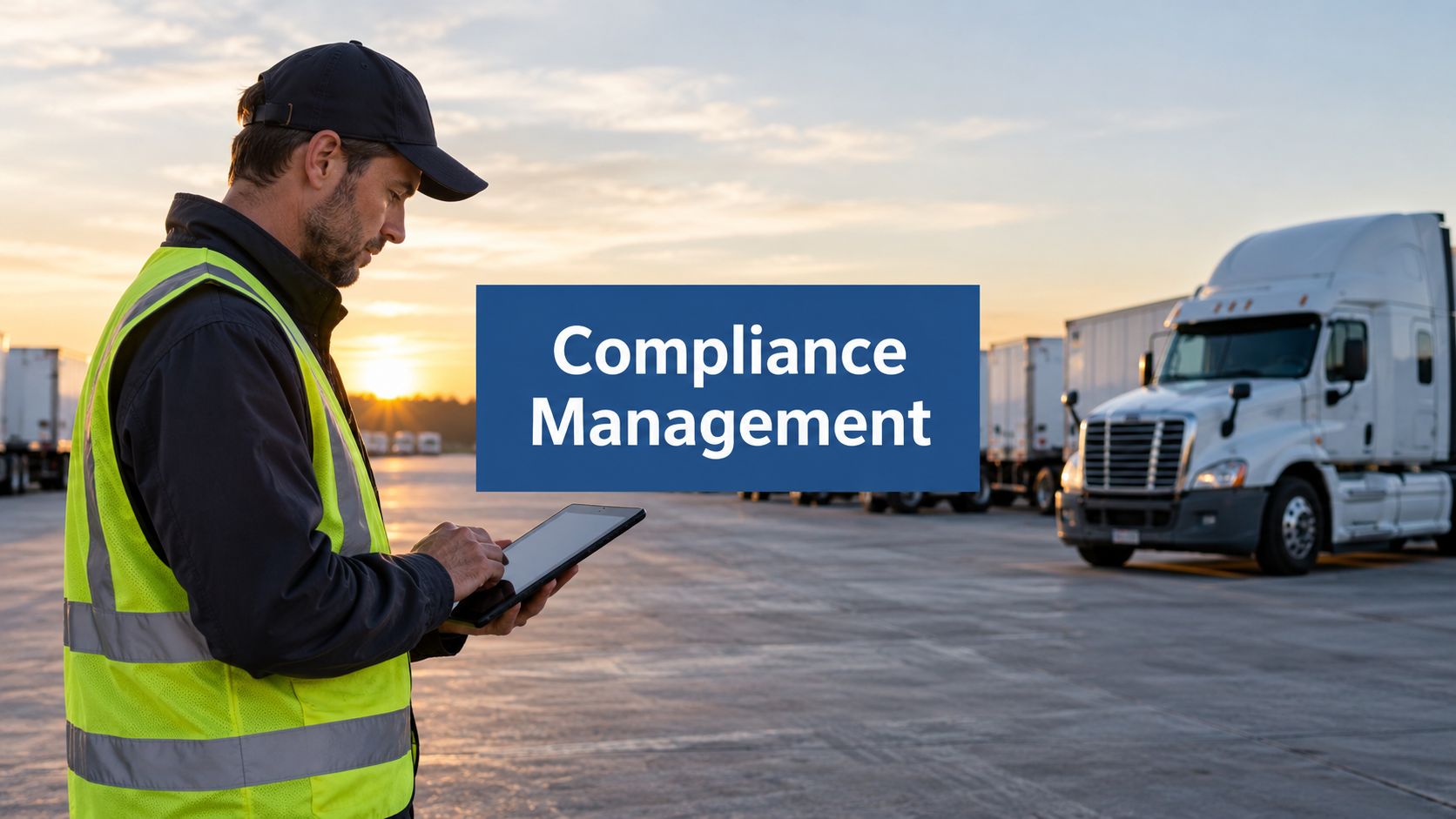
Compliance management is a continuous control system for meeting DOT and FMCSA obligations, internal policies, and evidence requirements, not a one-time audit. Regulatory costs average 1.34% of a firm's total wage bill, rising to 3.33% when related tasks such as tax compliance are included, according to U.S. compliance cost research summarized by Secureframe.
What is compliance management for a trucking fleet? It's how you keep your obligations visible, assign ownership, check records, respond to exceptions, and prove what you did. If you're a fleet owner or safety manager, you're probably balancing dispatch pressure, maintenance deadlines, HOS questions, and driver qualification files at the same time.
The common mistake is treating compliance like a filing cabinet. Your team may have documents stored in different folders, but a roadside inspection or audit can still expose an expired credential, an incomplete record, or a missing corrective action.
A live compliance system helps you stay audit ready while keeping trucks moving. This guide explains the operating model, the core DOT and FMCSA requirements, the business value, the common pitfalls, and the practical steps for embedding compliance into dispatch, maintenance, HOS, and driver qualification workflows.
Table of Contents
- Introduction to What Is Compliance Management
- What Compliance Management Really Means for Your Fleet
- Core Components You Must Manage Every Day
- How DOT and FMCSA Rules Shape Your Compliance Map
- Business Benefits KPIs and Common Pitfalls to Avoid
- How to Implement Compliance Management and Simplify It With My Safety Manager
- Frequently Asked Questions About Compliance Management
- What is compliance management in trucking?
- How is compliance management different from safety management?
- What does DOT compliance include?
- How can CSA BASIC scores affect your fleet?
- What belongs in a driver qualification file?
- How often should you monitor compliance?
- Does a small fleet need a formal compliance program?
- Regulatory References
Introduction to What Is Compliance Management
You're preparing for the day's dispatches when a roadside inspection creates an unexpected problem. A record isn't current, a maintenance item lacks supporting documentation, or a driver qualification file doesn't contain the evidence you thought it did. Your fleet may be operating safely, but your compliance process can still leave you scrambling.
That situation happens when you manage compliance as paperwork instead of as an operating process. Filing documents after an event can create the appearance of control without giving you a dependable way to identify missing records, watch changing conditions, or assign corrective work.
The paperwork problem
Your obligations touch nearly every part of the fleet. Dispatch affects HOS exposure. Maintenance affects inspection readiness. Driver onboarding affects qualification records. Testing status affects controlled substances and alcohol compliance. Accident information can affect your broader safety profile.
A periodic audit can show what was true on the day someone reviewed the files. It can't, by itself, tell you whether a document becomes stale tomorrow or whether a recurring HOS exception points to a coaching issue.
Practical rule: If you only discover a compliance gap during an audit, your process is detecting risk too late.
Compliance management creates a continuous control loop. You identify applicable obligations, map them to policies and procedures, use preventive and detective controls, and correct problems when they appear. The process also preserves evidence, so you can show how your team handled a requirement rather than saying that you intended to follow it.
For broader people and recordkeeping workflows, a guide to cloud-based HR systems can help you think about how centralized employee information supports operational control. In trucking, you can apply the same principle to driver qualification, training, testing, maintenance, and safety records.
You can learn more about the regulatory foundation in this DOT compliance overview. The important distinction is simple: an audit is an event, while compliance management is what you do every day before the audit arrives.
What Compliance Management Really Means for Your Fleet
Compliance management starts with a basic question: What must your fleet do, who owns it, and what evidence proves it happened? You answer that question by identifying obligations, translating them into policies and procedures, and connecting each requirement to a control.
A preventive control stops a problem before it occurs. A qualification review before dispatch is one example. A detective control identifies a problem that already exists, such as an alert for an expired medical qualification or a recurring HOS exception. A corrective control assigns remediation, documents the response, and verifies completion.
This structure turns compliance into a loop:
- Define obligations: Identify the DOT, FMCSA, state, contractual, and internal requirements that apply to your fleet.
- Map responsibilities: Assign each task to a person, role, or workflow.
- Monitor evidence: Check whether records, inspections, training, and testing status remain current.
- Remediate exceptions: Remove the root cause, document the action, and confirm closure.
- Review the system: Adjust policies and controls when your operations or obligations change.
From filing cabinet to dashboard
A filing cabinet stores evidence. A compliance dashboard helps you manage conditions. That difference matters when you operate American-style semi-trucks across changing routes, schedules, and maintenance cycles.
Your dashboard should help you see which records require attention now, which tasks are approaching a deadline, and which patterns deserve investigation. It should also connect an exception to an owner. A missing inspection record isn't resolved because someone noticed it. It's resolved when the responsible person completes and records the corrective action.

Weak monitoring creates compounding exposure. One stale record can lead to a failed inspection. Repeated exceptions can point to weak training or supervision. A delayed correction can create operational disruption, enforcement exposure, and more administrative work.
Your fleet safety management process should therefore connect safety information to daily work. Compliance management isn't separate from operations. It's the control layer that helps you make safer dispatch, maintenance, and personnel decisions.
Core Components You Must Manage Every Day
Your compliance program becomes practical when you divide it into clear operating responsibilities. The exact workflow depends on your fleet, but the following areas give you a reliable daily management structure.
Policies and procedures
Your written policies should explain what your team must do, when it must happen, and what evidence must be retained. Keep the language usable. A policy that nobody can apply during dispatch, onboarding, maintenance, or an incident won't protect your operation.
Review policies when your equipment, routes, staffing, or regulatory obligations change. Make sure supervisors know how to act when an exception appears, rather than leaving every decision to the safety manager.
Driver qualification files
Your driver qualification process should show that each person assigned to operate a commercial motor vehicle has been properly reviewed and that required records remain current. You need a consistent way to collect documents, verify information, record training, and monitor renewal or expiration dates.
A good file isn't complete only at onboarding. It stays controlled throughout the working relationship. If a credential changes or a required review becomes due, your system should identify the issue before dispatch creates additional exposure.
Vehicle maintenance and inspections
Maintenance compliance depends on more than repair invoices. You need inspection records, defect information, corrective actions, and evidence that your team addressed safety-related issues before returning equipment to service.
When a roadside inspection identifies a defect, treat it as an operational signal. Ask whether the issue is isolated or whether similar defects appear across a vehicle group, maintenance vendor, or inspection routine. That approach helps you address causes instead of repeatedly filing symptoms.
Drug and alcohol program
Your drug and alcohol process must connect policy, testing procedures, status tracking, supervisor actions, and records. The applicable program can involve pre-employment, random, post-accident, reasonable suspicion, return-to-duty, and follow-up testing requirements.
Your process should prevent dispatch when a person's status doesn't permit operation. It should also preserve the evidence showing what your team did and when it acted.
Recordkeeping and document control
Centralize records where authorized people can find them quickly. Use naming standards, ownership rules, access controls, and retention procedures that fit your operation.
A document becomes a risk when it's missing, stale, duplicated, or impossible to connect to the underlying event. Recency checks and exception alerts help you focus attention where the evidence needs work.
Continuous monitoring
Your monitoring process should look for patterns, not just isolated failures. Track HOS exceptions, inspection defects, accident information, training completion, qualification status, and maintenance follow-through.
The FMCSA CSA program provides a data-driven safety compliance and enforcement framework, with seven BASIC categories identified in its materials: Unsafe Driving, Hours-of-Service Compliance, Driver Fitness, Controlled Substances/Alcohol, Vehicle Maintenance, Hazardous Materials Compliance, and Crash Indicator. You can use those categories as an organizing map, while recognizing that your internal controls need to cover the specific obligations that apply to your fleet.

The same documentation principle applies in other regulated industries. A resource on trade licensing in Australia offers a useful reminder that licensing systems depend on current evidence, defined requirements, and ongoing status control. Your fleet needs that same discipline across its own records.
For a practical starting point, use this DOT compliance checklist to identify ownership gaps and records that need attention first.
How DOT and FMCSA Rules Shape Your Compliance Map
FMCSA's CSA program gives you a concrete way to organize safety oversight. The program uses data-driven compliance and enforcement, so your process must connect everyday activity to the categories regulators use to evaluate safety performance.
The seven BASIC categories are:
- Unsafe Driving: Review behavior that can create immediate roadway risk.
- Hours-of-Service Compliance: Monitor fatigue-related exposure and HOS requirements.
- Driver Fitness: Keep qualification and fitness evidence current.
- Controlled Substances/Alcohol: Manage testing obligations and status.
- Vehicle Maintenance: Track defects, inspections, repairs, and corrective action.
- Hazardous Materials Compliance: Control applicable cargo-handling and transportation requirements.
- Crash Indicator: Review accident information and identify preventable patterns.
The FMCSA CSA program defines the framework and explains how these categories support safety compliance and enforcement. You're not managing one general idea called “safety.” You're managing distinct risk areas that can generate specific inspection findings, violations, and intervention concerns.
HOS and controlled substances risk
The HOS Compliance BASIC connects to 49 CFR Parts 392 and 395, making hours-of-service monitoring a central compliance responsibility. You need to watch log accuracy, exceptions, out-of-service events, and fatigue indicators as operating conditions develop.
The Controlled Substances/Alcohol BASIC covers operation affected by alcohol, illegal drugs, or misuse of prescription or over-the-counter medications. The FMCSA drug and alcohol program requirements state that covered CDL employers and people subject to CDL requirements must follow applicable alcohol and drug testing rules.
Part 382 is the federal regulatory home for these controlled substances and alcohol use and testing requirements. Depending on the situation, your procedures may need to address pre-employment, random, post-accident, reasonable suspicion, return-to-duty, and follow-up testing.
Percentiles create measurable attention points
The SMS methodology uses percentile-based scoring, with lower being better. The FMCSA SMS methodology identifies the scoring structure, while industry guidance commonly refers to a 65th-percentile intervention threshold for HOS Compliance and a 50th-percentile threshold for passenger carriers.
Those thresholds don't replace judgment. They give you a reason to prioritize certain records and behaviors before a problem expands. A recurring HOS violation, an out-of-service event, or a pattern involving substance risk deserves a defined response, not merely a note in a file.
The FMCSA CSA FAQ materials also identify HOS-related violations such as driving after being declared out of service. Your compliance map should therefore connect telematics, logs, inspection data, testing status, coaching, and corrective action.

You can use this DOT compliance approach for trucking companies to connect regulatory categories to the people, vehicles, and workflows that create the underlying data.
Business Benefits KPIs and Common Pitfalls to Avoid
Compliance management has a financial and operational dimension. NBER research summarized by Secureframe's compliance statistics resource found that regulatory costs averaged 1.34% of a firm's total wage bill, with broader estimates reaching 3.33% when regulation-related tasks such as tax compliance were included. The research also estimated aggregate U.S. regulatory compliance wage costs rose from $51.9 billion in 2002 to $78.7 billion in 2014.
A separate industry summary cited a total U.S. federal regulatory cost of $3.079 trillion in 2022, equal to 12% of U.S. GDP, and an average company cost of about $13,000 per employee per year. The same source reported UK financial services regulatory compliance costs exceeding £33.9 billion, more than 13% of average operating costs, with directly attributable costs estimated at 2.6% of operating costs. These figures appear in the Cato research brief.
Those figures aren't a fleet-specific ROI promise. They show why compliance management belongs in operating expense, staffing, recordkeeping, and process-control conversations.
What to measure
Choose indicators that tell you whether your controls are working. Useful fleet KPIs include:
- BASIC percentile movement: Watch category trends and investigate unfavorable movement.
- Violation rate: Review the type, frequency, and root cause of violations.
- DQ file completeness: Confirm that required records are present and current.
- Maintenance on-time rate: Track whether scheduled inspections and corrective actions happen as planned.
- Drug testing compliance rate: Monitor required testing events, status, and documentation.
- Open corrective actions: Measure how long exceptions remain unresolved.
The value comes from acting on the signal. A dashboard that produces numbers without ownership won't improve your process.
Where fleets lose control
| Focus Area | KPI to Track | Common Pitfall |
|---|---|---|
| Driver qualification | DQ file completeness | Letting required records expire after onboarding |
| HOS | Exception and violation trends | Treating inconsistent logs as isolated paperwork errors |
| Maintenance | On-time inspections and repairs | Missing defect documentation or closure evidence |
| Drug and alcohol | Testing status and required-event completion | Dispatching without confirming current eligibility |
| CSA oversight | BASIC percentile movement | Reviewing scores only after an enforcement concern |
| Corrective action | Open items and closure time | Assigning work without verifying completion |
Insurance outcomes can be influenced by safety performance, claims, and underwriting factors, so avoid promising that a compliance system will automatically reduce premiums. The stronger business case is control: earlier detection, clearer accountability, better evidence, and less time spent reconstructing what happened.
How to Implement Compliance Management and Simplify It With My Safety Manager
Start with your current state. Review where you store driver files, who monitors HOS, how maintenance exceptions reach supervisors, and how you confirm drug and alcohol status. Don't begin by buying technology. Begin by identifying the gaps between the process you believe you have and the evidence you can produce.
Build the operating model
Use a staged approach:
- Map obligations and owners: Assign every recurring requirement to a role and define the evidence required for closure.
- Centralize records: Bring qualification, training, testing, inspection, maintenance, and accident information into a controlled workspace.
- Standardize policies: Give supervisors clear procedures for onboarding, dispatch holds, inspections, incidents, and corrective action.
- Automate reminders: Use alerts for expiration dates, missing records, incomplete tasks, and unusual patterns.
- Create correction loops: Assign the issue, coach the person involved, document the response, and verify that the problem is closed.
- Review trends: Look for repeated exceptions by vehicle, route, supervisor, or workflow.
Digital-first records and real-time visibility become especially useful when your fleet includes electric or mixed equipment. Those operations can add inspection, emissions, data-tracking, and cybersecurity responsibilities, so your system needs to handle more than static documents.

Use a system that matches your workload
My Safety Manager offers driver qualification management, CSA BASIC score management, drug and alcohol program management, mobile training, and continuous monitoring through an online compliance dashboard. The program is offered at $49 per month per driver with no hidden fees or contracts, as stated in the publisher information.
You can review the DOT compliance management service to see how centralized records and monitoring can fit into your fleet's daily process. The right system won't eliminate your responsibility. It should make ownership, deadlines, exceptions, and evidence easier to manage.
Frequently Asked Questions About Compliance Management
What is compliance management in trucking?
Compliance management is the continuous process of identifying DOT and FMCSA obligations, applying controls, monitoring records and operations, and correcting gaps before they become larger safety or enforcement problems.
How is compliance management different from safety management?
Safety management focuses broadly on preventing crashes, injuries, and unsafe operations. Compliance management gives you the control structure for meeting specific legal, regulatory, policy, and evidence requirements that support safe operations.
What does DOT compliance include?
DOT compliance can include driver qualification, HOS, vehicle maintenance, inspections, drug and alcohol testing, accident records, training, and other requirements that apply to your fleet and operations.
How can CSA BASIC scores affect your fleet?
CSA BASIC categories organize safety data for compliance and enforcement. Changes in your category performance can help identify where you need stronger monitoring, coaching, documentation, or corrective action.
What belongs in a driver qualification file?
Your driver qualification file should contain the records required for the person and operation involved, along with evidence that your team completed required reviews and kept the information current.
How often should you monitor compliance?
You should monitor compliance continuously, with daily attention to operational exceptions and scheduled reviews for records, policies, training, maintenance, testing, and corrective actions.
Does a small fleet need a formal compliance program?
Yes. A formal program helps you assign responsibility, centralize evidence, catch expiration dates, and respond consistently, even when one person handles several safety and administrative duties.
Regulatory References
- 49 CFR Part 382, Controlled Substances and Alcohol Use and Testing
- 49 CFR Part 392, Driving of Motor Vehicles
- 49 CFR Part 395, Hours of Service of Drivers
- 49 CFR Part 391, Qualification of Drivers
My Safety Manager helps you manage driver qualification files, CSA BASIC oversight, drug and alcohol programs, mobile training, and continuous compliance monitoring in one workflow. Visit My Safety Manager to connect your DOT compliance tasks to the daily work of dispatch, maintenance, and safety management.
