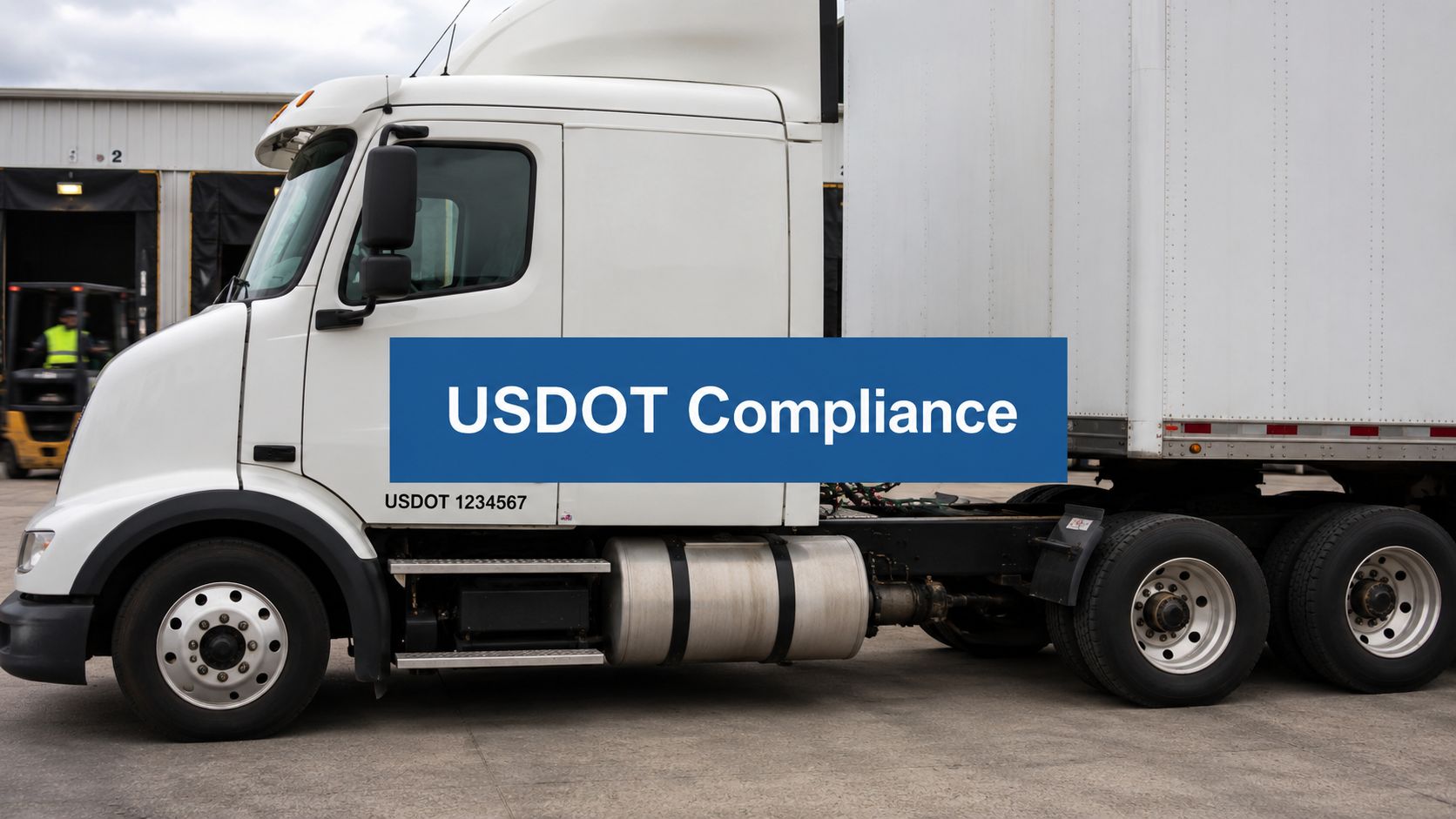
USDOT number marking requirements are one of those details you can ignore for months, right up until an inspector walks up to your truck and writes a violation. If you own a fleet or manage safety, this is one of the easiest compliance items to get wrong and one of the easiest to fix before it costs you time on the road.
Most problems start with something small. The lettering is too small. The company name on the door doesn't match the MCS-150. A leased unit still shows the wrong carrier. A truck gets rebranded, but the old number is still faintly visible underneath. In 2024, violations of 49 CFR 390.21 were among the top five most-cited violations nationwide during roadside inspections, with over 153,000 marking violations recorded across the country, and more than 42,000 citations were specifically for the carrier name or USDOT number not being displayed as required, according to FreightWaves coverage of FMCSA marking violations.
If you're still sorting out the basics, start with this quick guide on what a USDOT number is. Once you have the number, the next job is displaying it the right way on the right equipment. That's where many fleets slip. You don't need a complicated system to fix it. You need clear rules, a clean audit process, and attention to the gaps that get overlooked most often.
Introduction
You probably have at least one truck in your fleet right now that would make an inspector stop and look twice. It may still be legal. It may also be one worn decal, one mismatched business name, or one leased tractor away from a violation.
That's what makes USDOT number marking requirements frustrating. They look simple on paper, but they break down in day-to-day operations. A shop orders decals using your logo instead of your legal carrier name. A dispatcher swaps in a rental unit and nobody changes the markings. A used truck comes in with old numbers half-scraped off and someone decides that's “good enough.”
The rule itself is straightforward once you strip away the confusion. You need the correct carrier identification on the vehicle, in the right format, in the right place, and readable to an inspector. If you treat markings as a one-time setup task, problems build up fast. If you treat them as a regular compliance check, they stay manageable.
Practical rule: If an officer can't quickly tell who is operating the truck, assume your markings need work.
The Core Federal USDOT Marking Rules
The federal baseline starts with one question. What must appear on your vehicle? If you can answer that clearly, you can prevent most avoidable marking problems before they start.
Under FMCSA guidance, your vehicle marking must display the legal name or a single trade name of your business entity exactly as it appears on your Form MCS-150, plus the letters USDOT followed by your assigned number, as stated in the FMCSA commercial motor vehicle marking final rule summary.
If you need a broader compliance overview, this primer on USDOT number regulations is a useful companion to your vehicle audit.
What has to be on the truck
For each self-propelled commercial motor vehicle you operate, the basic federal rule is that the marking must show:
- Your carrier name: Use your legal business name or one trade name, and make sure it matches your MCS-150 exactly.
- Your USDOT number: The letters USDOT must appear before the number.
- Both sides of the vehicle: The required information has to be shown on each side of the self-propelled CMV.
- Only one visible USDOT number: If an old number is still visible, you've created a compliance problem.
A common point of confusion is branding versus registration. Your truck can have a logo, a marketing slogan, or a broader brand identity on it. That doesn't replace the legal marking requirement. Inspectors care whether the operating carrier is clearly identified under the federal rule.
When multiple names appear
This trips up growing fleets all the time. You may have a parent company name, a DBA, and a lease operator reference on one truck. That's where you have to be careful.
If more than one name appears on the vehicle, the words “operated by” must precede the operating carrier's name. That helps enforcement identify who is responsible for the unit on the road.
| Requirement | Specification | Regulation |
|---|---|---|
| Carrier name | Legal name or a single trade name exactly as shown on Form MCS-150 | 49 CFR 390.21 |
| USDOT number | Must be preceded by the letters “USDOT” | 49 CFR 390.21 |
| Placement | Displayed on both sides of each self-propelled CMV | 49 CFR 390.21 |
| Multiple names | Use “operated by” before the operating carrier's name when needed | 49 CFR 390.21 |
| Visible number count | Only one USDOT number may be visible at a time | 49 CFR 390.21 |
If your office records say one thing and your truck door says another, the truck door will lose that argument at roadside.
What a correct marking looks like
A compliant example is simple: your registered carrier name on the door or forward side area, followed by USDOT 1234567 on both sides. The exact layout can vary, but the identity must be clear and tied to the operating carrier.
A noncompliant example is just as common: a truck with a shortened nickname on one side, a logo on the other, and a USDOT number underneath that belongs to a prior operator. That setup creates confusion, and confusion is what the rule is meant to eliminate.
Getting the Display Specs Exactly Right
Knowing the right words isn't enough. The physical display is where a lot of fleets get cited. Size, contrast, placement, and legibility matter because the standard is based on what an inspector can read.

Federal regulations require USDOT numbers to be printed in lettering at least two inches tall, and the marking must be clearly visible from 50 feet away during daylight hours while the vehicle is stationary, according to this summary of USDOT number size and display rules. If you're ordering decals, keep these DOT sticker requirements in mind before you approve the proof.
The 50-foot test you should use
Forget the shop conversation about whether a font “looks fine.” Use the field test that matters. Stand back and ask whether the name and number are easy to read from a distance in daylight.
That's the practical meaning of the rule. If the lettering barely meets the measurement but disappears into the paint color, it's still going to draw attention. If the text is hidden by straps, mirrors, side boxes, or grime, you're inviting an inspection problem.
What usually goes wrong on real trucks
These are the display issues I'd look for first during a yard walk:
- Too-small lettering: Shops sometimes shrink the text to fit around logos or door hardware.
- Weak color contrast: Gray on silver, red on maroon, or dark blue on black can all create legibility issues.
- Decorative fonts: Script and compressed fonts may look sharp in a mockup but read poorly at distance.
- Bad placement: Markings behind accessories, fuel tank hardware, or heavy road spray areas don't stay readable.
A safer approach is boring on purpose. Use clean block lettering. Use strong contrast. Put it where road dirt won't cover it first.
Simple display choices that hold up better
For a dark tractor, light lettering usually gives you the clearest result. For a white or light-colored truck, dark lettering is easier to read. That isn't a styling preference. It's a compliance choice.
Clean, high-contrast block lettering beats clever design every time on a roadside inspection.
If your trucks work in rough conditions, inspect decals as part of routine maintenance. Markings that were compliant when installed can become noncompliant after weather, washing, body repairs, or everyday wear.
Common Marking Mistakes and How to Avoid Them
The most expensive marking mistakes usually aren't about brand-new trucks. They show up when equipment changes hands, leases get renewed, or old information stays on the vehicle longer than it should.

One issue stands out above the rest. According to Foley's FMCSA compliance checklist discussion of marking rules, over 32% of marking violations in a 2024 FMCSA audit review involved leased units where the operating carrier's name and USDOT number were not visibly displayed.
Leased units cause more trouble than most fleets expect
Owners often get burned. For instance, you lease a tractor, rent a replacement, or use an intermodal unit, and the vehicle already carries someone else's identification. The driver assumes it's fine because the truck already has numbers on it. It isn't fine if the unit is operating under your authority and your operating carrier information isn't what's visibly displayed.
That's the gap many guides gloss over. The operating carrier's markings must control during the lease term. If your name and USDOT number aren't the visible identifiers, you've created a direct exposure point.
The other mistakes I see most often
Some errors are less technical, but they still trigger violations:
- Old markings still visible: You update the truck, but faint old lettering or an old number still shows through.
- MCS-150 mismatch: Your truck shows a DBA, abbreviation, or branding phrase that doesn't match your registration.
- Faded decals: Sun, chemicals, pressure washing, and road film make legal markings unreadable over time.
- Partial rebranding: One side of the truck gets updated. The other side doesn't.
- Used truck leftovers: A newly purchased truck comes with old carrier info that wasn't fully removed before service.
A better audit mindset
Think of your marking check as an identity check, not a sticker check. Ask one simple question for each unit: Does this truck clearly show who is operating it right now?
If the answer is anything other than yes, pull the unit into review. That includes owner-operator arrangements, temporary replacements, and tractors moving between divisions or authorities.
| Situation | What often happens | What you should do |
|---|---|---|
| Leased tractor | Prior carrier markings stay visible | Display the operating carrier's name and USDOT number |
| Used truck purchase | Old decals are partly removed | Fully remove prior markings before dispatch |
| Name change | Trucks keep old branding language | Match the MCS-150 carrier name on the vehicle |
| Weathered decal | Text fades into paint or dirt | Replace before legibility becomes questionable |
Navigating State Variations and Special Cases
Federal rules are the baseline. They are not the full picture for every route, unit type, or business setup. Once your trucks cross certain state lines or your equipment mix gets more complicated, the marking question becomes less about one rule and more about stacking rules correctly.
If you’re still figuring out whether your operation needs a federal number in the first place, review who needs a DOT number before you order anything.
State identification rules can add another layer
Some states require additional identifiers beyond your federal USDOT marking. California, New York, and Kentucky are common examples that fleet owners talk about because state-specific identifiers can become part of roadside expectations depending on where and how you operate.
The main takeaway is simple. Don’t assume federal compliance equals full route compliance. Before a truck runs a new lane or enters a new state program, verify whether that state expects separate operating identification to be displayed.
Trailer marking can surprise smaller fleets
Many owners assume the tractor door is the only concern. That isn’t always true. If your trailer has a GVWR exceeding 10,001 pounds and is used in interstate commerce, it must display the operating carrier’s name and USDOT number on its sides under the same sharp contrast and legibility standards, according to this explanation of FMCSA marking requirements for trailers.
That matters for fleets that rotate trailers across customers, drop lots, and lease pools. If you operate under conditions where trailer markings apply, don’t leave that review to chance.
Short-term rentals have a narrow exception
Rental equipment is another area where people assume flexibility means freedom from documentation. It doesn’t. There is a limited exception for vehicles leased for less than 30 days, but the paperwork has to be right.
When leasing a vehicle for less than 30 days, you may use the rental company’s name and USDOT number only if the rental agreement includes your principal place of business address, your specific USDOT number, and a statement confirming whether you are transporting hazardous materials in that rented CMV.
Rental paperwork is part of your marking compliance if you’re relying on the rental company’s displayed information.
A practical way to handle special cases
Use a separate review list for units that don’t fit your standard fleet pattern:
- Leased tractors: Confirm the operating carrier’s markings are visible before dispatch.
- Intermodal units: Check whether your operating information is the one that can be readily identified.
- Trailers in applicable interstate use: Verify whether your trailer setup requires side markings.
- Short-term rentals: Match the truck markings to the rental agreement documentation.
- State-specific routes: Check whether additional state identifiers apply before the truck rolls.
Your Step-by-Step Compliance Action Plan
Once you know the rules, the next job is turning them into a repeatable process. That matters more than having a perfect decal template. Most fleets don’t struggle because they can’t understand the rule. They struggle because nobody owns the check.

If you’re setting this up from scratch, start with the registration side first by reviewing how to get a DOT number, then tie that information directly to every unit in service.
Five actions to put in place now
-
Audit every active unit
Walk every self-propelled CMV and any trailer in a use case where markings apply. Check both sides. Read the name and number exactly as displayed, not how they’re supposed to appear in your system. -
Match the truck to the MCS-150
Pull your current carrier registration and compare it to what’s physically on each vehicle. The common failure isn’t a missing number. It’s a truck carrying a name that’s close, but not exact. -
Order markings for clarity, not minimum effort
Use block lettering, strong contrast, and a layout that stays readable in field conditions. If the design team wants to make it look slick, remind them this is a compliance marking first. -
Remove old information completely
Don’t layer new markings over old ones or leave ghosted numbers behind. If another USDOT number can still be made out, you haven’t finished the job. -
Train dispatch, maintenance, and drivers
A solid process fails fast if one rental unit gets sent out without review. Drivers should know to report missing, damaged, or incorrect markings the same way they report a light or tire issue.
What to keep on your internal checklist
A short checklist works better than a long policy nobody reads. Your yard or maintenance team should verify:
- Correct carrier name: Exact match to current registration
- Correct USDOT format: Includes the letters USDOT before the number
- Dual-side display: Present and readable on both sides where required
- Legibility: Clear in daylight, not faded, dirty, or blocked
- No conflicting info: No prior carrier name or old USDOT number visible
The easiest time to fix a marking problem is before the truck leaves your yard.
Build marking checks into normal operations
Tie the review to events that already happen. New truck in service. Bodywork complete. Lease swap. Name change. Decal damage report. Rental replacement. Annual fleet audit.
That way, markings stop being a forgotten compliance detail and become part of how your operation stays inspection-ready.
Frequently Asked Questions About USDOT Markings
Do you need your USDOT number on both sides of the truck
Yes. The rule requires the operating carrier identification to appear on both sides of each self-propelled CMV.
Does the carrier name have to match your MCS-150 exactly
Yes. Your vehicle marking should use the legal name or a single trade name exactly as it appears on your Form MCS-150.
How big do the letters need to be
The federal minimum is two-inch-tall lettering, and the marking must be legible from 50 feet away in daylight while the vehicle is stationary.
Can you show more than one USDOT number on the vehicle
No. Only one visible USDOT number should appear on the vehicle at a time.
What if your truck has more than one business name on it
If more than one name appears, the operating carrier’s name should be identified with the words “operated by” so enforcement can tell who is responsible for the unit.
Do leased trucks need your company name and USDOT number
Yes, if the truck is operating under your authority. Leased and intermodal units are one of the biggest compliance gaps because fleets often leave the prior markings visible.
Can you use the rental company’s markings on a short-term rental
Sometimes. For rentals under 30 days, the rental company’s markings may be used only if the rental agreement includes your business address, your USDOT number, and hazardous materials information as required.
Do trailers need USDOT markings
In some cases, yes. If your trailer has a GVWR over 10,001 pounds and is used in interstate commerce, it may need the operating carrier’s name and USDOT number on its sides.
What should you do when you buy a used truck with old numbers on it
Remove the old carrier information completely before putting the unit into service. Don’t assume partially removed numbers are good enough.
Are faded or dirty decals a problem
Yes. If the markings aren’t readily legible, you have a compliance issue even if the original installation was correct.
Regulatory References
| Regulation | Title | Link |
|---|---|---|
| 49 CFR 390.21 | Marking of self-propelled CMVs and intermodal equipment | View 49 CFR 390.21 on the eCFR |
| 49 CFR 390.19 | Motor carrier, hazardous material shipper, and intermodal equipment provider identification reports for the MCS-150 | View 49 CFR 390.19 on the eCFR |
| 49 CFR 390.5T | Definitions relevant to commercial motor vehicle compliance | View 49 CFR 390.5T on the eCFR |
| 49 CFR 376.11 | General leasing requirements for authorized carriers | View 49 CFR 376.11 on the eCFR |
If you want help keeping fleet paperwork, driver files, and ongoing DOT compliance under control, take a look at My Safety Manager. It's built for trucking companies that want expert support without adding more administrative strain to the office.
