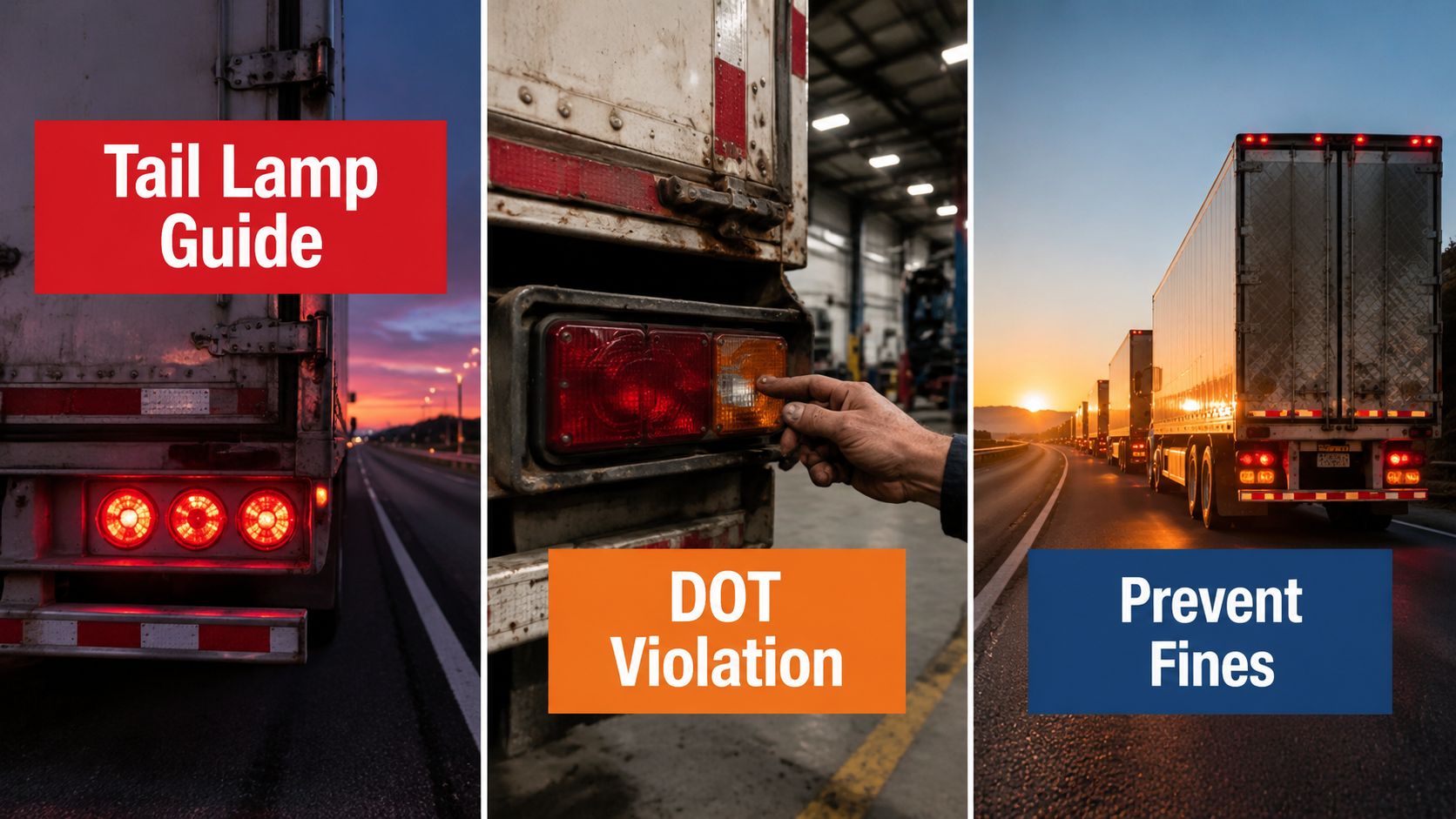
A tail lamp DOT violation is one of the quickest ways to derail a trip and damage your fleet's safety record. As a fleet owner or safety manager, you know the frustration of a driver getting sidelined for a simple lighting issue that should have been caught before they ever left the yard. You might see a bulb that needs replacing, but a DOT inspector sees a major safety hazard, especially at night or in bad weather. This one small problem can snowball into a massive headache, dinging your CSA scores, driving up insurance premiums, and hurting your bottom line. This guide will break down exactly what a tail lamp violation is, why it is a bigger deal than a minor inconvenience, and how you can build a system to keep it from happening to your fleet.

What a Tail Lamp Violation Really Means
A DOT inspector is looking for much more than a light that just turns on and off. A violation can be written up for a whole range of issues that compromise the lamp's effectiveness.
Understanding these details is the first step in avoiding them. A violation is not just about a broken part; it is about failing to meet a specific safety standard designed to make your truck visible and its actions predictable to everyone else on the road.
Common reasons for a tail lamp DOT violation include:
- Inoperable Lamp: The most obvious one. The bulb or the entire unit is not working.
- Cracked or Broken Lenses: A compromised lens can let in moisture, leading to corrosion and shorts. It can also distort the light, making it less visible.
- Incorrect Color: Tail lamps must be red. Any other color, or even using clear lenses over red bulbs, is an immediate violation.
- Obstructed or Dirty Lens: The lamp has to be visible from a specific distance. A layer of dirt, mud, or snow is all it takes to earn a citation.
- Improper Mounting: Lamps that are loose, hanging, or not securely fastened are a clear violation.
The core issue with any tail lamp DOT violation is visibility. If your truck cannot be clearly seen from the rear, its size, speed, and intentions become dangerously unclear to other motorists, dramatically increasing the risk of a rear-end collision.
Understanding DOT Tail Lamp Regulations
When it comes to avoiding a tail lamp violation, just having the lights turn on is not enough. You need to know exactly what the DOT regulations demand. The rules are not just about basic function; they cover specific details like color, placement, and even visibility from a distance.
These requirements are all laid out in the Federal Motor Vehicle Safety Standard (FMVSS) 108. Think of this as the official playbook for all vehicle lighting. It’s what inspectors use as their guide during a roadside stop, and knowing the details is your best defense against getting a citation.
Core Requirements for Tail Lamps
Your truck's tail lamps have to meet a few simple, non-negotiable standards. These are the absolute basics an officer will check right away.
- Color: All tail lamps must be red.
- Number: You are required to have at least two tail lamps, with one on each side of the vehicle's rear.
- Placement: The lamps need to be mounted symmetrically at the rear, positioned as far apart as is practical.
- Visibility: They have to be visible from a minimum distance of 500 feet to the rear, whether it’s day or night. This is exactly why keeping those lenses clean is so important.
A violation often happens when a driver thinks a lamp is "good enough," but the inspector sees a clear failure to meet these standards. For instance, a trailer with only one working tail lamp is an automatic violation because the rules clearly require two.
Equipment Choice and Common Pitfalls
A tail lamp violation does not always come from a burnt-out bulb. Sometimes, it’s the equipment you have installed. Using the wrong type of lamp, even if it lights up, can land you in hot water. This is a common issue with certain aftermarket parts that look the part but do not actually meet federal standards.
Modifications are a huge trip-up. One of the most common mistakes is using clear lenses with red bulbs, which is a guaranteed violation. The National Highway Traffic Safety Administration has made it clear that using a white lens where a red one is required is a problem, even with a red bulb inside. The lens and lamp must be certified together as a compliant unit.
The key takeaway is that every lamp, whether it’s OEM or aftermarket, must be DOT-certified for its specific use. Look for the "DOT SAE" stamp on the lens. It is your signal that the part meets the required standards. Anything less is a gamble you cannot afford to take. For a deeper dive into the specific rules, check out our complete guide to DOT lighting regulations.
The True Cost of a Lighting Violation
A DOT tail lamp violation is a lot more than just a roadside fine; it’s a problem that can ripple through your entire operation. Every single citation adds points to your Compliance, Safety, Accountability (CSA) score, hitting you right in the Vehicle Maintenance BASIC category.
As those points pile up, your company’s score climbs, essentially painting a target on your fleet's back for DOT officers. This unwanted attention leads to more frequent and thorough inspections for all your drivers, which can derail schedules and increase the chances of them finding other violations. It is a chain reaction that can start with something as simple as a burned-out bulb, eventually leading to higher insurance premiums as your fleet is seen as a bigger risk.
How Violations Impact Your CSA Score
Not all violations carry the same weight. The Federal Motor Carrier Safety Administration (FMCSA) assigns severity points based on how likely a violation is to cause a crash. A seemingly minor issue like an inoperable required lamp comes with a hefty 6 severity points.
These points are then multiplied by a time weight, meaning recent violations hurt your score the most. When you start stacking up multiple lighting violations, your CSA score can quickly enter the red zone, flagging your company for intervention.
The real danger is not just one burned-out bulb. The out-of-service (OOS) criteria for lighting kicks in when a combination of required lamps, like both tail lamps, are inoperable. An OOS order takes your truck off the road immediately, causing costly delays and disrupting your entire logistics chain.
The infographic below breaks down just how quickly a single lighting issue can spiral into a major operational headache.

As you can see, what starts as a simple fix can escalate into a significant financial and logistical problem.
Violation Severity and CSA Impact
To give you a clearer picture of the risk, the table below shows the CSA severity points for some of the most common lighting violations. These are the points that directly impact your Vehicle Maintenance BASIC score before any time-weight multipliers are even applied.
| Violation Code (as per FMCSA) | Violation Description | CSA Severity Points |
|---|---|---|
| 393.9H | Inoperable head lamps | 6 |
| 393.9T | Inoperable tail lamp | 6 |
| 393.9TS | Inoperable turn signal | 6 |
| 393.11 | Stop lamp violations | 6 |
| 393.9BRKLAMP | Inoperative brake lamps | 6 |
| 393.9RL | Inoperable required lamp | 6 |
Remember, these points are just the beginning. The FMCSA’s Safety Measurement System (SMS) will multiply these values based on how recently the violation occurred, making new infractions especially damaging.
In fact, lighting defects are consistently one of the top reasons for roadside citations. In 2025 alone, inspectors wrote up 344,225 violations for inoperable required lamps. That accounted for nearly 12% of all vehicle violations found during inspections. You can learn more about how these frequent lighting violations impact fleets on MySafetyManager.com.
This statistic shows just how common a tail lamp DOT violation is and why being proactive with your maintenance is the absolute best defense.
Your Pre-Trip Inspection Lighting Checklist
The best way to sidestep a tail lamp DOT violation is to catch it before your truck ever leaves the yard. A solid pre-trip inspection is your first and most reliable line of defense against citations.
Giving your drivers a simple, repeatable checklist transforms a routine chore into a serious compliance tool. This is not about piling on more work; it’s about making the work count. By focusing on function, condition, and cleanliness, your drivers can spot the exact same things that catch an inspector's eye, long before they hit the road.

The Essential Lighting Inspection Steps
Here is a straightforward checklist to build into every pre-trip inspection. You can find even more details in our guide on how to properly check all truck lights before driving.
Test All Functions: Start with the engine off but turn the key to the "on" position. Switch on the headlights, which powers up the tail lamps. Cycle through the left and right turn signals and then the four-way flashers. Finally, have a partner hit the brakes or use a pedal depressor tool to make sure the brake lights fire up.
Inspect for Damage: A working light with a cracked lens is still a clear violation. Do a walk-around and visually inspect every single lens for cracks, chips, or holes. Any opening can let in moisture and cause a failure down the line.
Check for Secure Mounting: Grab each light housing and give it a firm but gentle shake. Every lamp has to be securely mounted to the vehicle. A loose, vibrating, or dangling light is a dead giveaway for an inspector and screams maintenance failure.
Confirm Cleanliness and Visibility: Are the lamps caked in mud, dirt, or snow? DOT regulations demand that tail lamps be visible from 500 feet, and a dirty lens can easily slash that distance in half. A quick wipe-down might be the only thing standing between a simple warning and an expensive citation.
Why Each Check Matters
The real-world impact of lighting defects gets magnified by how inspectors view them. For instance, steady-burning tail lamps are non-negotiable at night or during bad weather. If paired lights on a unit are out, an Out-of-Service order is a very real possibility.
Developing a complete inspection habit is crucial for avoiding these headaches. For a wider look at all the checks your drivers should be making, you can also reference AutoProv's vehicle checklist.
Proactive Maintenance to Prevent Tail Lamp Violations
Your drivers do a great job checking for burnt-out bulbs during their pre-trip inspections, and that’s your first line of defense. But if you want to get serious about eliminating a tail lamp DOT violation for good, the real work starts in your maintenance shop. Shifting from a reactive, "fix-it-when-it-breaks" approach to a truly proactive one is the only way to protect your CSA scores and keep your trucks earning.
A top-tier maintenance program does not just sit back and wait for a driver to write up a problem. It actively hunts for potential failures by scheduling deep-dive lighting inspections that go way beyond a simple on/off check.
Building a Stronger Maintenance Protocol
Let’s be honest: the bulb is rarely the real problem. Most lighting failures trace back to issues hiding in the wiring and connections. Things like corrosion, chafed wires, and bad grounds are silent killers that build up over time until a lamp just gives up. A proactive plan finds and fixes these gremlins before they can cause a headache on the side of the road.
Your maintenance schedule needs dedicated time for technicians to get their hands dirty and:
- Inspect all wiring harnesses for any signs of abrasion, rubbing, or heat damage. Pay close attention to spots where they bend or pass through the truck's frame.
- Check for corrosion on every bulb socket, plug, and ground connection. This is a huge source of those frustrating, intermittent electrical faults that are so hard to track down.
- Verify the integrity of all seals and gaskets on the lamp housings themselves. Keeping moisture out is critical to preventing shorts and making your components last.
For a more granular checklist of the specific components you should be inspecting, you can dig into our detailed overview of DOT truck lighting requirements.
Upgrading for Long-Term Reliability
One of the smartest long-term investments you can make for your fleet is upgrading from old-school incandescent bulbs to modern LED lighting. Yes, the upfront cost is a bit higher, but the payoff is massive. LEDs last exponentially longer, are way more resistant to the constant shock and vibration of road life, and they draw less power from your electrical system.
A proactive maintenance plan is about preventing failures, not just fixing them. By focusing on root causes like wiring corrosion and upgrading to more durable components like LEDs, you turn unpredictable breakdowns into scheduled, manageable tasks.
Beyond the lights themselves, a solid grasp of general vehicle inspection practices can slash your violation risk across the board. Check out these essential tips for a smooth vehicle registration to help keep your entire fleet compliant. Also, consider setting up a simple inventory system for common bulbs, lenses, and pigtails. This ensures your techs can grab what they need for a quick repair, minimizing downtime and getting your trucks back on the road faster.
A Better Way to Manage Fleet Compliance
Let's be honest: trying to juggle pre-trip inspections, maintenance schedules, and DOT regulations by yourself is a recipe for burnout. Relying on manual tracking for every Driver Vehicle Inspection Report (DVIR) is a huge gamble. You are just hoping you will catch every recurring maintenance issue, like a nagging tail lamp problem, before an inspector does.
A single missed repair or a lost piece of paper can throw your entire operation into chaos during a DOT audit. It is a risky, inefficient way to run a business. This is exactly where My Safety Manager can help. Our program is built to take the administrative headache and guesswork completely off your plate, all for a simple flat monthly fee.

From Reactive Fixes to Proactive Control
Our platform makes it simple to track DVIRs and, more importantly, spot trends in equipment failures. You can finally get ahead of those repeat lighting issues and maintain perfect records for any audit that comes your way.
This systematic approach makes sure that small problems, like a tail lamp DOT violation, get flagged and fixed long before they become a roadside violation. By identifying these patterns, you stop wasting money on quick fixes and can finally address the root cause, something we dig into in our guide on avoiding lighting violations.
Partnering with us means you get more than just software. You gain a team of compliance experts who provide clear, practical guidance on complex regulations, helping you manage your CSA scores and protect your bottom line.
Stop reacting to problems and start preventing them. Let us handle the compliance details so you can focus on what you do best: running your business. Visit www.MySafetyManager.com to learn how we can lock down your compliance and give you some well-deserved peace of mind.
Frequently Asked Questions About Tail Lamp Violations
What is the penalty for a broken tail light?
A tail lamp DOT violation is a moving violation that comes with a fine and adds 6 severity points to your Vehicle Maintenance BASIC CSA score. While a single violation may not seem severe, multiple lighting violations can quickly raise your CSA score, leading to more frequent inspections and higher insurance premiums.
Can I drive with a broken tail light?
It is illegal and unsafe to operate a commercial motor vehicle with a broken or inoperable required tail lamp. If you are pulled over, you will receive a citation. If both of your tail lamps are out, your vehicle will likely be placed out of service, causing significant delays and costs.
What lights are required on a semi truck trailer?
According to FMCSA regulations, a semi truck trailer must have at least two red tail lamps, two red stop lamps, two red or amber turn signals, and two red reflectors on the rear. Additional lighting, such as clearance lamps and identification lamps, are also required depending on the trailer's width and length.
Is a cracked tail light a DOT violation?
Yes, a cracked tail lamp lens is a DOT violation, even if the light still works. A crack compromises the lamp's ability to protect the bulb from moisture and can distort the light output, making it less visible. An inspector will cite this as a violation of 49 CFR § 393.11.
How often should you check your tail lights?
You should check your tail lights as part of your daily pre-trip and post-trip inspections. This simple habit is the most effective way to catch issues like burnt-out bulbs, cracked lenses, or dirty covers before they lead to a tail lamp DOT violation on the road.
Regulatory References
Your best defense against a potential tail lamp DOT violation is knowing exactly what the regulations say. The Federal Motor Carrier Safety Administration (FMCSA) publishes all the official standards you need to follow.
Here are the key regulations that cover lighting requirements for commercial vehicles:
- 49 CFR § 393.11 – Lighting devices and reflectors: This outlines every required lamp and reflector for all commercial motor vehicles.
- 49 CFR § 393.25 – Requirements for lamps other than head lamps: This section gets into the details of mounting requirements for tail lamps, stop lamps, and turn signals.
- 49 CFR § 396.11 – Driver vehicle inspection report(s): This rule connects it all to your daily process, covering the DVIR and your absolute duty to repair any listed defects.
Trying to piece all these regulations together can be a full-time job. Let My Safety Manager take DOT compliance off your plate so you can get back to managing your fleet. Visit us at www.MySafetyManager.com to see how we help businesses like yours stay compliant and on the road.
