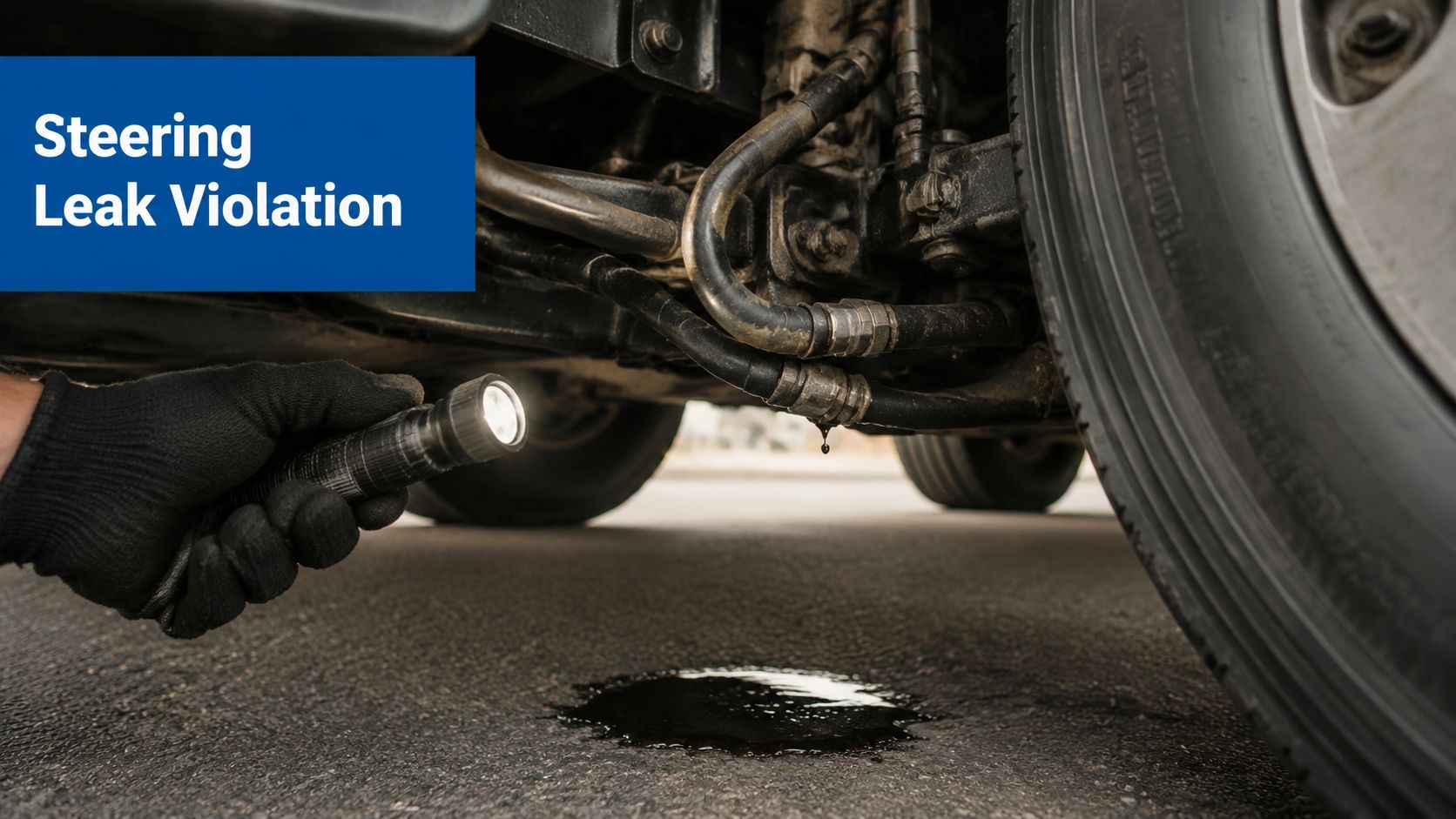
A power steering leak DOT violation can sideline your truck fast, turning a minor drip into a major compliance headache, an out-of-service order, and a hit to your CSA score. For fleet owners and safety managers, knowing exactly where the Department of Transportation draws the line isn't just good practice; it's essential for keeping your operation running smoothly.
You've likely seen it before: a slight wetness on a hose or a small puddle under a parked truck. You might wonder if it's a big deal. The reality is that a seemingly minor leak noted on a pre-trip inspection can quickly become a costly violation if you don't address it. This guide will walk you through what inspectors look for, how to tell a simple maintenance note from an out-of-service condition, and how to protect your fleet.
When Is a Power Steering Leak a DOT Violation?
You’ve probably seen it before—a wet sheen on a power steering component or a small, dark puddle under a parked truck—and wondered, "Is this a big deal?" The answer comes down to one critical factor: is the fluid actively dripping?
This is the main distinction an inspector will make between a minor issue for your mechanic and a citable offense that impacts your safety record. A damp power steering hose is something you should note on a Driver Vehicle Inspection Report (DVIR) and get fixed. A leak that actually forms drops and falls from the truck? That's a clear-cut violation.

Drips vs. Seepage: The Official DOT Stance
The heart of the matter is how active and severe the leak is. A power steering system that is just wet or "sweating" fluid isn't usually enough to trigger a violation on its own.
The moment that seepage becomes significant enough to form drops that fall from the component during an inspection, you've crossed the line.
To give inspectors a clear standard, the CVSA outlines specific out-of-service criteria. For steering systems, Criterion 1.f. under Steering states a vehicle is out-of-service if there is "Any leakage of power steering fluid." However, an important note clarifies that "seepage that is not sufficient to form a drip" is not an OOS condition.
This table breaks down how an inspector is likely to view the situation.
| Power Steering Leak Severity and DOT Actions | ||
|---|---|---|
| Leak Severity | Visual Cue | Potential DOT/CVSA Action |
| Seepage or "Sweating" | Component is wet or damp; no drops are forming. | Not a violation. You should note it on a DVIR for monitoring and future repair. |
| Slow Drip | Fluid collects and forms a drop but may not fall immediately. | Citable Violation. This will be written up on an inspection report and add points to your CSA score. |
| Active Drip | Fluid is actively and consistently dripping onto the ground or other components. | Out-of-Service (OOS) Condition. Your truck will be sidelined until the leak is repaired. |
Essentially, if it’s just wet, you need to get it on the maintenance schedule. If it drips, you're looking at a violation and potentially an OOS order that will hurt your operation and your CSA scores.
When a Minor Drip Becomes a Major Violation
A little dampness on a power steering line won't get you a power steering leak DOT violation. The real trouble starts when that dampness turns into an active leak, putting safety at risk. If you want to keep your trucks rolling and your CSA scores low, your entire team needs to know exactly where inspectors draw the line.
It all boils down to what inspectors call the "drip and drop" rule. A hose that's just "sweating" or looks wet usually isn't enough for a citation. But the second that seepage forms a full drop of fluid that falls onto another truck part or the ground, you’ve officially got a violation.

From Drip to Out-of-Service
An inspector doesn't just stop at seeing a drip. They have to figure out if that leak creates an immediate danger, which is what elevates a simple violation to a much more serious out-of-service (OOS) order.
A leak is not just a leak. Its location is a major factor. Fluid dripping onto a hot exhaust manifold or turbocharger creates a significant fire hazard, which will almost certainly result in an OOS order.
Inspectors are primarily on the lookout for two things:
- Fire Hazard: Is that power steering fluid dripping onto a hot component like the exhaust system or turbo?
- Environmental/Road Hazard: Is the fluid hitting the pavement? This points to a major leak that could make the road slippery for other drivers and signals a rapid loss of fluid.
Steering-related defects accounted for about 4.1% of all DOT inspection violations, so this isn't a small issue. And since every truck needs an annual periodic inspection, you are expected to catch these problems long before an inspector does. You can find more details in this breakdown of recent DOT inspection violations.
It’s crucial to train your drivers and mechanics to see leaks through an inspector's eyes. This is the same mindset you'd use for other fluid leaks, which we cover in our guide on how to handle an oil leak DOT violation. Catching these issues during a pre-trip inspection is your best line of defense against a costly surprise at the scale house.
How an Inspector Evaluates Your Steering System
When a DOT officer spots a power steering leak during a roadside inspection, they don't just see a drip. They see a clue. That puddle or wetness is a signal for them to dig deeper, because a leak is often just a symptom of a much larger, and potentially dangerous, problem with the steering system.
To an inspector, that fluid on the ground is just the starting point. They will immediately widen their focus to the entire steering assembly, looking for other problems that might be lurking. This is how a seemingly small leak can quickly snowball into a serious violation.
The Inspector's Mental Checklist
An inspector is trained to connect the dots between different signs of wear and tear. They aren't just checking for fluid.
Once a potential leak is found, here’s what they’re looking at next:
- Steering Wheel Play: They’ll get in the cab and check for excessive "slop" or looseness in the steering wheel. Too much play points to worn-out parts somewhere down the line.
- Component Integrity: They will physically inspect the steering box, pump, and hoses. They’re hunting for cracks, loose fittings, damaged components, or anything that isn't securely mounted.
- Linkage and Joints: Inspectors get underneath the truck to check critical parts like tie-rod ends, drag links, and pitman arms. Any looseness or obvious wear here is a huge red flag.
The inspector's job is to build a complete picture of the steering system's condition. A small leak combined with excessive steering wheel play or a worn tie-rod end presents a much greater risk than a leak on an otherwise solid system.
Why Context Matters So Much
Roadside inspection data consistently shows that while steering violations aren't as frequent as brake problems, they are a steady source of out-of-service orders. One recent CVSA Roadcheck event put 262 vehicles out of service for steering defects, proving just how seriously inspectors take these issues. In fact, as this recap of CVSA Roadcheck priorities highlights, officers are specifically trained to look for leaks in conjunction with loose components and worn linkages.
Understanding this big-picture approach is the key to avoiding violations. Your pre-trip and maintenance inspections need to mirror what the officer does on the side of the road. Don't just look for leaks; teach your team to check the whole system for wear. Our comprehensive commercial vehicle inspection checklist is a great way to build this habit into your daily routine. That way, you can find and fix small issues before they team up to cause a major roadside headache.
Building a Proactive Maintenance and Inspection Plan
The best way to steer clear of a power steering leak DOT violation is to get ahead of the problem. That means ditching the reactive, break-fix mindset and building a proactive maintenance and inspection plan that turns your whole team into problem-solvers.
This all starts with your drivers during their daily pre-trip inspections. You don't need them to be master mechanics, but adding a simple, 60-second visual check of the power steering system can make all the difference. This is just a quick look at the fluid level, a scan of the hoses for wetness or cracks, and a peek under the engine for any fresh drips on the ground.
This process chart shows exactly how a DOT inspector thinks—they'll spot a leak and then follow the trail, escalating their search from there.

As you can see, a simple leak is just the beginning. It’s an open invitation for an inspector to start digging deeper into your entire steering system's health.
Technician Periodic Inspection Checklist
While your drivers are your first line of defense, your technicians are your compliance specialists. Their periodic inspections have to be much more thorough. A driver might spot a leak that's already happened; a tech’s job is to prevent it from ever starting.
Your technician’s power steering checklist should include these key points:
- Fluid Level and Condition: Check the level, but also note the fluid's color and smell. If it's dark or smells burnt, you've got signs of internal wear or overheating.
- Hose Integrity: Physically inspect all power steering hoses. Don't just look—feel for brittle sections, cracking, and soft or bulging spots, paying close attention to the areas near fittings.
- Component Inspection: Get eyes on the pump and steering box. You're looking for any signs of seepage, grime buildup that indicates a slow leak, or physical damage.
- Tighten Fittings: Check and snug up all hose clamps and fittings. This simple step can stop a slow, seeping leak from ever developing.
The real goal here is to create a seamless workflow. When one of your drivers writes "damp power steering hose" on their DVIR, that note should automatically trigger a repair order. This creates a documented trail showing you found and fixed a potential issue before it became a violation.
This kind of proactive documentation is gold during a compliance review or audit. It proves your commitment to safety. For more help building out your processes, a solid vehicle maintenance schedule template is a great place to start.
How Strong Documentation Protects Your Fleet
When it comes to DOT compliance, there's one golden rule: if it isn't documented, it didn't happen. Your records are your single best defense against a power steering leak DOT violation.
Good paperwork proves to an inspector, an auditor, or even an attorney that you take safety seriously and are proactive about maintaining your equipment.
This means correctly documenting pre-trip inspections, writing up clear and detailed repair orders, and keeping those records organized. It all starts with the Driver Vehicle Inspection Report (DVIR). When your driver notes a damp power steering hose on their DVIR, that report becomes the first link in your chain of compliance.
The Paper Trail That Proves Compliance
Think of your documentation as the story of your safety program. A clear, detailed paper trail shows a consistent pattern of proactive maintenance, which can directly help improve your Vehicle Maintenance BASIC score over time.
So, what does this look like in practice?
- DVIRs: Your driver’s daily reports need to be specific. A note like "PS leak" is okay, but "slight dampness on low-pressure power steering return hose" is much, much better. The more detail, the better.
- Repair Orders: When a mechanic addresses the issue, the work order needs to clearly reference the original complaint from the DVIR and describe the fix. For example, "Replaced power steering hose per DVIR #12345 to correct reported dampness."
- Maintenance Records: All of these records must be filed together in the truck’s maintenance file. Having a complete history proves you not only find problems but fix them promptly.
This complete record—from the driver's report to the mechanic's sign-off—is your most powerful tool. It shows you have an effective system in place to manage vehicle maintenance and take safety seriously, which is exactly what the FMCSA wants to see.
Using Documentation to Fight a Violation
What happens if you get a citation you believe is unfair? This is where your documentation becomes your primary evidence in a DataQs challenge.
If an officer writes you up for a leak that your records show was just repaired, you have a rock-solid case for getting that violation thrown out. Without those records, it’s just your word against the officer’s report.
Ultimately, good records do more than just protect you from violations—they are the foundation of a strong safety program. Keeping your vehicle maintenance files organized is critical, and our guide on the DOT vehicle maintenance file checklist can help you ensure you have everything in order. Strong documentation turns compliance from a burden into a verifiable strength.
Frequently Asked Questions (FAQ)
Here are short answers to some of the most common questions fleet managers have about power steering leaks and DOT violations.
What makes a power steering leak a DOT violation?
A power steering leak becomes a DOT violation when the fluid is actively dripping. If a component is just "sweating" or damp, it is usually not a violation, but it should be noted on a DVIR for repair. An active drip that falls onto the ground or other components is a citable offense.
Can a truck be put out of service for a power steering leak?
Yes. A truck will be placed out of service (OOS) if the leak is severe enough to be a safety hazard. This typically happens if the fluid is dripping onto a hot surface like an exhaust manifold (fire risk) or if the leak is substantial enough to cause a loss of steering control.
How do power steering violations affect CSA scores?
A power steering leak violation adds points to your Vehicle Maintenance BASIC score in the CSA system. Steering system violations are considered serious and carry a high severity weight, which can negatively impact your score, potentially leading to more inspections and higher insurance rates.
What is the difference between a leak and seepage for DOT?
Seepage is when a component is wet or damp with fluid, but not enough to form a drop. This is a maintenance issue but not a violation. A leak is when the fluid forms a drop and falls. That is a clear violation according to CVSA out-of-service criteria.
How often should power steering systems be inspected?
Your drivers should visually inspect the power steering system during every daily pre-trip inspection. This includes checking the fluid level and looking for visible drips. A more thorough inspection by a qualified mechanic should be part of your scheduled preventative maintenance, typically every 30-90 days, and is required for the annual DOT inspection.
Turn Your Compliance Program into a Competitive Advantage
Juggling a potential power steering leak DOT violation on top of the hundreds of other compliance details you're responsible for can be completely overwhelming. The last thing you need is a system that just adds more tasks to your to-do list.
That’s where we come in. My Safety Manager is designed to transform your compliance program from a source of anxiety into a real competitive advantage. Imagine having all your driver qualification files, maintenance logs, and training records in one simple dashboard, right at your fingertips.
For one flat fee, you get a dedicated team of compliance professionals who live and breathe this stuff. We handle the DOT complexities so you can get back to what you do best: running your business. Let us give you total control and peace of mind over your safety operations.
Visit www.MySafetyManager.com to see how our program works and schedule a demo to find out how we can help your fleet.
Regulatory References
Understanding the specific rules inspectors follow is key to avoiding violations. Here are the primary Federal Motor Carrier Safety Regulations (FMCSRs) that apply to a power steering leak DOT violation.
- 49 CFR § 393.209 – Steering Wheel Systems: This regulation outlines the requirements for steering components and specifically defines defects, including fluid leaks and excessive looseness.
- 49 CFR § 396.3 – Inspection, Repair, and Maintenance: This foundational rule requires that all commercial motor vehicles be systematically inspected, repaired, and maintained to ensure they are in safe and proper operating condition at all times.
- 49 CFR § 396.11 – Driver Vehicle Inspection Report(s) (DVIR): This rule mandates that your drivers conduct pre-trip and post-trip inspections, report any defects found, and that you certify repairs are made before the vehicle is operated again.
- Appendix G to Subchapter B – Minimum Periodic Inspection Standards: This appendix serves as the official checklist for the required annual vehicle inspection, detailing every system that must be checked, including the entire steering mechanism.
For a deeper dive into these critical maintenance rules, check out our complete guide on 49 CFR Part 396.
