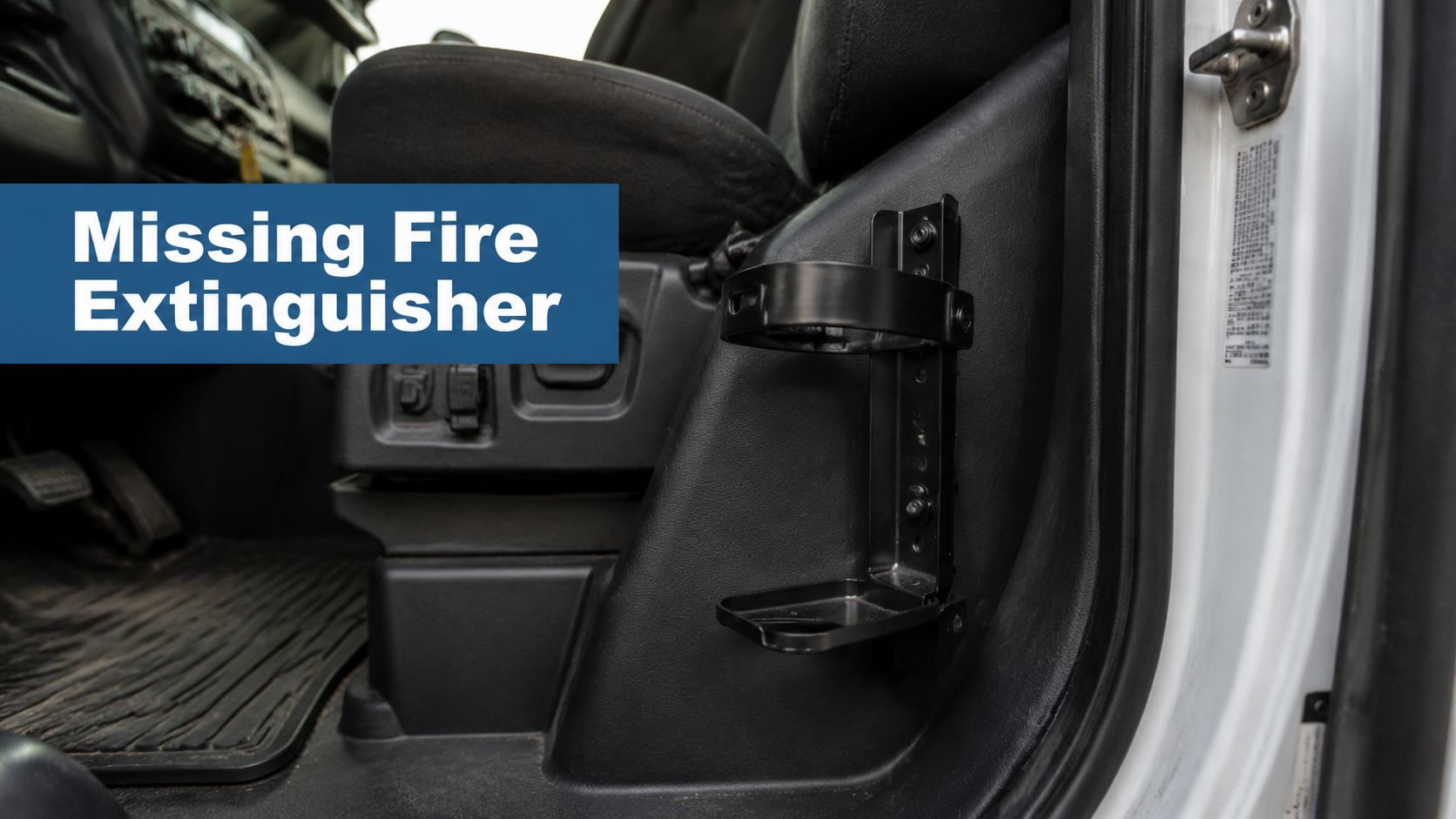
A missing fire extinguisher DOT violation is a 4-point CSA violation under code 393.95A, and it can put your truck out of service. Your standard commercial vehicles must carry at least one 5 B:C rated fire extinguisher.
Missing fire extinguisher DOT violation issues catch fleets off guard because they feel small right up until a roadside inspector writes them up and your truck stops moving. If you manage a fleet, you already know the frustration. One cheap piece of safety equipment can turn into a bad inspection, a hit to your CSA profile, and a long phone call with operations.
What usually goes wrong is simple. The extinguisher was there last month, but nobody noticed the gauge dropped, the bracket broke, the unit got moved, or the truck got reassigned to a load that needed a different rating. That's why this violation matters more than it looks. It usually points to a system problem, not a one-time oversight.
A fire extinguisher citation is one of those violations that tells you whether your pre-trip process, shop process, and safety follow-up are working. If you want a broader view of how these issues fit into your overall DOT violation risk, start there, then come back and tighten this specific area before it costs you another inspection.
Introduction
Most fleets don't lose sleep over a fire extinguisher until an inspector asks for it. Then the problem gets expensive fast, not because the extinguisher costs much, but because the violation exposes weak habits in inspection, maintenance, and dispatch.
This is why I never treat a missing fire extinguisher citation as a minor equipment ticket. It's a visible sign that your compliance system allowed a basic requirement to fail in the field. If that happened with an extinguisher, you should assume other preventable defects may be hiding in the same process.
Practical rule: If a fleet misses simple, visible equipment, it usually has a process issue, not a driver-only issue.
Your goal isn't just to replace a canister and move on. Your goal is to fix the operating gap that let the truck leave the yard in noncompliant condition. That means knowing the exact violation, understanding what inspectors look for, correcting the record properly, and building a repeatable check that keeps the same mistake from coming back.
Understanding the 393.95A Violation
A driver gets pulled in for a routine roadside inspection. The truck is otherwise clean, but the inspector asks for the fire extinguisher and finds it missing, discharged, or loose in the cab. What looked like a small equipment miss is now a recorded violation that can affect CSA, delay the load, and raise bigger questions about how your fleet controls basic safety items.

What inspectors are citing
Violation 393.95A covers a fire extinguisher that is missing, discharged, or not properly secured. Inspectors use that code during roadside inspections because 49 CFR §393.95 requires the vehicle to carry the required emergency equipment in usable condition.
That distinction matters in the field. A truck does not pass just because an extinguisher is somewhere in the cab. If the gauge shows discharged, the unit is not mounted or secured, or the extinguisher does not meet the vehicle's operating requirement, the inspector can still cite the truck.
For fleets, substantial costs emerge at this point. The violation can hit your CSA profile, create downtime while the driver gets a compliant unit in place, and draw closer attention to the rest of the equipment on the vehicle.
What the regulation requires
The rule behind the citation is 49 CFR §393.95(a). It requires most interstate commercial motor vehicles to carry at least one fire extinguisher that is properly filled and rated, readily accessible for use, and securely mounted.
The practical compliance points are straightforward:
| Issue | What it means for you |
|---|---|
| 393.95A code | The violation is entered on the roadside inspection report under the emergency equipment rule |
| CSA impact | The citation affects your safety record and can weigh more heavily if there is a pattern of basic equipment defects |
| Possible out-of-service exposure | If the vehicle cannot meet the equipment requirement at inspection, the truck may be delayed until corrected |
| Condition matters | Missing, empty, discharged, loose, or otherwise unusable equipment can all create the same problem |
If you need the exact equipment standards and rating details, use this guide to DOT fire extinguisher requirements for commercial trucks.
Why fleets should treat 393.95A as a system warning
I do not treat a 393.95A citation as a one-off driver mistake unless the facts clearly support it. In most fleets, this violation points to a broken handoff between maintenance, dispatch, supervision, and pre-trip verification.
Here is the pattern I see. A truck comes out of service after repair. The bracket is there, but nobody verifies the extinguisher is charged. Dispatch reassigns the unit to a different operation. The driver assumes the equipment was checked in the shop. An inspector finds the gap in five minutes.
That is why this violation matters beyond the ticket itself. If your fleet misses a visible, low-cost item that is easy to inspect, underwriters may reasonably ask what else is being missed in your preventive maintenance and driver inspection process. Repeated basic equipment violations can also affect how insurers price risk under semi-truck insurance policies.
A missing extinguisher is not just an extinguisher problem. It is a signal that your compliance system may be allowing preventable defects onto the road.
DOT Fire Extinguisher Requirements for Your Trucks
The most common mistake isn't always having no extinguisher. Often, it's having the wrong extinguisher for the way the truck is being used.

The rating problem fleets miss
A common compliance trap is mixed operations. One day a power unit is running general freight. Another day it's assigned to placarded hazmat. The extinguisher that was acceptable yesterday may not be acceptable today.
The practical distinction is straightforward:
- Non-hazmat power units: You need the rating required for standard operations.
- Placarded hazmat power units: You need a 10 B:C extinguisher.
- Fleet reassignment risk: If dispatch changes the load profile and nobody checks the extinguisher rating, the truck can leave legally assigned but improperly equipped.
The nuance around 10 B:C for placarded hazmat versus 5 B:C for non-hazmat power units is a real fleet-management issue, as discussed in this industry compliance discussion on mixed-use fire extinguisher requirements.
What the unit must look like in the truck
Even the correct extinguisher can fail inspection if it's not installed right. In practice, you want all of these to be true before the truck leaves:
- Readily accessible: You shouldn't have to unload half the cab to reach it.
- Securely mounted: A loose extinguisher is asking for a citation.
- Clearly labeled: The rating needs to be visible.
- In serviceable condition: Pressure and physical condition need to support use in an emergency.
For a more detailed checklist on equipment, mounting, and daily checks, use this DOT fire extinguisher requirements guide.
The insurance angle you shouldn't ignore
A missing fire extinguisher DOT violation doesn't just stay in the safety department. Repeated maintenance and inspection issues can show up in underwriting conversations because they suggest weak controls. If you review your operation through the lens of risk, it helps to understand how carriers and agents look at semi-truck insurance policies and why equipment-related violations can matter beyond the ticket itself.
A fire extinguisher is cheap. The operational signal from not having one is not.
Your Action Plan After a Fire Extinguisher Violation
When one of your trucks gets cited, speed matters. So does documentation. If you treat this casually, you can fix the truck and still leave a mess in your internal records.
First deal with the truck
Start with the actual unit on the vehicle, not the paperwork in the office.
- Confirm what the inspector cited. Was it missing, discharged, unsecured, or the wrong rating for the operation?
- Get the truck compliant immediately. Install the correct extinguisher, mount it properly, and make sure it's accessible.
- If the truck was placed out of service, clear the defect before dispatch touches it again. Don't let pressure from operations override the correction.
If you need a broader view of violations that can shut a truck down, keep your team aligned with this DOT out-of-service violations list.
Then build your correction file
Your safety file should include enough detail that anyone reviewing it later can see the defect was corrected promptly and correctly.
Keep these items together:
- Inspection report copy: This anchors the event.
- Receipt or work order: Show what was purchased or installed.
- Photos: Take clear pictures of the extinguisher mounted in place.
- Internal note: Record who verified the correction and when.
Decide whether the violation should be challenged
Not every citation should be disputed. Some should. If the extinguisher was compliant and the record is wrong, preserve evidence and evaluate a DataQs challenge. But don't challenge just because you dislike the violation. Challenge when your documentation is solid and the inspection record is genuinely inaccurate.
The worst response is doing nothing. The second worst is arguing without evidence.
Use the event to audit your process
After correction, ask three hard questions:
| Question | What you’re looking for |
|---|---|
| Did pre-trip miss it? | Training gap or rushed inspection culture |
| Did maintenance miss it? | Weak release-to-service procedure |
| Did dispatch create a mismatch? | Load assignment changed without equipment verification |
That review is where substantial savings happen. Replacing one extinguisher solves today’s problem. Fixing the handoff between shop, safety, and operations prevents the next one.
How to Prevent Fire Extinguisher Violations
A truck leaves the yard with a load that has to deliver that morning. The driver gets stopped, the inspector finds no compliant fire extinguisher in place, and what looked like a minor equipment miss turns into a preventable hit on the inspection record. That is not just a driver problem. It points to a gap in the way the fleet checks equipment, releases trucks, and verifies readiness before dispatch.

Build the extinguisher check into normal operations
Fire extinguisher requirements under 49 CFR 393.95 is basic equipment control. Fleets still miss it because they treat it as something the driver should notice if there is time, instead of a required release item checked the same way every day.
Put the extinguisher into the pre-trip process, the shop process, and the dispatch release process. If only one person owns it, it will get missed when equipment changes, trucks swap drivers, or a unit comes out of service.
Use a short field check that takes seconds:
- Gauge: Pressure is in the operable range
- Pin and seal: Present and intact
- Mounting bracket: Secure
- Location: Readily accessible
- Condition: No visible damage, corrosion, or signs of discharge
A written truck driver pre-trip inspection checklist helps because it turns an assumption into a documented task.
Assign responsibility at more than one point
A driver should inspect the extinguisher before departure. That alone is not enough.
The shop should verify the extinguisher is mounted and serviceable when the truck is PM’d, repaired, or returned to service. Safety should review inspection activity for repeat equipment misses. Dispatch should stop treating tractor assignment as proof that the unit is fully compliant, especially when a last-minute truck swap happens.
That overlap is not wasted effort. It is how fleets catch simple defects before an inspector does.
Standardize what “good” looks like
Many fire extinguisher violations happen because crews are checking for presence, not compliance. A canister sitting loose behind the seat, a discharged unit, or a bracket with no extinguisher still creates exposure.
Set one standard across the fleet:
- The extinguisher must be the required type and rating for the vehicle
- It must be properly mounted
- It must be accessible to the driver
- It must be in usable condition
Train to that standard with photos, not general reminders. A two-minute visual example of pass versus fail usually does more than a policy memo.
Audit the misses, not just the trucks
If one truck gets cited for a missing extinguisher, check more than that unit. Review the rest of the assigned fleet, recent shop releases, and any terminals using the same process.
The violation offers particular utility. A missing fire extinguisher is often an early warning sign. If the fleet is loose on a visible item required by 49 CFR 393.95, there is a fair chance the same weak process is affecting triangles, spare fuses where applicable, DVIR follow-up, or other basic equipment controls. Inspectors, underwriters, and shippers all read that pattern the same way. Weak attention to simple requirements usually means wider compliance risk.
Use the violation trend as a management signal
Fleet managers sometimes treat this citation as a cheap fix and move on. That is the expensive approach.
Repeated equipment violations can raise CSA exposure, trigger more scrutiny during inspections, and create questions from insurers about maintenance control and safety oversight. The extinguisher itself is inexpensive. The pattern behind the violation is what costs money.
A practical system should let you track repeat defects by unit, terminal, shop, and driver, assign corrective actions, and confirm that the truck was brought back into compliance. My Safety Manager can support that workflow if you need one place to manage inspections, training tasks, and violation follow-up without relying on paper files and text messages.
Manage Compliance with My Safety Manager
A truck leaves the yard after service. The driver assumes the extinguisher is mounted. The shop assumes the driver checked it on pre-trip. Safety assumes the unit is inspection-ready. Then an officer writes a 393.95A violation, and what looked like a cheap equipment miss starts affecting CSA exposure, insurer confidence, and how much trust you can place in your own release process.

A missing, discharged, or unsecured fire extinguisher is rarely just a truck problem. It usually points to a control problem. The key question is whether your system can show, by unit and by date, that required equipment was present, checked, corrected, and documented before that truck hit the road.
What a managed system should help you do
A usable process needs to handle the basic compliance work that fleets often split between text messages, paper files, and memory:
- Track violations through closure: Record the inspection, assign the correction, and confirm the truck was returned to service in compliant condition.
- Keep equipment checks consistent: Give drivers, technicians, and managers one standard for verifying extinguishers, warning devices, and other required items.
- Assign ownership: Make it clear who corrects the defect, who reviews it, and who keeps the supporting record.
- Handle equipment changes tied to operations: Catch cases where a unit’s load type or assignment changes and the extinguisher rating or related equipment no longer matches the job.
My Safety Manager supports that kind of control structure. If you want to compare your current process against a managed workflow, review the DOT compliance management service and look at whether your team can track open defects, training status, and correction records without chasing multiple systems.
What matters most
The product is not the point. Proof is the point.
If your current setup cannot tell you which truck is missing an extinguisher, which unit has the wrong rating for its operation, whether the defect was corrected, and who signed off on that correction, then you do not have a reliable compliance process. You have assumptions. That is how small equipment violations turn into repeat citations, harder roadside inspections, and bigger questions about the fleet’s safety culture.
Frequently Asked Questions
What is a missing fire extinguisher DOT violation?
It is a roadside equipment violation for having no, discharged, or unsecured fire extinguisher in a commercial motor vehicle under violation code 393.95A.
How many CSA points is a missing fire extinguisher violation?
Industry guidance tied to the FMCSA coding identifies it as a 4-point violation.
Can a truck be placed out of service for no fire extinguisher?
Yes. A fire extinguisher violation may trigger an out-of-service order until a compliant extinguisher is installed and mounted.
What fire extinguisher rating does a standard commercial vehicle need?
A standard commercial vehicle must have at least one extinguisher rated 5 B:C.
What fire extinguisher rating is required for placarded hazmat?
Placarded hazardous-materials transport requires a 10 B:C extinguisher.
Is the violation only for a missing extinguisher?
No. The citation can also apply if the extinguisher is discharged or unsecured.
Does the extinguisher have to be mounted?
Yes. It needs to be securely mounted and readily accessible for use.
Who should check the extinguisher before the truck leaves?
Your driver should check it during pre-trip, but your shop and safety team should also verify it through maintenance and audit processes.
What’s the most common fleet mistake with extinguishers?
For many fleets, the biggest mistake is carrying the wrong extinguisher for the truck’s load profile, especially in mixed hazmat and non-hazmat operations.
How do you prevent repeat fire extinguisher violations?
Use a simple checklist, verify mounting and charge daily, document replacements, and make sure dispatch, maintenance, and safety all own part of the process.
Regulatory References
- 49 CFR 393.95 Emergency equipment on all power units
- 49 CFR 392.7 Equipment inspection and use
- 49 CFR 396.3 Inspection, repair, and maintenance
- 49 CFR 396.11 Driver vehicle inspection report
Stay Compliant and Keep Rolling
A missing fire extinguisher DOT violation looks small on paper, but it tells you a lot about your operation. If your fleet misses simple, visible, low-cost equipment, you’re not dealing with a fire extinguisher problem. You’re dealing with a process problem.
Fix the truck, yes. But also fix the handoff between pre-trip, maintenance, dispatch, and safety. That’s how you protect your CSA profile, reduce preventable downtime, and show that your fleet takes compliance seriously every time a truck leaves the yard.
If you want help tightening your inspection process, tracking violations, and building a cleaner compliance system, take a look at My Safety Manager. It gives you a practical way to manage DOT compliance without piecing everything together manually.
