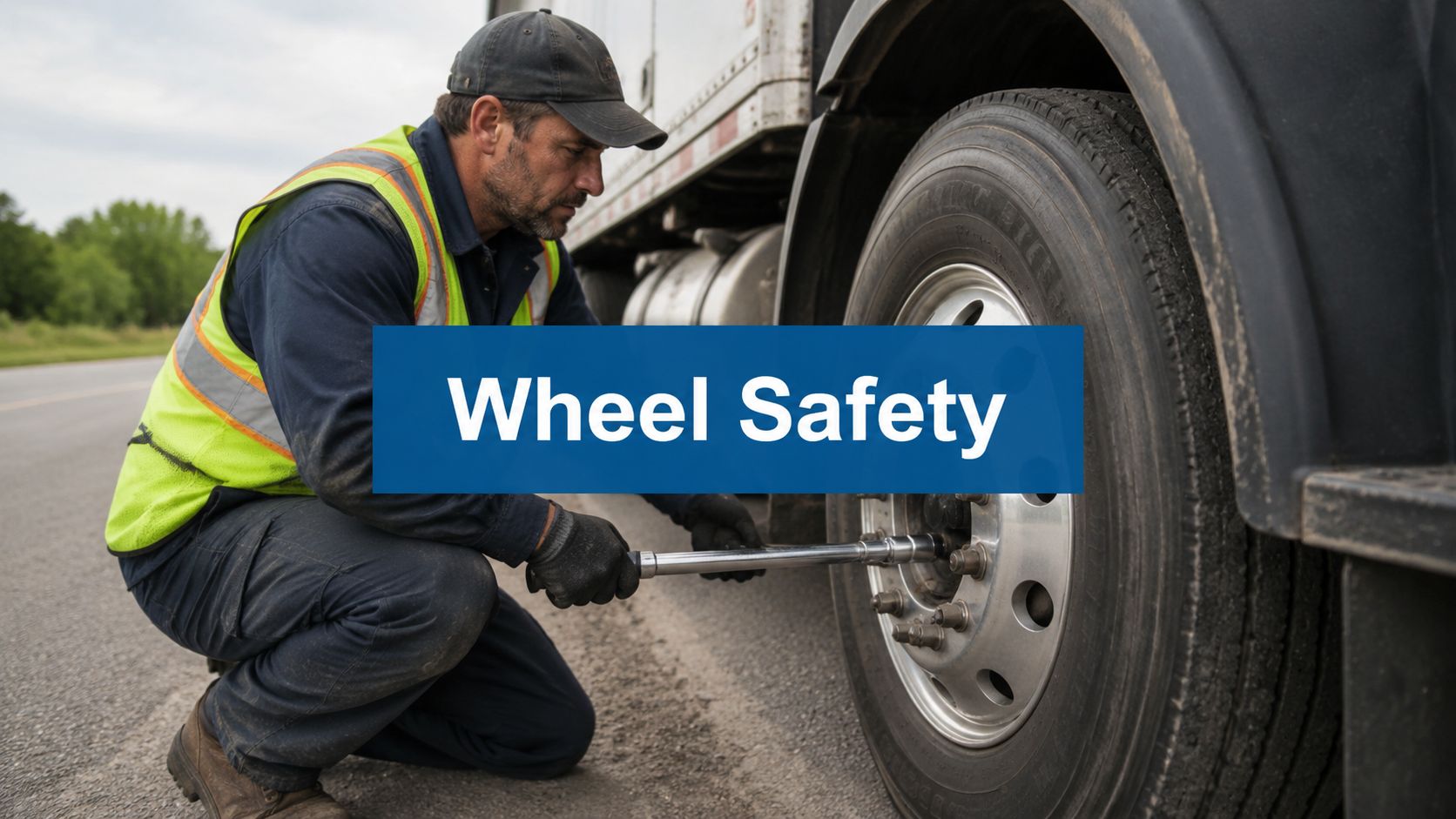
Loose wheel fastener DOT violation problems usually start small. You hear about a driver feeling a faint wobble, a shop finding rust trails around a lug nut, or an inspector writing up a wheel issue that suddenly turns into a much bigger compliance headache.
If you’re managing trucks, this is one of those defects you can’t afford to treat as routine. A lot of fleets assume that if the wheel was torqued in the shop, the risk is handled. That mindset is where trouble starts. Roadside inspectors don’t judge your intent. They judge what they can see, what they can touch, and whether the wheel assembly meets the inspection standard at that moment.
What occurs is simple. A small amount of movement at the fastener can turn into hardware damage, wheel damage, an out-of-service event, and a violation that follows your fleet after the truck is repaired. You need to manage the full lifecycle, from early warning signs in the cab to documentation after the inspection report is issued.
Introduction Why Wheel Fasteners Are a Big Deal
A loose wheel fastener DOT violation gets people’s attention for one reason. Everyone in trucking knows what a wheel-off incident can do.
You may be dealing with this right now. A driver reports a vibration that wasn’t there yesterday. A technician says the wheel looks fine at a glance. Then a roadside inspection puts the unit out of service, and now you’re trying to sort out safety exposure, downtime, records, and whether the violation itself was written correctly.

What catches new managers off guard is that wheel fastener issues rarely look dramatic at first. The truck may still track down the road. The tire may still hold air. The wheel may not look loose from ten feet away. But a small amount of movement at the stud or nut leaves evidence, and inspectors are trained to read that evidence during events like International Roadcheck inspections.
Practical rule: Treat any wheel-end complaint as a safety event first and a maintenance event second.
That means you don’t wait for obvious failure. You react when the driver feels a wobble, hears a click, notices heat, or sees rust streaking from a fastener. If you wait for visible separation, you waited too long.
What Inspectors See The Signs of a Loose Wheel
Most fleets talk about loose lug nuts as if the only question is torque. Roadside enforcement is more visual than that. The inspector is looking for signs that the wheel assembly has been moving under load.

Rust trails and polished metal
The first thing I tell managers to teach is this. Rust around a lug area isn’t always just age.
When a fastener loosens, the mating surfaces can shift slightly. That movement can create reddish streaks coming out from the nut seat or stud area. It can also polish metal where the wheel has been rubbing instead of staying clamped.
Look for these clues during walkarounds:
- Rust streaks at the nut seat: Thin lines running outward from the lug area often mean the components have been moving.
- Bright or shiny witness marks: Fresh polished metal around bolt holes can show friction where there shouldn’t be any.
- Metal dust or debris: Fine debris near the wheel face can point to ongoing wear.
- Uneven appearance across one wheel position: If one fastener area looks freshly disturbed while the others don’t, pay attention.
A driver can miss these signs if you only tell them to “check the tires.” You need to train them to inspect the wheel face itself. That’s the same mindset you’d use when reviewing other visual defects such as a wheel seal leak DOT violation, where the evidence often shows up before the failure does.
Cracks, damaged holes, and missing hardware
Loose fasteners don’t stay isolated for long. Once clamping force is compromised, stress gets transferred into places that weren’t supposed to carry it.
That’s when you start seeing:
- Cracks radiating from the bolt hole
- Elongated or wallowed bolt holes
- Broken, stripped, or visibly damaged fasteners
- Missing nuts or studs
- Heat discoloration at the wheel end
If an inspector sees hardware movement, damaged seating surfaces, or visible cracking, your argument that the wheel was serviced recently won’t carry much weight.
Shop paperwork matters later. At roadside, the visible condition of the wheel controls the conversation.
What you should train your team to notice
The best driver instruction is specific and repeatable. Tell your team to look, listen, and feel.
- Look: Check every wheel position for rust trails, shiny rub marks, missing fasteners, and cracks.
- Listen: Clicking, popping, or unusual wheel-end noise after a recent tire or brake service deserves immediate follow-up.
- Feel: Vibration through the seat, steering wheel, or trailer isn’t always a tire issue. It can be a loose wheel developing.
A manager who teaches these details catches more defects before enforcement does. That’s what keeps a roadside inspection from becoming a catastrophe.
Understanding the Regulations and Inspection Criteria
A wheel can feel only slightly off to the driver and still put the unit on the shoulder before the load reaches its stop. By the time an inspector puts eyes on that wheel end, the question is no longer whether the truck recently left the shop. The question is whether the hardware meets the rule in that moment.
Under 49 CFR 393.205, wheel nuts and bolts cannot be loose or missing. FMCSA inspection guidance treats wheel-end defects as serious safety problems, and wheel conditions can rise to out-of-service status under the inspection framework summarized in the FMCSA Safety Planner guidance on wheels and rims.
For a fleet manager, that changes the job. A loose wheel fastener is not just a maintenance defect to log and schedule. It is an enforcement issue, a CSA issue, and in the worst cases, the start of a wheel-off event that hurts people.
If you run your maintenance program under 49 CFR Part 396 inspection, repair, and maintenance requirements, wheel hardware needs clear inspection standards, technician torque procedures, and a way to verify follow-up after wheel-end service. One weak handoff between the shop, the driver, and dispatch is enough to turn a minor vibration complaint into a violation on an inspection report.
How inspectors apply the rule
Inspectors do not need a dramatic failure to write this up. They are looking for whether fasteners are loose, missing, broken, cracked, or stripped, and whether the pattern across the wheel reaches the out-of-service threshold.
That threshold depends on wheel design:
| Wheel Stud Positions | Loose, Missing, Broken, Cracked, or Stripped Fasteners Anywhere on Wheel | Loose, Missing, Broken, Cracked, or Stripped Fasteners Adjacent |
|---|---|---|
| 10 fastener positions | 3 can trigger out-of-service | 2 adjacent can trigger out-of-service |
| 8 fastener positions or fewer | 2 can trigger out-of-service | 2 can trigger out-of-service |
The point managers miss is adjacency. On a 10-stud wheel, two bad fasteners beside each other can park the truck even if the rest of the wheel still looks intact. On wheels with 8 positions or fewer, the margin is tighter.
What that means on the inspection report
Roadside enforcement is built around observable condition. If the inspector finds loose or missing hardware, damaged seats, or related wheel-end damage, the report reflects the condition found at roadside. Service records help later if you challenge the citation or document your repair process. They do not override a visible defect during the inspection.
That is why this violation has to be managed across the full life cycle. The driver feels a wobble. The shop checks the wheel end correctly or misses it. The inspector documents the defect. The violation hits your maintenance history. Then your team decides whether the record is accurate enough to contest. Managers who understand that chain usually build better controls upstream, because they know the paperwork fight at the end is the expensive way to learn the lesson.
The Real Cost How Violations Impact Your CSA Score
The roadside repair is the cheap part. The record is what follows you.
A wheel fastener violation lands in the Vehicle Maintenance BASIC. That means the inspection result becomes part of how enforcement views your maintenance discipline, not just that one truck on that one day. If you start collecting wheel-end violations, you send a message that your fleet may not be controlling critical mechanical risk consistently.
Why this violation carries weight
A loose wheel fastener issue tells an inspector something important. It suggests that one or more parts of your system may have broken down:
- Shop installation quality
- Post-repair verification
- Pre-trip inspection effectiveness
- Defect reporting culture
- Repair record follow-through
That's why these violations sting more than managers expect. A bad wheel-end condition doesn't look like random bad luck. It looks preventable.
You can read more about how inspection history affects enforcement attention in this overview of the truck driver CSA score and related compliance issues.
The business fallout after the inspection
Damage shows up after the unit is repaired and dispatched again.
Insurance partners may ask hard questions when they see maintenance-related enforcement patterns. Brokers and shippers may dig deeper into your safety profile before awarding freight. Your own team feels it too. A driver who gets put out of service over wheel hardware will remember whether your operation gave them the tools to catch the problem first.
Here's the trade-off that matters. It costs time to inspect wheel ends carefully, retrain drivers, and verify shop work. It costs more to defend your maintenance program after repeated wheel violations make your fleet look sloppy.
A wheel fastener violation is rarely judged as an isolated defect. Most people reading the inspection record will treat it as evidence of your maintenance culture.
That's why smart fleets don't manage these events as one-off breakdowns. They manage them as indicators.
Your Proactive Plan to Prevent Wheel Violations
Prevention works when you treat wheel security as a process, not a reminder on a checklist.

Start in the shop
Most wheel fastener problems begin with rushed work, mixed hardware, dirty mating surfaces, or weak follow-up after installation.
Your shop routine should include:
- Correct hardware control: Keep the right nuts, studs, and wheel components together. Don't normalize “good enough” substitutions.
- Clean mounting surfaces: Dirt, corrosion, paint buildup, and trapped debris can compromise clamp load.
- Calibrated torque tools: Use the right torque wrench and make sure it's maintained and used correctly.
- Manufacturer procedure discipline: Follow the specified sequence and torque method for that wheel system.
- Documented post-install checks: Any wheel that has been removed and reinstalled needs follow-up attention, not assumptions.
The biggest mistake I see is treating wheel installation as complete when the truck leaves the bay. It isn't complete until the assembly has been checked again after returning to service.
Tighten up driver inspections
Drivers won't catch what they haven't been taught to recognize. A generic pre-trip form won't fix that by itself.
Build your wheel inspection training around specific observations from a truck driver pre-trip inspection checklist and make the wheel-end section more detailed than most templates usually are.
Use simple field language:
- After service work, stay alert: If the wheel was recently removed for tires, brakes, seals, or hub work, pay extra attention on the next trips.
- Check the wheel face, not just the tire: Fasteners, holes, cracks, and streaking matter.
- Report vibration early: Don't let drivers self-diagnose a wobble as “probably balance.”
- Compare left to right: A wheel position that looks different from its mate deserves inspection.
Build a reporting culture that works
A prevention program fails when your people think reporting a concern will create blame or delay with no support.
Good fleets make this easy:
- Drivers report symptoms immediately. Vibration, clicking, pull, heat, and visual irregularities all count.
- Dispatch stops debating mechanical complaints remotely. If the wheel end is in question, the truck gets checked.
- Maintenance inspects with urgency. Wheel complaints go to the front of the line.
- Managers review repeat patterns. If the same terminal, vendor, or service type keeps showing up before wheel defects, fix that root cause.
Technology helps, but culture matters more. A torque wrench, training app, and maintenance software are useful tools. None of them matter if your team ignores the first warning sign.
What to Do When You Get a Violation
A wheel fastener violation usually starts long before the inspection report. The driver feels a light wobble, hears a click on low-speed turns, or notices the truck changed after recent wheel-end work. By the time an inspector writes the violation, the job shifts from spotting a defect to controlling the damage. That means protecting people first, then locking down the facts that will follow the carrier through repairs, CSA exposure, and any challenge you decide to file.

What your driver should do at roadside
Roadside is not the place for a debate. It is the place to preserve the condition, understand what was cited, and make sure the truck does not keep operating with a wheel-end problem.
Give drivers a simple standard:
- Get a readable copy of the inspection report before leaving
- Take clear photos of the exact wheel position cited
- Capture both wide shots and close-ups of the studs, nuts, and wheel holes
- Note any recent tire, brake, seal, or hub work at that position
- Call maintenance and safety immediately with the unit number, wheel position, and inspection details
I tell drivers to stay professional and avoid arguing adjacency, fastener counts, or technical interpretation on the shoulder. If the report is wrong, that gets handled later with records and photos, not roadside opinions.
Repair the defect and build the file
The first priority is correction. The second is documentation that matches the cited wheel position and condition. If those records are sloppy, the violation will follow you all the way into CSA with little chance of relief.
Pull these items together right away:
- Inspection report
- Repair order
- Technician findings tied to the exact wheel position
- Parts replaced
- Photos from before and after the repair
- Maintenance history for that wheel end
- Any internal notes showing when the symptom was first reported
Review the report against the inspection criteria already discussed earlier in the article. Wheel fastener cases often turn on details. Count matters. Placement matters. Adjacent loose or damaged fasteners matter. Wheel configuration matters. A vague note from the shop saying “tightened lugs” does not help much if the report cites a more serious condition or an out-of-service threshold.
Decide whether to accept it or challenge it
Some violations are clean and valid. In that case, the best move is to document the repair, close the loop internally, and treat it as a root-cause event. Look at recent service, torque practices, parts condition, and whether the driver reported an early warning that nobody acted on.
Some cases deserve a closer review.
An appeal usually makes sense only when the paperwork and evidence point to a specific error, such as:
- The wrong number of affected fasteners
- An incorrect claim that the affected fasteners were adjacent
- The wrong wheel type or fastener count
- A mismatch between the condition cited and the repair findings
- An out-of-service designation that does not fit the documented condition
That is where many fleets lose discipline. They get frustrated by the violation and file a weak challenge anyway. DataQs is not a place for general objections. It is a place for precise disputes supported by photos, repair records, technician notes, and a clear explanation of what the inspector got wrong.
Manage the CSA impact while the case is fresh
A wheel fastener violation is not just a maintenance event. It becomes an enforcement record, a score issue, and sometimes a customer conversation. Treat it that way from day one.
Safety should track four things immediately:
- Was the vehicle placed out of service
- What exact violation language appeared on the report
- Whether the repair documents match that language
- Whether the file is strong enough to support a DataQs request
If you wait two weeks, the driver forgets what he felt, the shop cannot remember what it saw before teardown, and the photos are gone. Good fleets handle these cases while the details are still sharp.
A loose wheel fastener violation can start with a small wobble and end as a wheel-off risk, a CSA hit, and a preventable fight over bad documentation. Handle the full chain correctly, from roadside response to repair file to appeal decision, and you give yourself the best chance to protect both safety and the carrier record.
Frequently Asked Questions About Wheel Fasteners
Can one loose lug nut cause a DOT problem
Yes. One loose fastener can be the start of a larger wheel-end defect. Even when one fastener is the first thing noticed, surrounding hardware may also be affected or damaged.
Is a loose wheel fastener always out of service
Not always. Out-of-service status depends on the number and placement of affected fasteners and the wheel configuration, based on the inspection criteria cited earlier.
What regulation covers loose wheel fasteners
The core federal requirement is 49 CFR 393.205, which requires wheel nuts and bolts to not be missing or loose.
What should your driver report first
Report any vibration, clicking, unusual wheel-end heat, visible rust streaking, missing hardware, or recent service followed by a handling change. Early reporting gives your shop a chance to stop the problem before enforcement does.
Does recent shop work protect you from a violation
No. A recent tire change, brake job, or hub repair doesn't excuse the condition at roadside. Inspectors judge the wheel as presented during the inspection.
What evidence helps if you dispute the violation
The most useful evidence is usually clear photos, repair records, technician notes, and maintenance history tied to that exact wheel position. General statements without documentation won't help much.
Should you let the truck keep moving if the driver feels a wobble
Not until someone qualified checks it. A wheel complaint is not something to “watch and see” over the next few hundred miles.
Are visual signs enough to pull the truck in for inspection
Yes. Rust trails, shiny movement marks, cracks, elongated holes, or missing hardware are enough reason to inspect the wheel end immediately.
How often should you train on wheel fasteners
Train during onboarding, after wheel-end related events, and whenever you see repeat defects or weak inspections in the field. Wheel-end awareness fades if you only mention it once.
What's the best mindset for managing this risk
Treat wheel fasteners as a catastrophic-risk item. The goal isn't just to avoid a citation. The goal is to keep a loose wheel from becoming a wheel-off event.
Regulatory References
- 49 CFR 393.205 on wheels
- 49 CFR 396.3 on inspection, repair, and maintenance
- 49 CFR 396.11 on driver vehicle inspection reports
- 49 CFR 396.13 on driver inspection before driving
If you want help tightening your compliance process before a wheel issue turns into a violation, take a look at My Safety Manager. It gives you a practical way to keep inspection, maintenance, driver qualification, and safety records organized so you're not scrambling when DOT problems show up.
