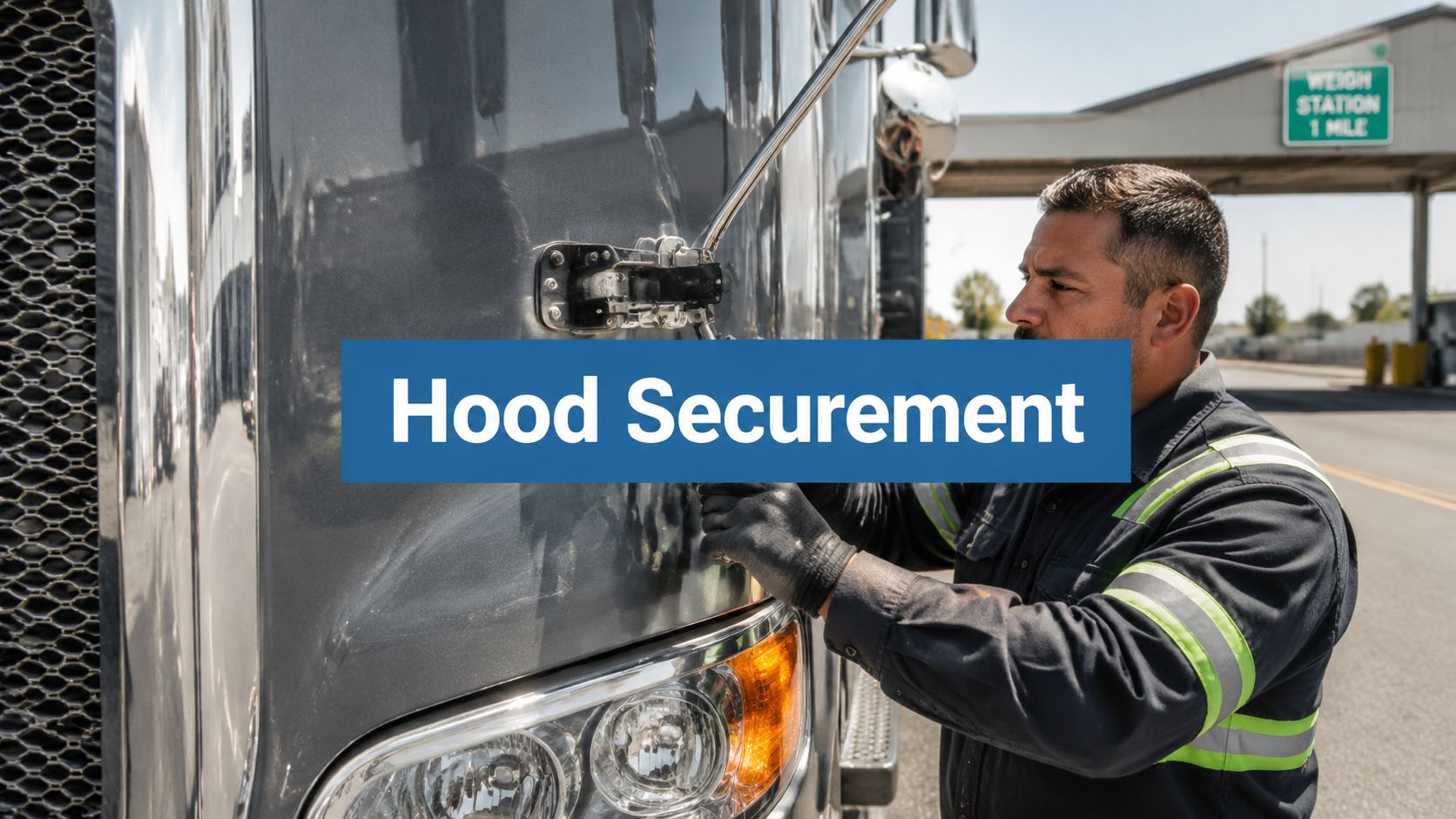
Hood securement DOT violation is the citation that catches a clean-looking tractor at the worst possible moment. You and your maintenance team may have checked the tires, lights, and paperwork, yet a Level I inspection can still turn into a roadside defect because the hood looks closed but isn't fully latched.
The common mistake is treating hood closure as a visual check. A driver lowers the hood, sees it sitting flush, and moves on without confirming the primary latch, secondary catch, release cable, and striker engagement. An inspector may test the mechanism and find that the hood can open, the safety catch is missing, or the latch hardware can't hold it securely.
Federal rules treat this as a vehicle-maintenance compliance issue, not a paperwork problem. This guide separates a simple pre-trip miss from a deeper latch-system failure, then gives you a practical repair and prevention process for your next inspection.
Why a Hood Securement DOT Violation Catches Fleets Off Guard
Your driver rolls into a weigh station confident that the American-style semi-truck is inspection-ready. The hood is down, the body panels look straight, and nothing appears loose from the driver's seat. During the inspection, the officer checks the hood release and secondary catch, then discovers that the primary latch never engaged completely or that the safety catch isn't holding.
The driver may believe the hood was secure. That's why this violation creates so much confusion. A hood can appear closed while the latch teeth sit only partially on the striker, the release cable remains under tension, or the secondary catch fails to engage. The officer isn't limited to a visual glance. State inspection procedures can require checking hinges, release mechanisms, latches, safety catches, and fasteners, then closing the hood to verify full closure, as shown in Maryland's hood-and-catches inspection standard.

Why the citation feels disproportionate
FMCSA records “Hood not securely fastened” under cab and body parts in the Vehicle Maintenance BASIC. One carrier profile records a single citation with a severity weight of 2 and no out-of-service designation, which shows that the defect can affect safety data without automatically immobilizing the vehicle. The same violation also appears in roadside histories for different carriers and vehicle types, including straight trucks and truck tractors, so it isn't an isolated oddity. FMCSA's inspection profile illustrates how the defect enters a carrier's safety record.
Practical rule: Treat every hood complaint as a maintenance signal until you prove that the latch system works correctly.
A single citation may feel minor, but repeated vehicle-maintenance defects tell inspectors that your controls aren't catching problems before dispatch. Your response should therefore go beyond telling the driver to close the hood. Use your roadside inspection violation guide to connect roadside findings with pre-trip checks, DVIR follow-up, and shop accountability.
The FMCSA Rules Behind Hood Securement Enforcement
A truck can leave the shop with the hood lowered but not fully engaged. At a weigh station, the inspector checks whether the hood will remain closed during operation, not whether it looks closed from the outside.
49 CFR 393.203(c) identifies the defect as “Cab And Body Parts, Hood Not Securely Fastened.” It falls under Part 393, the federal standards for commercial motor vehicle parts and accessories. If the hood cannot stay secure while the vehicle moves, the vehicle has a condition-related compliance defect.
Every hood also needs a latch system. As noted in the regulatory references, FMVSS 113 requires a front-opening hood that could obstruct the driver's forward view when open to have a secondary latch position or a second latch system.
What the inspector is really checking
The inspection covers the complete securement system: primary latch, secondary catch, striker or keeper, hinges, release mechanism, cables, springs, and fasteners. A hood left one click short after engine work is a different problem from rounded latch teeth, a broken cable, or a loose striker.
That distinction determines the remedy. A procedural pre-trip miss calls for driver correction, a physical closure check, and follow-up coaching. A shop-level hardware failure requires repair under the manufacturer's requirements, documentation, and a review of why the defect reached dispatch.
FMCSA inspection records place this violation in the Vehicle Maintenance BASIC. One carrier profile shows a severity weight of 2, with the violation included in SMS and no out-of-service designation shown for that inspection event. Do not assign the same result to every inspection. The recorded defect, inspection circumstances, and any related condition determine the outcome.
| Violation Description | CFR Reference | SMS Severity Weight | OOS Potential |
|---|---|---|---|
| Hood not securely fastened | 49 CFR 393.203(c) | 2 in one FMCSA carrier profile | No automatic OOS designation shown in that profile |
| Cab and body parts, hood not securely fastened | 49 CFR 393.203(c) | Depends on recorded inspection context | May require correction if the hood can't remain secure |
Use 49 CFR Part 396 guidance for fleets to align inspection, repair, and recordkeeping practices. Also review 49 CFR 393.51, which addresses loose, broken, or missing cab and body bolts or brackets. A hood citation may reveal a broader body-condition problem, not just an incomplete pre-trip closure.
Common Causes of Hood Securement Failures
Mechanical problems usually develop before anyone sees the citation. A primary latch can wear gradually, a release cable can corrode or stretch, and a spring can lose the force needed to keep the hood seated against the striker. A prior minor collision or body-shop repair can leave hinges or the striker out of alignment even when the exterior panel looks acceptable.
Road conditions accelerate that process. Road salt promotes corrosion, repeated heat cycles affect cables and springs, and vibration from rough routes can loosen fasteners or move an already marginal latch out of position. Waiting for the next general preventive maintenance visit may leave too much time for a small defect to become an inspection failure.

Separate hardware defects from process defects
Use the symptom to choose the response:
- The hood wasn't fully latched: Re-train the driver, inspect the latch for damage, and require a physical closure test before dispatch.
- The latch teeth are rounded or damaged: Remove the vehicle from service until the latch or equivalent assembly is repaired according to the manufacturer's requirements.
- The release cable is frayed, corroded, stretched, or sticking: Replace or repair the cable and verify that the latch fully engages and releases.
- The hood spring has lost tension: Inspect spring force and hood seating. A hood that rattles or lifts under hand pressure needs maintenance.
- The striker or hinges are misaligned: Correct the alignment, inspect mounting points, and verify that previous body repairs didn't leave loose or damaged hardware.
A recurring DVIR entry changes the diagnosis. If several reports mention a hard-to-close hood, rattling, or a release that doesn't return, don't classify each entry as a separate driver mistake. Review the truck's repair history and inspect the entire latch system.
Your shop should cycle the hood during maintenance instead of signing off after a visual glance. Your fleet system should also connect recurring DVIR defects to a work order, repair confirmation, and supervisor review. A structured preventive maintenance program for trucks makes that connection easier to manage across multiple units.
How Hood Violations Affect Your CSA Scores and Insurance
A hood securement citation enters the Vehicle Maintenance BASIC, which means it can affect the safety profile used by enforcement personnel. The practical impact depends on your inspection history, carrier size, violation context, and the way FMCSA's safety measurement system evaluates the record. You shouldn't promise a fixed CSA result from one hood citation.
The distinction between an isolated defect and a pattern matters more than the driver's frustration at the roadside. One documented issue may require correction and internal follow-up. Several similar findings suggest that your pre-trip process, shop inspections, or defect-tracking controls aren't working as intended.
FMCSA inspection records show hood-securement violations in roadside events from 2024 and 2025, including the coding 393.203(c) and “Cab and Body Parts, Hood not securely fastened.” Those records show that enforcement remains active, rather than being limited to an older rule. FMCSA's inspection event record demonstrates how the violation can appear in SMS without an automatic out-of-service designation.
Compare the operational outcomes
| Impact Area | Consequence | Estimated Cost or Effect |
|---|---|---|
| Vehicle Maintenance BASIC | The violation is added to the carrier's safety data | Can contribute to monitoring when combined with other maintenance findings |
| Roadside inspection | The officer may require correction or document the defect | May delay the trip, depending on the condition and enforcement response |
| Insurance review | Underwriters may examine maintenance history and inspection patterns | Any premium effect depends on the insurer, account, loss history, and overall safety record |
| Out-of-service exposure | A condition that prevents safe operation can create a stronger enforcement response | May interrupt dispatch and delivery operations |
Don't assign a made-up insurance percentage or repair bill to this event. The financial exposure varies by carrier and by the condition discovered. For context on how some insurance programs handle minor violations, review this resource on forgiveness for minor violations from Professional Insurance Advisors, LLC.
Your best control is early pattern detection. Track every hood-related DVIR, repair, roadside citation, and repeat complaint by unit. A dashboard that identifies recurring defects gives you time to correct the latch system before the issue becomes part of a broader CSA score improvement process.
Pre-Trip Inspection Steps That Prevent Hood Citations
A proper hood check takes more than looking at the front of the tractor. You need to operate the release, inspect the hardware, close the hood completely, and apply reasonable hand pressure to confirm that it stays seated.
Use the following sequence on every applicable pre-trip inspection. Your electronic DVIR should give each item its own response rather than hiding hood condition under a broad “body” field.
Start with the mechanism
Open the hood deliberately. Operate the primary release and lift the hood. Check that the hinges move smoothly, the hood springs or struts support the hood, and mounting hardware appears secure. A bent hinge, weak spring, or loose fastener needs a maintenance entry.
Inspect the primary latch. Look for worn, rounded, cracked, or corroded latch teeth. Follow the release cable through its routing and check for fraying, kinks, rubbing, corrosion, or excessive slack.
Test the secondary catch. Lower the hood far enough for the safety catch to engage, then confirm that it holds the hood before the primary latch is released. A missing, broken, or improperly adjusted safety catch is not a cosmetic defect.

Finish with a closure test
Check striker alignment. Confirm that the striker or keeper is centered and undamaged. Look at rubber bumper stops and hood contact points. Uneven gaps, rubbing marks, or a hood that sits high on one side can indicate alignment trouble.
Close and test the hood. Lower it fully, confirm primary and secondary engagement, and press firmly on the front. The hood shouldn't move, rattle, or release. If it doesn't pass this test, write the defect before dispatch and route it to qualified maintenance personnel.
A driver who finds a hood that wasn't fully latched may need a correction and documented coaching. A driver who finds damaged latch teeth, a failing cable, or a broken catch needs a repair decision. Don't let the driver repeatedly force the hood closed, because that can hide the symptom while worsening the hardware.
For a broader walk-around format, compare your form with this Ohio truck accident pre-trip checklist from Spivak & Sakellariou. Then build hood-specific fields into your own truck driver pre-trip inspection checklist, including defect photos, repair status, and supervisor sign-off.
How My Safety Manager Keeps Your Fleet Compliant
Hood securement control breaks down when information stays in separate places. A driver reports a hard-to-close hood in a paper DVIR, a shop repairs the latch without linking the work order, and the safety manager learns about a roadside citation only after reviewing an inspection notice.
My Safety Manager provides a compliance dashboard for tracking driver and vehicle safety information, including maintenance-related follow-up. For this issue, the useful workflow is straightforward: record the hood defect, assign corrective action, document completion, and review repeat findings by unit or operating group.
The platform also supports ongoing CSA BASIC score management, driver qualification oversight, drug and alcohol program management, mobile training, and vehicle-maintenance monitoring. Those functions don't replace a qualified mechanic's inspection, but they can reduce the manual effort required to keep reports, repairs, and compliance reviews connected.
Use the system alongside your existing maintenance software if your shop already has a strong repair process. The value comes from closing the administrative gap between a pre-trip observation and a verified correction, especially when you manage multiple trucks, terminals, or maintenance providers.
Frequently Asked Questions About Hood Securement Violations
Is a hood securement violation automatically out of service?
No. FMCSA records show a hood-securement citation with no out-of-service designation and an inspection event where the violation was included in SMS without OOS status. A more serious condition can still require correction before operation.
What regulation covers a hood that isn't securely fastened?
The federal basis is 49 CFR 393.203(c), recorded by FMCSA as “Cab And Body Parts, Hood Not Securely Fastened.” Related cab and body hardware requirements also appear in Part 393.
How many CSA points does the violation carry?
One FMCSA carrier profile shows a severity weight of 2 for a single hood-securement citation. You shouldn't assume that every record receives the same result, because inspection context and SMS treatment can differ.
Does a pre-trip miss receive different points?
The underlying defect is still a hood-securement issue. The outcome depends on what the inspection record documents, not just on whether you believe the hood was left partially latched.
Can you challenge an incorrect citation?
You can review the inspection record and consider a DataQs request when you have evidence that the record is inaccurate or should be changed. A request isn't an automatic dismissal.
How long does it affect your safety record?
The violation remains part of the available inspection and safety history used in FMCSA systems. Its practical effect changes as newer inspection data enters the profile and older information becomes less influential.
Do owner-operators face the same rule?
Yes. The federal hood-securement requirement applies to the commercial motor vehicle, whether you operate one unit or manage a larger carrier.
What should you repair first?
Start by identifying whether the hood was merely not fully latched or whether the latch system failed. Correct the procedure in the first case, and inspect or replace defective hardware in the second.
Regulatory References
Use the regulation itself when training drivers or revising your DVIR process. These references identify the federal requirements behind hood, cab, inspection, and securement findings.
| Regulation | Subject | Relevance to Hood Securement |
|---|---|---|
| 49 CFR 393.203 | Cab and body components | Provides the federal basis for securely fastening the hood |
| 49 CFR 393.51 | Loose, broken, or missing bolts and brackets | Applies when cab or body mounting hardware is defective |
| 49 CFR 392.9 | Cargo and equipment securement | Covers secured equipment and conditions that can interfere with safe operation |
| 49 CFR 571.113 (FMVSS, Hood latch systems) | Hood latch systems | Requires a hood latch system and, where applicable, a secondary latch position |
| 49 CFR Part 396 | Inspection, repair, and maintenance | Provides the broader maintenance and inspection framework for commercial vehicles |
Use the applicable state commercial vehicle inspection manual as well. It may describe the physical inspection method in greater detail and impose requirements beyond the federal minimum. That distinction matters when a pre-trip oversight involves an incompletely closed hood versus a failed latch, striker, spring, or mounting bracket. Correct the driver procedure in the first case. Inspect, repair, or replace hardware in the second.
My Safety Manager connects vehicle inspection reports, maintenance follow-up, CSA BASIC monitoring, and audit-ready compliance records in one workflow. Visit My Safety Manager to review how your fleet can address hood securement defects before they become roadside citations.
