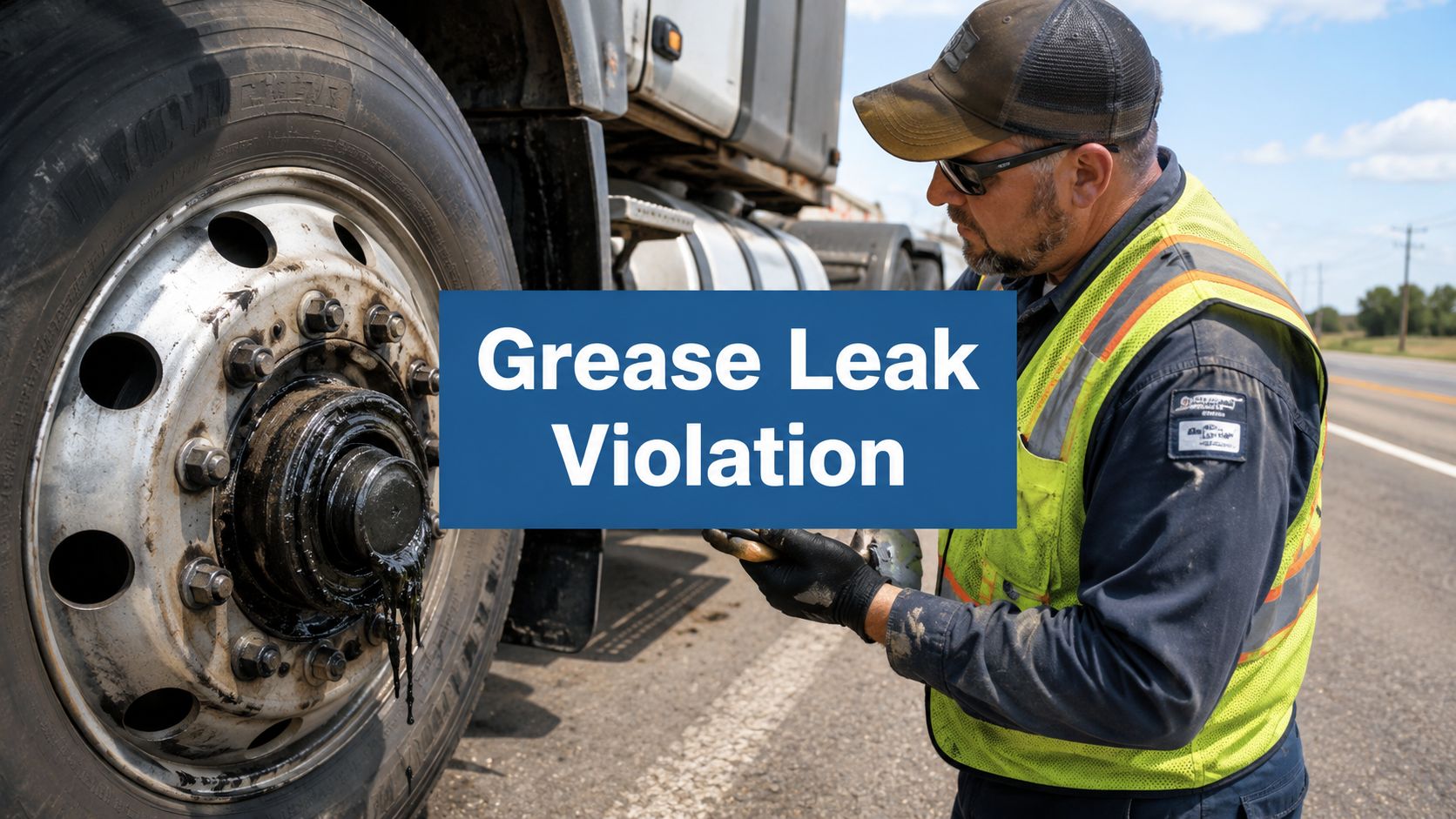
grease leak roadside inspection violation can put you out of service over something many fleets shrug off as “just a little seepage.” If you own trucks or manage safety, you already know how this goes. A unit leaves the yard, gets stopped, and now a wheel end or seal that looked minor has turned into downtime, repair calls, paperwork, and a mark against your operation.
What usually trips people up is simple. You assume dirty buildup is harmless, your shop says it’s been like that for a while, or your driver doesn’t know what matters during the inspection. Then the stop happens, and everyone starts arguing about whether it was fresh, active, or old residue.
This issue is more common than most fleets want to admit. In the 2025 International Roadcheck results from CVSA, inspectors identified 13,553 vehicle out-of-service violations, and oil and grease leaks remained a top violation category. CVSA data also shows that thousands of citations, often over 6,000 per year, are written for lubrication leaks alone. That tells you this isn’t a fringe problem. It’s a routine enforcement item. If you want fewer surprises, fewer preventable roadside delays, and better control over your CSA exposure, you need a system for the whole lifecycle. Prevention, inspection behavior, repair follow-up, and long-term control.
Introduction
A grease leak violation usually starts long before the roadside stop. It starts when a hub seal begins to weep, when a mechanic notes residue but doesn’t verify whether it’s active, or when your pre-trip process turns into a quick walk-around instead of a real inspection.
That’s why this violation frustrates owners so much. On the surface, it looks small. In practice, it can trigger an out-of-service event, create repair downtime, and add more pressure to your maintenance and compliance systems.
There’s also a big difference between what your team thinks an inspector will call a leak and what the inspection process targets. If your people don’t understand that difference, they’ll either miss real defects or waste time replacing parts that only look messy.
Practical rule: Treat every suspected grease leak as a compliance issue first and a repair issue second. You need to know whether it is active, where it is coming from, and how you’ll prove the condition if the stop is disputed later.
A solid response has four parts:
- Prevention in the yard: Catch wheel end, hub, and seal issues before dispatch.
- Control at the stop: Make sure your driver stays professional and documents the condition.
- Fast back-office follow-up: Repair it, certify it, and store proof correctly.
- Trend control over time: Find repeat units, repeat components, and repeat habits that keep causing the same violation.
When you handle grease leaks this way, you stop treating them like random bad luck. You start treating them like a manageable maintenance and safety process.
What Officially Counts as a Grease Leak Violation

The most important point is this. A dirty component is not automatically a roadside grease leak violation. The question is whether the inspector sees an active leak.
CVSA guidance is very specific on that point. A violation should not be written until seepage is great enough to form drops and drip during the inspection. The guidance also describes a practical way to check. The area is examined for wetness, wiped, and then rechecked to confirm whether the fluid is fresh and mobile rather than old residue or grime. You can review that standard in the CVSA inspection guidance on active leaks. This is a key defense that can be used if you try to DataQ this violation.
What inspectors are separating
In the field, there are really two conditions your team has to distinguish:
| Condition | What it means in practice | Risk level |
|---|---|---|
| Old contamination | Dry or tacky buildup, grime, or residue with no fresh drop formation | Lower, but still worth tracking |
| Active leak | Wet area with fluid mobility that forms drops and drips during inspection | High, because it can support a violation |
That sounds simple, but at this point, fleets often become careless. A wheel end can look ugly and still not meet the threshold. Another one can look minor from six feet away but produce fresh drops once it's checked closely.
What works in the shop and in the yard
When your team sees suspected leakage, use the same sequence every time:
- Locate the exact source area. Don't just write “wheel seal leaking.” Note whether it's the hub, axle seal area, backing plate area, or another nearby component.
- Check whether the fluid is fresh. Wet, mobile material matters more than caked residue.
- Observe for drop formation. If the truck is idling and the area continues to produce drops, you likely have a true active leak.
- Preserve evidence. Photos before cleaning, photos after cleaning, and repair notes matter if the violation is later challenged.
A lot of roadside arguments happen because nobody documented the source. They only documented the mess.
Old grime can make you suspicious. Fresh drop formation is what makes you actionable.
If you want your team to understand how these findings fit into broader out-of-service exposure, keep a reference like this DOT out-of-service violations list in your training materials. It helps people connect what they see in the shop to what happens on the shoulder.
Common trouble spots
The usual places to inspect closely are:
- Wheel hubs and hub caps: These are often the first place visible grease shows up.
- Axle seals: Leaks here can migrate and make diagnosis messy.
- Brake-adjacent areas: If leaking lubricant reaches brake components, your exposure gets worse fast.
- Trailer wheel ends: These often get less daily attention than the tractor and still create roadside trouble.
Your mechanics need one mindset. Don't label it by appearance alone. Verify whether it's active.
A Driver's Guide to Handling the Roadside Inspection
It is 2:15 a.m. Your driver is on the shoulder, an officer is looking at a greasy wheel end, and the call to the office starts with, “I think I'm getting written up.” That moment is not the time to debate seal design or argue about old residue. It is the time to control the stop, document the facts, and protect your options after the inspection.
Drivers cannot repair a wheel seal at roadside. They can keep a manageable inspection from turning into a bigger business problem.
What your driver should do during the stop
A roadside inspection is usually methodical, especially when the officer decides to look underneath the vehicle. Drivers should expect a process, answer what is asked, and stay steady. Tone matters. A cooperative driver gets clearer information, and clear information helps the shop fix the right issue and helps the office decide whether the citation should stand.
Give drivers a simple sequence to follow:
- Provide documents promptly: License, medical card if required, registration, shipping papers, and ELD information if requested.
- Listen for the exact defect: “Grease leak” is too vague for your internal follow-up. The driver should listen for the actual location and description.
- Ask one useful question: “Can you show me the area you're citing?” is respectful and usually gets a better answer than arguing.
- Call the office early: Safety or maintenance needs the location, unit number, and the officer's stated concern while details are fresh.
- Follow instructions closely: If the officer asks the driver to remain in the cab, step out, or move to a safer spot, do that without commentary.
I tell new owners the same thing every time. The roadside stop is won or lost by discipline, not by speeches.
What your driver should document
If the officer allows it and the scene is safe, documentation starts right there. Good notes help with three things later: diagnosis, repair verification, and any review of whether the violation was correctly written.
Have the driver capture:
- Photos of the area cited: Close shots and wider shots that show the wheel position, axle, and side of the unit
- The officer's description: Wheel seal, hub, brake contamination, or general grease leakage
- Basic stop details: Date, time, location, weather, unit number, trailer number, and inspection level if given
- Observed condition: Fresh wetness, active dripping, sling pattern, or old buildup
- Any immediate operating limits: Out-of-service status, movement restrictions, or instructions to repair before continuing
Clean, boring notes are the goal. Drivers do not need to write a defense statement on the shoulder.
What your driver should avoid
Some mistakes create more exposure than the leak itself.
- Do not argue the regulation on the roadside. The place to challenge a bad call is later, with records and photos.
- Do not guess. If the driver does not know how long the condition existed, the answer is, “I don't know.”
- Do not volunteer damaging opinions. Casual comments about poor maintenance or skipped inspections can end up hurting the carrier.
- Do not leave without the paperwork path clear. The driver should know where the report goes and who in the company needs it first.
That last point is where fleets often slip. The truck may get repaired, but the information from the stop never makes it back into training, maintenance review, or inspection prep.
For day-to-day coaching, pair this process with a commercial vehicle inspection checklist for drivers and fleet teams. It gives drivers a familiar routine before the officer ever finds a problem, and over time that routine reduces surprises, improves reporting, and helps you catch repeat wheel-end issues before they become another roadside event.
After the Stop Managing Repairs and CSA Damage Control

The roadside stop is over, but the business risk is just starting.
A grease leak violation creates four jobs at once. Get the equipment repaired, meet the paperwork deadline, protect your CSA record as much as the facts allow, and figure out why the leak made it to the roadside in the first place. Fleets that handle only the repair usually see the same problem again, either on another axle position or at the next inspection.
First, repair the defect and document the repair like it may be reviewed later
If the unit was placed out of service, keep it out until the defect is corrected and the repair is verified. If it was not placed out of service, treat it with the same discipline anyway. Wheel-end leaks have a habit of looking minor right up until contamination reaches the brakes.
The file should answer basic questions without anyone guessing later:
| Question | What your file should show |
|---|---|
| What failed | Specific leak source and affected area |
| What was done | Seal replacement, hub service, cleanup, brake inspection, or other corrective work |
| Who did it | Shop name or qualified technician identity |
| What proves completion | Work order, invoice, photos, technician notes |
I always want photos before cleanup if the shop can get them safely. Those pictures help in two ways. They support the correction record, and they often show whether the problem was an active leak, old residue, over-greasing, or a failed seal that should trigger a wider maintenance review.
Then handle the 15-day certification requirement
The repair is only half the job. FMCSA requires the carrier to certify the correction within 15 days and keep the signed report for one year, as noted earlier from the FMCSA Safety Planner.
That deadline gets missed for a simple reason. The truck is back in service, the office is buried, and the inspection paperwork sits in someone’s inbox until it is too late. Put one person in charge of collecting the inspection report, matching it to the repair order, submitting the certification, and saving the complete file in the right place.
A simple process works best. Inspection report. Repair record. Certification. Retention copy.
For fleets that want a consistent paper trail, use a DOT vehicle maintenance file checklist for post-inspection records so the same documents get saved every time.
Understand the CSA side before you decide your next move
A grease leak violation does more than create a repair bill. It adds to your vehicle maintenance history, and that record affects how enforcement and insurers view your operation over time.
Do not waste energy challenging a violation that is plainly supported by the facts. Fix it, certify it, and look at why your controls failed.
Challenge it only when the record supports a challenge. Good examples include residue mistaken for an active leak, the wrong component identified, or shop findings that directly conflict with the inspection description. DataQs is not a place for frustration. It is a place for organized evidence.
Build that case with:
- Photos from the inspection or immediately after the stop
- Shop findings after teardown or close inspection
- Repair notes that identify the actual condition
- A clear timeline showing what was found and what was corrected
The office should treat every grease leak violation like a case file, not a loose stack of papers.
Use the event to find the control failure
This is the part that separates a one-truck repair from fleet management.
After the unit is fixed, review what allowed the defect to reach the roadside. Did the driver miss fresh wetness on the pre-trip. Did the shop service the hub recently and fail to catch a bad seal or poor cleanup. Is one trailer showing repeat wheel-end problems. Is one vendor sending equipment back with thin write-ups and no root cause?
Watch for patterns such as:
- Same trailer getting repeated wheel-end findings
- Same vendor returning units with poor cleanup or weak diagnosis
- Same driver missing obvious wetness during inspections
- Same axle positions showing repeat failures
That review closes the lifecycle. The stop creates the record. The repair closes the defect. The follow-up tells you what to retrain, what to inspect harder, and which maintenance habits are costing you inspections.
Your Proactive Grease Leak Prevention Program

If you want fewer grease leak roadside inspection violations, your answer isn’t “tell the shop to look harder.” You need a repeatable program that separates quick driver checks from deeper maintenance inspection.
What you want your drivers to catch
Your pre-trip doesn’t need to become a teardown. It does need to become intentional.
Have your drivers focus on what can be seen, smelled, or felt during a normal walk-around:
- Wheel end appearance: Look for fresh wetness around hubs, lug area, and inside wheel surfaces.
- Ground evidence: Check for fresh drops or small trails where the unit was parked.
- Brake-adjacent contamination: Any sign that lubricant has moved toward brake components should trigger immediate reporting.
- Change from yesterday: A component that was dirty last week but is wet today needs attention.
Give your drivers one simple instruction. Don’t diagnose the part. Report the condition.
A formal DOT pre-trip inspection process helps because it turns “take a look” into an actual routine.
What your mechanics should verify during PM
The shop needs a different standard. Mechanics should be confirming source, severity, and consequence.
Here’s a practical PM focus list:
- Clean first where needed: You can’t diagnose an active leak through layers of old grime.
- Inspect seals and wheel ends closely: Check for fresh lubrication movement, not just staining.
- Look for migration: Follow the fluid path. The visible mess is not always the source.
- Check nearby brake condition: If grease has moved into the brake area, your risk profile changes.
- Road test and recheck when appropriate: Some leaks only show themselves after operation.
Build training around real trade-offs
Seasoned fleets achieve cost savings through effective management. You don’t want your team overcalling every dirty hub and creating unnecessary parts replacement. You also don’t want them normalizing actual wet leaks because “it’s not that bad yet.”
Use side-by-side examples in training:
| Situation | Wrong response | Better response |
|---|---|---|
| Old dry buildup | Replace parts immediately without verification | Clean, inspect, monitor, document |
| Fresh wetness with mobility | Keep dispatching until next service | Pull for inspection and repair decision |
| Repeat residue after recent repair | Assume “that’s normal” | Audit workmanship, torque, seal installation, and parts quality |
That kind of training is more useful than generic reminders to “do a better pre-trip.”
Good prevention is not guessing less. It's verifying more.
Use systems, not memory
This violation tends to expose weak process control. Paper DVIRs get lost. Mechanics note “leak checked” without photos. The office can't tell if the same trailer has had three wheel-end issues in six months because the records live in different places.
A practical setup includes:
- Driver reports with photos
- Maintenance work orders tied to unit number
- Repair proof stored in one place
- Recurring issue review during safety meetings
- Dispatch hold process for unresolved active leaks
If you want one platform-based option for tying inspections, maintenance records, and compliance follow-up together, My Safety Manager is built around that kind of tracking. Its true value isn't the software by itself. It's having one workflow that keeps the driver, shop, and office working from the same record.
Where technology actually helps
Technology won't stop a seal from failing. It will help you control what happens around that failure.
The best use cases are practical:
- Photo-backed DVIRs: Better than vague handwritten notes
- Maintenance alerts: Useful for recurring wheel-end defects
- Repair status visibility: Dispatch can see whether the defect is cleared
- Retention: Easier access if you need records later
- Trend review: You can spot repeat vendors, repeat units, and repeat failure points
That's how you turn leak prevention into a management process instead of a guessing game.
Conclusion Protecting Your Fleet and Bottom Line
A grease leak roadside inspection violation is rarely about one bad moment on the shoulder. It usually points to a weak handoff somewhere between the driver, the shop, and the office.
If you tighten that chain, you reduce a lot more than leak citations. You reduce downtime, repeat repairs, paperwork failures, and ugly conversations with insurers. You also give your team a clearer standard. Fresh active leakage gets handled. Old residue gets verified before anyone panics. Roadside stops get documented. Repairs get certified and retained.

That same systems mindset helps in other parts of your business too. If you're improving your operation's visibility to shippers and local customers, a practical resource on building a business website to win jobs can help you think about how your company presents itself beyond compliance.
For day-to-day fleet control, the primary win is simple. You need one place to track inspections, defect reports, repair proof, and follow-up tasks so nothing falls through the cracks. That's what keeps a small leak from turning into a bigger business problem.
Frequently Asked Questions
Can you get a grease leak violation for residue only
Usually, the key issue is whether the leak is active. CVSA guidance says the seepage should be great enough to form drops and drip during the inspection before the violation is written.
What parts most often lead to this violation
Wheel hubs, axle seals, and wheel-end areas are common trouble spots. Any area where lubricant can move outward and become visibly wet deserves close attention.
Is a wheel-end grease leak more serious if brakes are involved
Yes. If leaking grease can affect brake components or wheel-end integrity, your exposure is worse. Even before a formal finding, that should move the unit to the front of your repair line.
Should your driver argue if the officer calls it a leak
No. Your driver should stay professional, ask respectful clarifying questions, document the area if safe, and notify the office. The roadside shoulder is not the place to debate standards.
How fast do you need to handle the paperwork after a violation
You need to move quickly. FMCSA requires carriers to certify corrections within 15 days and keep the signed report for one year.
Can one grease leak really affect CSA and insurance
Yes. A grease leak violation can negatively affect your Vehicle Maintenance BASIC score, and that can contribute to higher insurance premiums.
Can you challenge an incorrect grease leak violation
Yes, if you have evidence. Photos, shop findings, repair notes, and clear documentation of the actual condition give you a much stronger position if the finding was wrong.
Does this only apply to the tractor
No. Trailer wheel ends and other equipment areas can create the same kind of maintenance exposure. Your prevention program should cover every unit you dispatch.
Regulatory References
- 49 CFR 396.3. Inspection, repair, and maintenance. View on the eCFR
- 49 CFR 396.5. Lubrication of motor vehicles. View on the eCFR
- 49 CFR 396.11. Driver vehicle inspection report. View on the eCFR
- 49 CFR 396.17. Periodic inspection. Review the annual inspection requirement here
- 49 CFR 396.9. Inspection of motor vehicles and intermodal equipment in operation. View on the eCFR
If you want help turning grease leak prevention, roadside documentation, repair certification, and maintenance tracking into one clean process, take a look at My Safety Manager. It gives you a practical way to stay ahead of violations instead of chasing them after the stop.
