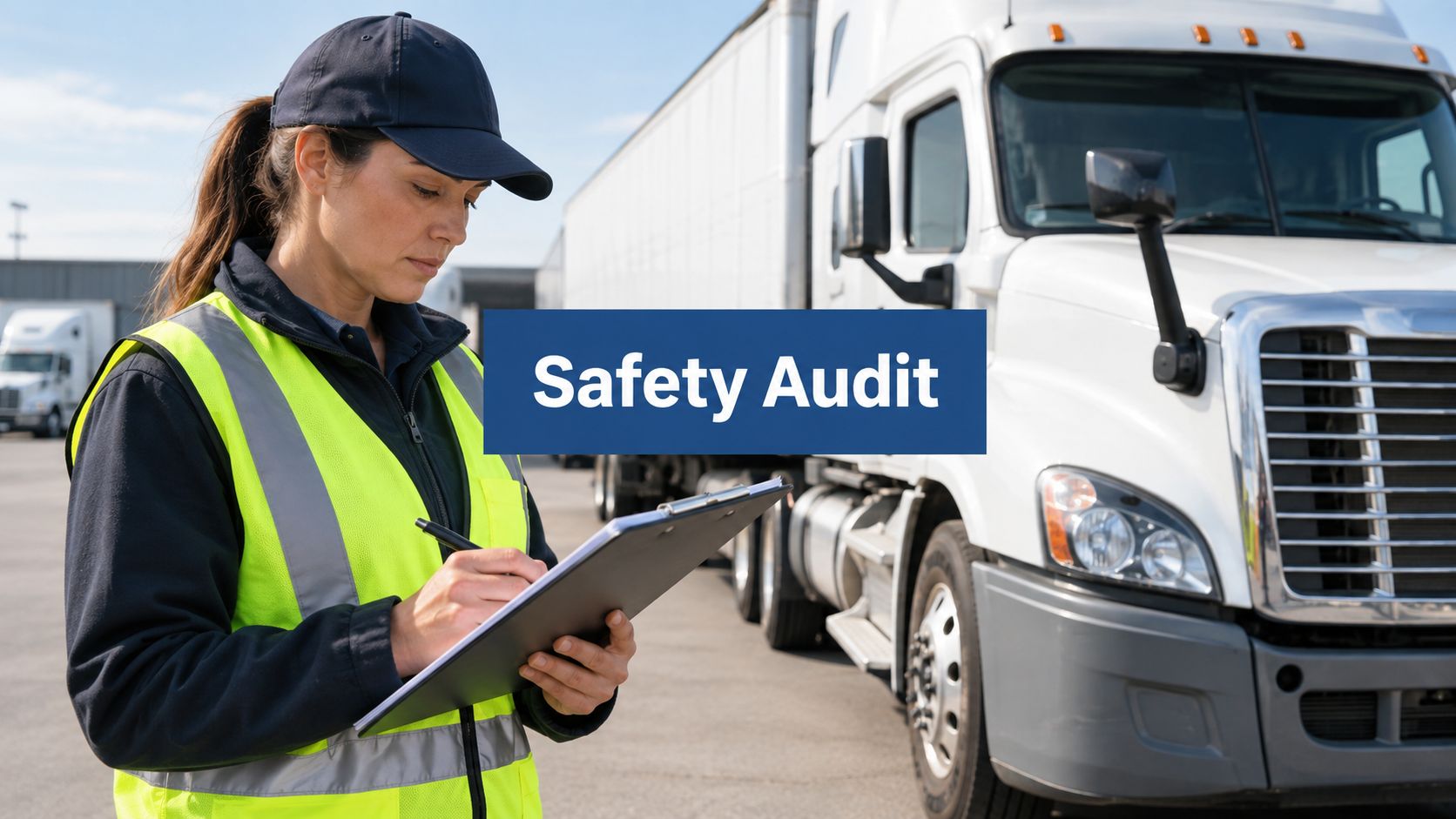
FMCSA new entrant safety audit preparation can determine whether your new trucking operation keeps moving or gets forced into corrective action before your systems are ready. Fleet owners and safety managers often discover the risk when an audit notice arrives and one driver file, maintenance record, or testing document isn't complete.
The common mistake is treating every compliance task as equally important. FMCSA has identified 16 essential regulations where a failure can automatically fail the audit, so a polished policy binder won't protect you if one critical control is missing. You need working procedures, current records, and evidence that your team follows them during daily operations.
The audit is a review of your safety management controls and required records, not a test of how well you can recite regulations. This guide maps the review to the highest-risk failure points, explains the timing, and gives you a practical preparation plan.
Table of Contents
- What the FMCSA New Entrant Safety Audit Actually Is
- Who Must Complete the Audit and When It Happens
- The 16 Essential Regulations That Trigger Automatic Failure
- How FMCSA Conducts the Safety Audit Step by Step
- Documentation Checklist by Audit Area
- What Passing or Failing Really Means for Your Operation
- A 90-Day Preparation Plan to Pass on the First Try
- FAQ, Regulatory References, and Next Steps
What the FMCSA New Entrant Safety Audit Actually Is
The FMCSA new entrant safety audit checks whether your carrier has basic safety management controls in place. FMCSA reviews a sample of records and operating evidence connected to the Federal Motor Carrier Safety Regulations, applicable hazardous materials rules, and related recordkeeping requirements. The agency specifically identifies areas such as driver qualification, duty status, vehicle maintenance, accident records, and controlled-substance and alcohol testing in its Safety Planner audit guidance.
That makes the audit broader than a paperwork review. Your written policies matter, but the auditor also needs to see that your procedures are functioning. A driver qualification policy without complete qualification files, or a maintenance plan without inspection and repair records, leaves a gap between what you say and what you do.
The audit is part of the New Entrant Safety Assurance Program. FMCSA generally conducts it during the first 12 months for property carriers. The program is designed to verify that you have basic controls before your operation builds a long record of roadside inspections, trips, and safety activity. It is separate from a broader compliance review or ongoing safety-data monitoring.

What the auditor is really testing
Think of each audit area as a control loop:
- Qualification: You confirm that your people are legally and medically qualified before dispatch.
- Hours of service: You monitor duty status and supporting records for accuracy.
- Maintenance: You identify defects, document repairs, and keep equipment inspected.
- Testing: You operate a compliant controlled-substances and alcohol program.
- Recordkeeping: You can produce reliable evidence when FMCSA asks for it.
If you need a plain-language foundation for the wider subject, review this explanation of what DOT compliance includes. The important point is simple: the auditor is measuring operational readiness, not just regulatory knowledge.
Who Must Complete the Audit and When It Happens
The New Entrant Program generally applies to new motor carriers operating in interstate commerce, including for-hire property carriers, passenger carriers, and certain intrastate carriers subject to Federal Motor Carrier Safety Regulations. Whether you fall inside the program depends on your operating authority, vehicle activity, and the federal rules that apply to your operation.
For property carriers, FMCSA states that the safety audit occurs within the first 12 months of starting operations. Passenger carriers face a shorter timeline in FMCSA guidance, while the broader new entrant monitoring period lasts 18 months. These are different concepts. The audit is the compliance checkpoint, while the monitoring period continues after the checkpoint.
FMCSA controls the scheduling process. You shouldn't assume you can choose the audit date or wait until your records look mature. Your systems need to operate from the beginning because the auditor may use actual business records to assess whether your controls are adequate.
| Carrier Type | Window to Complete Audit | Monitoring Length | Why the Difference |
|---|---|---|---|
| Property carrier | Within the first 12 months | Under 18 months of new entrant monitoring | FMCSA uses early operating records to verify basic controls |
| Passenger carrier | Shorter timeline in FMCSA guidance | New entrant monitoring continues under the applicable program rules | Passenger operations receive an earlier safety review because of the nature of the service |
| Intrastate carrier subject to federal safety rules | The applicable FMCSA scheduling window | Program coverage depends on federal safety-rule applicability | State location alone doesn't determine whether federal requirements apply |
Carriers operating only in commerce outside the program's scope, some farm-to-market operations, and certain government carriers may qualify for different treatment or exemptions. You should confirm your status rather than relying on an informal assumption that “intrastate” automatically means exempt.
Your USDOT number is central to the process, so make sure you understand what a USDOT number is, when it becomes active, and how it connects to your operating activity. If FMCSA hasn't completed the audit by the end of the monitoring period through no fault of your own, FMCSA says you may continue operating as a new entrant until the audit is completed and a final determination is made. A satisfactory result doesn't end oversight. FMCSA continues monitoring your safety performance for the remainder of the new entrant period.
The 16 Essential Regulations That Trigger Automatic Failure
The most important preparation insight is that the 16 essential regulations aren't an ordinary point-based checklist. FMCSA treats these rules as essential basic safety-management controls, and failure to comply with any one can produce an automatic audit failure, as described in the agency's Federal Register notice on new entrant safety assurance.
You don't need to spend equal preparation time everywhere. Start with the controls that can independently sink the result.
Driver qualification
Your qualification system should prove that each person operating a covered commercial vehicle has the required credentials and screening. That usually means a complete qualification file, valid CDL information where required, medical qualification evidence, employment-history review, and road-test documentation.
The auditor isn't looking only for a blank form. The file should show dates, signatures, supporting records, and a clear connection to the person you dispatched. A missing medical document or unresolved licensing issue can outweigh otherwise orderly files. Use a dedicated driver qualification file checklist to inspect each file from the auditor's point of view.
Hours of service and records
Your hours-of-service process must connect dispatch activity, duty-status records, and supporting documents. Review whether records are complete, whether corrections are explainable, and whether your written procedure tells you how to handle exceptions.
A record that looks clean but doesn't match fuel, toll, payroll, or trip information can create questions. Reasonable evidence means your documents tell the same operational story.
Vehicle maintenance
Your maintenance control should cover inspections, defects, repairs, and follow-up. Keep records organized by unit number so an auditor can trace a reported problem to the repair and return-to-service decision.
Controlled substances and alcohol
You need an active testing program with the required procedures and records. Pay particular attention to pre-employment, random, and post-accident processes, along with evidence that your team knows who is responsible for each step.
Insurance and operating authority
Your insurance and registration records must be current and consistent with the operation shown in your FMCSA filings. A policy that exists somewhere in an email account isn't useful if no one can produce the applicable filing or verify its status.
Practical rule: Treat each essential regulation as a separate stop sign. One unresolved critical gap can control the audit outcome even when the rest of your program is organized.

How FMCSA Conducts the Safety Audit Step by Step
The audit usually begins with notification and a request for information. Read the letter carefully, identify the response deadline, and assign one person to coordinate communication. If FMCSA asks for electronic records, don't send a scattered collection of files with unclear names. Build a response package that lets the reviewer locate each record quickly.
The review may occur at your principal place of business or through an off-site document process, depending on the assignment and the size or structure of the operation. Your location matters less than your readiness. A remote review can still expose the same missing qualification, HOS, maintenance, testing, or insurance controls.
A practical four-phase walkthrough
- Notification and preparation: Confirm the audit contact, deadline, requested records, and preferred delivery method. Gather your core files before you begin answering individual questions.
- Records submission: Provide complete, readable documents in the requested format. Keep a copy of everything submitted and record the date of delivery.
- Review and verification: The auditor examines sampled driver files, duty-status records, testing documents, maintenance evidence, and related operating records. Be ready to explain who performs each control and how exceptions are corrected.
- Determination: FMCSA communicates the result and any corrective-action requirements. An exit discussion may identify deficiencies, but you should wait for the written determination before treating an issue as resolved.
A single compliance binder, whether physical or electronic, can save time. Organize it by audit area, then add an index showing the record owner, date range, and location. Your goal is to produce evidence in minutes instead of searching through inboxes, glove boxes, and disconnected folders.
For a broader preparation workflow, use this guide to preparing for a DOT audit. It can help you assign ownership before the request arrives.

Documentation Checklist by Audit Area
Your pre-audit review should answer one question for every area: Can you produce current, consistent evidence without relying on memory? Mark each group “must be available at audit” and give one person responsibility for keeping it current.
Driver qualification
Keep CDL information, medical certificates, applications, employment verification, road-test certificates, MVR reviews, and applicable safety-history records together. Check expiration dates before the audit notice arrives. A file should make it obvious that you verified qualification before allowing operation.
Hours of service
Retain duty-status records, supporting documents, exception documentation where used, and your written HOS policy. Compare the records with dispatch and trip information. If your team uses an exception, preserve the evidence showing why the exception applied.
Vehicle maintenance
Maintain a written inspection, repair, and maintenance program. Keep periodic inspection evidence, roadside inspection reports, DVIRs, defect corrections, and repair invoices tied to vehicle numbers. The record should show what was found, what was repaired, and who released the unit for service.
Drug and alcohol testing
Maintain your written testing policy, consortium enrollment evidence where applicable, pre-employment and random testing records, annual query evidence, and supervisor training documentation. Keep confidential testing information secured, but make sure authorized reviewers can access it.
Insurance and authority
Keep your applicable financial-responsibility filing, process-agent designation, UCR registration, and current operating-authority information. If you're reviewing coverage while preparing, this truck insurance guide from ISU Insurance can help you identify policy and filing questions to raise with your insurance professional.
| Audit Area | Required Records | Retention | Governing Rule |
|---|---|---|---|
| Driver qualification | Qualification files, CDL and medical evidence, MVR and road-test records | Keep according to the applicable recordkeeping rule and current FMCSA requirements | 49 CFR Part 391 |
| Hours of service | Duty-status records, supporting documents, exception evidence | Keep according to the applicable HOS recordkeeping rule | 49 CFR Part 395 |
| Vehicle maintenance | Inspection, repair, DVIR, roadside inspection, and periodic inspection records | Keep according to the applicable inspection and maintenance requirements | 49 CFR Part 396 |
| Drug and alcohol | Testing policy, testing records, training evidence, program records | Protect confidentiality and retain under applicable testing rules | 49 CFR Part 382 |
| Insurance and authority | Financial-responsibility filing, process-agent, UCR, and authority records | Keep current while operating | Applicable FMCSA registration and insurance rules |
Use a structured DOT audit checklist to turn these categories into assigned tasks rather than a last-minute document hunt.
What Passing or Failing Really Means for Your Operation
FMCSA's reported results show that the program has become stricter and operates at substantial scale. The agency reported 34,478 audits with a 67.8% pass rate in 2011, 34,248 audits with a 75.4% pass rate in 2012, and 28,857 audits with an 82.3% pass rate in 2015. More recent FMCSA reporting lists 63,672 audits in 2022 with a 92.2% pass rate and 58,600 audits in 2023 with a 91.3% pass rate. FMCSA's 2024 safety research forum materials also showed 72,566 carriers in the New Entrant Program and 2023 outcomes of 91.3% pass and 8.7% fail. These figures appear in FMCSA's historical New Entrant Safety Audit report.
The numbers don't guarantee your result. They do reinforce a practical lesson: organized controls and usable records matter more than a last-minute binder assembly.
| Outcome | Authority Status | Monitoring Period | Business Impact |
|---|---|---|---|
| Pass | FMCSA issues written notice of adequate basic safety controls, no later than 45 days after completion | Monitoring continues for the remainder of the 18-month new entrant period | You continue operating while maintaining the controls that produced the satisfactory result |
| Fail | Corrective-action evidence is required for each violation causing the failure; unresolved deficiencies can lead to registration revocation | New entrant oversight continues while the matter is addressed | Dispatch, authority, and cash flow can be disrupted if corrective action isn't accepted |
| No completed response | FMCSA can treat missing cooperation or evidence as a serious compliance problem | Monitoring and enforcement risk remain active | Your operation may face escalating scrutiny instead of a clean determination |
FMCSA says a passing carrier remains closely monitored after the audit. A failing carrier must submit evidence addressing every violation that caused the failure, so don't respond with a general promise to improve. Match each corrective action to a specific deficiency and preserve proof.
A 90-Day Preparation Plan to Pass on the First Try
Start before you receive an audit notice. A short, assigned work plan gives you time to find patterns, correct them, and prove that the correction is working.
Days 1 through 30, build the foundation
Set up your driver qualification file system, confirm your operating registrations, establish your testing responsibilities, and create a maintenance-control process. Pull current qualification information and make sure your insurance filings match the operation you run.
Assign an owner to each area. The fleet owner can oversee authority and insurance, a safety manager can control qualification and HOS records, and a maintenance lead can own inspections, repairs, and DVIR follow-up.
Days 31 through 60, operate the controls
Put the procedures into daily use. Record inspections, document repairs, review duty-status records, and complete required testing steps before dispatch. Then run an internal review against the 16 essential regulations, starting with automatic-failure risks.
Use short training sessions to explain what your team must record and when. If you're building internal learning materials, these safety training tips for L&D teams can help you structure practical instruction around repeatable procedures.
Days 61 through 90, verify the evidence
Assemble folders by audit area, compare records for consistency, and perform a mock interview. Ask your team who owns each control, where the evidence is stored, and what happens when a defect or missing document is found.
During the final 48-hour check, print a current safety snapshot, organize labeled folders, charge devices, confirm contact information, and rehearse the records walkthrough. Don't let one person carry the whole process without backup. A clear owner should exist for every task, with a second person able to produce the evidence.

FAQ, Regulatory References, and Next Steps
How long does the FMCSA new entrant safety audit take?
FMCSA's official materials focus on the records and safety controls reviewed, not a universal on-site duration. The time required depends on the scope of the review, the records requested, and how quickly you can produce complete evidence.
Does the audit happen at your terminal?
FMCSA may review records at your principal place of business or request electronic submission. Follow the instructions in your notice and keep the same organized files available for either format.
What happens if you fail the audit?
You must provide corrective-action evidence for every violation that caused the failure. If you don't cure the deficiencies, FMCSA can take steps that may include revocation of your U.S. DOT registration, as explained on the FMCSA New Entrant Safety Assurance Program page.
How long does monitoring continue after you pass?
Your safety performance remains closely monitored for the rest of the 18-month new entrant registration period. Passing confirms adequate basic controls at the audit checkpoint, but it doesn't end oversight.
Does the audit apply to intrastate-only carriers?
It can apply when an intrastate carrier is subject to the federal safety regulations covered by the New Entrant Program. Confirm your status with the applicable FMCSA and state requirements rather than assuming that intrastate operation alone creates an exemption.
Regulatory References
- 49 CFR Part 385, Subpart D, the New Entrant Safety Assurance Program.
- 49 CFR Part 391, driver qualification requirements.
- 49 CFR Part 395, hours-of-service requirements.
- 49 CFR Part 396, inspection, repair, and maintenance requirements.
- 49 CFR Part 382, controlled-substances and alcohol use and testing requirements.
Use this guide to complete your file review, assign owners, and schedule a mock audit before FMCSA contacts you.
My Safety Manager helps carriers manage driver qualification records, drug and alcohol program tasks, CSA-related compliance work, training, and vehicle-maintenance monitoring through an online compliance program. Visit My Safety Manager to review support options for your FMCSA new entrant safety audit and turn the checklist into an ongoing process.
