Fleet safety program owners and safety managers know the frustrating scenario. You have a thick binder, annual MVR reviews, a drug-testing contract, and forms for nearly every event, yet your fleet keeps collecting Unsafe Driving and HOS Compliance BASIC problems. The paperwork looks complete until you ask who reviewed the last alert, who coached the person involved, and where the follow-up was documented.
That gap is common. Policies get written by someone outside the operation, dispatchers inherit coaching without time or training, and managers collect KPIs nobody uses to make a decision. Technology creates more alerts, but not necessarily better habits.
A working fleet safety program is an execution system, not a document. You connect written rules, daily workflows, named ownership, coaching, maintenance, and KPIs to the same regulatory lens, the seven CSA BASICs. The blueprint below shows how to build that connection and keep it operating after the binder goes back on the shelf.
Table of Contents
- Why Most Fleet Safety Programs Stay on Paper
- Written Policies and Driver Qualification Files That Hold Up
- Hours of Service and Drug and Alcohol Program Controls
- Training and Coaching That Actually Changes Driver Behavior
- Vehicle Inspections and Maintenance Records That Satisfy DOT
- KPIs and Reporting That Prove the Program Is Working
- Turning Your Program Into a Daily Operating System
- Frequently Asked Questions About Fleet Safety Programs
- What is a fleet safety program?
- Who should own a fleet safety program?
- What are the seven CSA BASICs?
- How often should you review ELD data?
- What belongs in a Driver Qualification File?
- How long should you retain qualification records?
- What should happen after a telematics alert?
- What vehicle records should you keep?
- When does a BASIC require corrective action?
- Can technology replace safety training?
- Regulatory References
Why Most Fleet Safety Programs Stay on Paper
Consider a 40-truck regional hauler with a three-inch safety binder. The owner has an annual MVR pull, a drug-testing contract, written HOS procedures, and a stack of inspection forms. On paper, the operation appears prepared. In practice, the fleet continues to receive Unsafe Driving and HOS Compliance BASIC hits because nobody has turned the rules into repeatable decisions.
The failure usually starts with ownership. A consultant writes a policy, leadership approves it, and the safety manager stores it. Dispatch handles scheduling, maintenance handles defects, supervisors handle complaints, and nobody owns the complete loop from risk signal to corrective action. When a harsh-braking event appears, the notification may be reviewed days later, or not at all. When an ELD exception appears, someone fixes the log without identifying why the event happened or whether the same scheduling practice affects others.
Practical rule: If you can't name the person responsible for reviewing a signal, contacting the affected employee, documenting the action, and checking the result, you don't have a control. You have an expectation.

CSA BASICs are the operating backbone
The FMCSA CSA framework organizes carrier safety data into seven Behavior Analysis and Safety Improvement Categories, or BASICs. Those categories use inspection violations, crash reports, and investigation results to identify safety performance concerns. For most BASICs, the intervention threshold is the 80th percentile. HOS Compliance uses 75, while Driver Fitness and Crash Indicator use 65. Crossing an applicable threshold can lead to investigations and potential off-site reviews.
Your program should assign a practical control to each category:
| CSA BASIC | Operating control |
|---|---|
| Unsafe Driving | Telematics review, policy enforcement, and documented coaching |
| HOS Compliance | Schedule planning, ELD exception review, and fatigue intervention |
| Driver Fitness | Qualification files, MVR review, and medical-card tracking |
| Controlled Substances and Alcohol | Testing procedures, records, and status verification |
| Vehicle Maintenance | DVIR review, defect triage, repairs, and preventive maintenance |
| Hazardous Materials Compliance | Shipment, loading, communication, and emergency procedures |
| Crash Indicator | Incident investigation, root-cause review, and corrective action |
The point isn't to chase a score in isolation. FMCSA's online safety data resources reflect the broader shift from informal accident tracking toward data-driven oversight. A carrier's risk picture includes crash rates, inspection findings, driver behavior, and other safety-performance indicators.
Every policy, training entry, alert, and KPI should answer one question: which BASIC does this control protect, and what action follows when performance moves the wrong way?
The seven-step blueprint
Build the program in this order:
- Assign ownership for every BASIC and corrective action.
- Close qualification gaps before a driver operates under your authority.
- Control HOS and testing workflows through scheduled reviews.
- Coach specific behavior instead of sending generic reminders.
- Tie inspections to repairs and keep maintenance evidence organized.
- Review a concise KPI scorecard with operations and maintenance.
- Repeat the cadence daily, weekly, monthly, and quarterly.
A university research report on fleet safety describes a telecommunications fleet of about 3,600 drivers tracked over two years before and two years after intervention. The driver-training, group-discussion, and bonus-based groups all reduced crash rates and crash costs, with the discussion-group method producing the strongest safety benefit. The report also cites a separate company example where crashes fell by 79% between 2000 and 2005 while the fleet vehicle count increased by 68%, showing why structured management, training, and monitoring matter as operations grow. Read the fleet safety research report for the underlying examples.
Written Policies and Driver Qualification Files That Hold Up
A defensible fleet safety program starts with rules people can follow and records an auditor can retrieve. Your written policy should address seatbelts, distracted driving, cell phone use, speeding, collision reporting, vehicle inspections, HOS and ELD use, drug and alcohol testing, corrective action, and the authority to remove a person or vehicle from regulated service.
The discipline matrix matters because inconsistent enforcement undermines trust. Define how you respond to a first event, repeated behavior, a preventable crash, falsification, and a serious safety violation. Keep incident investigation separate from automatic punishment where possible, so you can identify route, equipment, scheduling, or training causes without discouraging near-miss reporting.
Build every DQ file as an active record
Under 49 CFR Part 391, maintain a Driver Qualification File for each CDL driver. The file should contain the completed employment application, a road-test certificate or accepted equivalent, a valid CDL with the appropriate endorsements, the current DOT medical examiner's certificate, MVRs from each state where you held a license during the prior three years, and Safety Performance History inquiries to prior DOT employers covering the previous three years.
Industry guidance also identifies a 30-day MVR review after hiring and an annual review as core qualification controls. Keep general DQ records for the duration of employment plus three years, while drug and alcohol program records generally require five-year retention for applicable records. Verify the specific retention rule for each record type before purging anything.
Use this driver qualification file management resource to structure the file, and keep a practical field team compliance checklist available for supervisors who collect records away from the main office.

Hours of Service and Drug and Alcohol Program Controls
HOS Compliance improves when you manage the duty clock before the violation appears. For property-carrying operations, your scheduling and ELD review should enforce no more than 11 hours of driving after 10 consecutive hours off duty, no driving beyond the 14th consecutive hour, and a 30-minute break after 8 cumulative hours of driving. The weekly limit is 60 hours in 7 days or 70 hours in 8 days, unless a qualifying restart applies.
Review ELD exceptions weekly, including form-and-manner issues, unidentified driving, edits, missed breaks, and approaching cycle limits. A useful checklist records the date, person reviewing, exception type, cause, correction, coaching decision, and closure date. Don't treat a corrected log as a completed safety action if the scheduling cause remains.
Your drug and alcohol workflow should track pre-employment checks, random testing, reasonable suspicion, post-accident testing, return-to-duty, and follow-up testing under 49 CFR Part 382. Clearinghouse controls include a full query before employment and a limited query at least annually. Post-accident testing can be triggered by a fatality, or by a citation combined with a tow and bodily injury requiring medical attention.

Maintain a Clearinghouse log with the person, query type, date, result, reviewer, and required follow-up. Your DOT drug and alcohol program should make those entries routine rather than dependent on memory.
Training and Coaching That Actually Changes Driver Behavior
A harsh-brake alert is only useful when someone turns it into a fair, timely conversation. Suppose an alert arrives from a delivery run. The safety manager reviews the clip, checks the person's event history for the prior 30 days, and schedules a one-on-one within 72 hours using the InGen X-2 driver coaching form.
The conversation follows three steps:
- State what the data shows without judgment.
- Ask for the person's explanation of traffic, routing, weather, and timing.
- Agree on one specific behavior change and define how you'll measure it.
The manager documents the event and response in the file, sets a 14-day review window, and measures subsequent events per 1,000 miles. That process protects the fleet from both extremes. Ignoring the alert wastes useful information, while automatic punishment can make people hide context and resist future reporting.
Coaching works when the person leaves knowing exactly what to do differently and when you'll check whether it happened.
Training still provides the foundation. Complete new-hire orientation within 14 days, refresh HOS and roadside-inspection knowledge annually, provide HazMat recurrent training every 3 years where applicable, and assign remedial training when a BASIC crosses its intervention threshold. Use driver safety training programs to organize assignments and completion evidence.
Keep coaching distinct from a return-to-duty process. A performance conversation isn't automatically a substance-abuse violation. If a regulated substance event requires return-to-duty action, follow the SAP process and applicable Part 382 requirements. Apply qualification and discipline standards consistently, and document legitimate safety criteria rather than making assumptions about protected characteristics or medical status.
Vehicle Inspections and Maintenance Records That Satisfy DOT
Your daily inspection process should start before the first trip. Under 49 CFR Part 396.11, check the brake system, coupling devices, lights and reflectors, tires, horn, mirrors, steering, and windshield wipers, along with other required equipment for the unit. Record defects on the DVIR, route safety-critical defects to a mechanic, and require sign-off before returning the vehicle to service when the defect affects safe operation.
The formal maintenance file should show more than a completed shop ticket. Under 49 CFR Part 396, carriers must systematically inspect, repair, and maintain commercial motor vehicles, retain maintenance records, and complete a periodic inspection at least once every 12 months. Keep proof of that inspection in the vehicle. Use qualified brake inspectors for brake inspection work under the applicable requirements.
Organize records by VIN or unit number:
- Inspection records: Daily DVIRs and annual inspection evidence.
- Repair evidence: Work orders, road-call receipts, and parts invoices.
- Preventive maintenance: Scheduled service, meter readings, and overdue-item follow-up.
- Defect closure: Reported defect, severity, repair decision, mechanic sign-off, and return-to-service date.
The vehicle maintenance records process should make it easy to connect a roadside finding to the inspection, repair, and preventive-maintenance history.
| Record Type | Minimum Retention |
|---|---|
| Daily inspection and DVIR records | Retain according to applicable Part 396 requirements and your recordkeeping policy |
| Maintenance and repair records | At least the applicable period required by Part 396 |
| Periodic inspection proof | Current proof maintained as required for the vehicle |
| Parts and repair invoices | Retain with the unit's maintenance history |
| Defect closure documentation | Keep with the related inspection and repair record |
Your Vehicle Maintenance BASIC improves through closed defects, not through a larger folder. Review PM compliance, repeat repairs, open safety defects, and roadside out-of-service findings together so the shop can address patterns rather than isolated tickets.
KPIs and Reporting That Prove the Program Is Working
A useful KPI earns a place on the monthly agenda by changing a decision. Keep the scorecard concise and connect each metric to a BASIC, an owner, and a response.
Review these eight measures:
- Driver out-of-service rate: Out-of-service driver inspections divided by total driver inspections.
- HOS violation rate: HOS violations per 1,000 ELD days.
- Preventable accident rate: Preventable crashes divided by your chosen exposure measure.
- Crashes per million miles: Crashes divided by miles traveled, normalized for fleet activity.
- Roadside inspection violation rate: Violations divided by inspections.
- BASIC percentile trend: Current percentile compared with prior review periods.
- Drug and alcohol completion rate: Required tests completed divided by tests due.
- Maintenance deferral rate: Safety-related work deferred divided by safety-related work identified.
Set action thresholds before the meeting. A Driver OOS rate above 10% requires immediate retraining. An Unsafe Driving BASIC above the 80th percentile requires targeted telematics coaching. A missed random-testing quarter means removing affected personnel from regulated duty until the required process is complete.
| KPI | Calculation | Action Threshold |
|---|---|---|
| Driver OOS rate | OOS driver inspections ÷ total driver inspections | Above 10%, retrain immediately |
| HOS violation rate | HOS violations ÷ 1,000 ELD days | Investigate rising trend |
| Preventable accident rate | Preventable crashes ÷ selected exposure | Assign root-cause review |
| Crashes per million miles | Crashes ÷ miles × 1,000,000 | Review trend, not one event |
| Roadside violation rate | Violations ÷ inspections | Target recurring violations |
| BASIC percentile trend | Current percentile versus prior periods | Unsafe Driving above 80, coach |
| Testing completion rate | Tests completed ÷ tests due | Missed quarter, remove from duty |
| Maintenance deferral rate | Deferred safety work ÷ identified safety work | Escalate open safety defects |
Run a 60-minute meeting with safety, operations, and maintenance leads. Review open corrective actions, the highest-risk BASIC movement, repeat defects, unresolved ELD exceptions, coaching completion, and the next assigned owners. Use year-to-date crashes per million miles and a quarterly rolling average as the board-level view, because raw incident counts change when miles and fleet activity change.
Turning Your Program Into a Daily Operating System
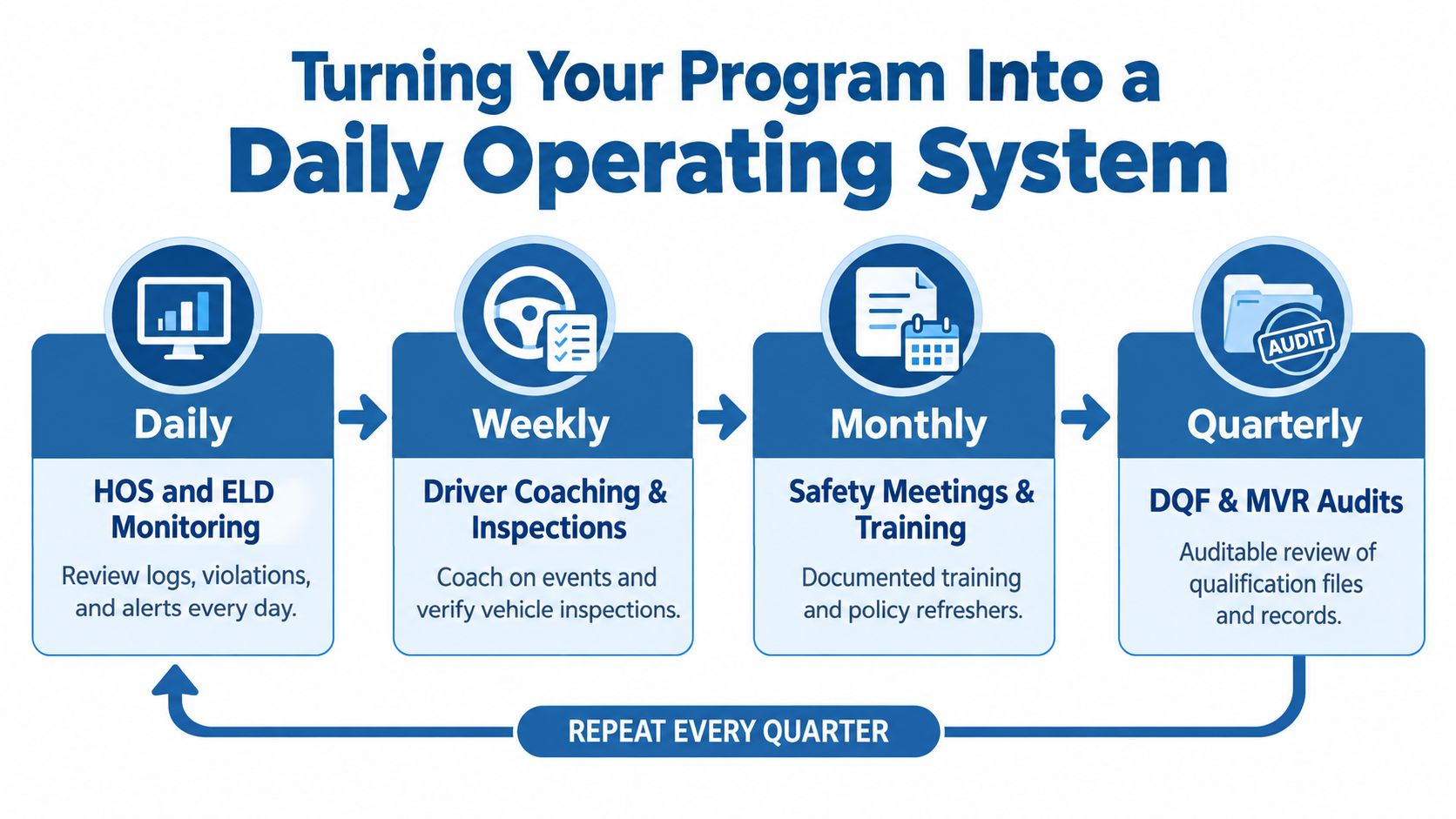
The operating system is the cadence. A safety manager reviews ELD exceptions daily, a supervisor discusses behavior events weekly, maintenance closes defects through a defined queue, and leadership reviews trends monthly. Qualification files and MVR records receive an auditable quarterly review, not a frantic response to an inspection notice.
Set the rhythm
Daily, supervisors review HOS exceptions, ELD edits, alerts, and start-of-shift DVIR completion. Maintenance triages reported defects and identifies anything that must keep a vehicle out of service.
Weekly, safety staff review behavior patterns, select coaching cases, conduct one-on-ones, and verify that inspection defects reached a repair decision. A single event may need context, while a repeated pattern needs a documented plan.
Monthly, safety, operations, and maintenance review the KPI scorecard, open corrective actions, training completion, BASIC movement, and incident root causes. Update a policy when the evidence shows that the current rule doesn't match the work.
Quarterly, audit DQ files, MVRs, medical-card status, drug and alcohol records, maintenance files, and corrective-action closure. The audit should produce named owners and deadlines, not just a pass or fail.
Roll out the loop in 90 days
During days 1 to 30, establish your baseline. Audit qualification files, inspect policy gaps, review HOS exceptions, identify overdue maintenance, and assign each CSA BASIC to an owner.
During days 31 to 60, launch the coaching workflow. Set alert priorities, train supervisors on the conversation format, document every session, and separate incident investigation from discipline.
During days 61 to 90, run the first complete KPI review. Compare baseline findings with current completion, closure, testing, inspection, and BASIC measures. Keep what produces action, remove reports nobody uses, and schedule the next review.
Your system should also account for people working alone around equipment, roadside hazards, or remote facilities. A separate resource on practical lone worker protection can help you examine communication and escalation procedures that sit outside vehicle controls.
Use DOT compliance software when disconnected records and manual follow-up are preventing you from maintaining this cadence. The objective isn't to collect more data. It's to ensure every meaningful signal reaches a person, produces an action, and gets checked again against the relevant BASIC.
Frequently Asked Questions About Fleet Safety Programs
What is a fleet safety program?
A fleet safety program combines written policies, qualification controls, training, inspections, maintenance, monitoring, coaching, and performance review. It turns safety expectations into documented daily actions.
Who should own a fleet safety program?
Assign one accountable program owner, with operations, maintenance, supervisors, and leadership holding defined responsibilities. Drivers need clear standards and a consistent process for feedback and corrective action.
What are the seven CSA BASICs?
The seven categories are Unsafe Driving, HOS Compliance, Driver Fitness, Controlled Substances and Alcohol, Vehicle Maintenance, Hazardous Materials Compliance, and Crash Indicator.
How often should you review ELD data?
Review ELD exceptions daily when possible, and complete a formal exception review at least weekly. Record the cause, correction, coaching decision, and closure.
What belongs in a Driver Qualification File?
Maintain the employment application, road-test evidence, CDL and endorsements, medical certification, required MVRs, and prior-employer safety-performance inquiries. Keep the file current throughout employment.
How long should you retain qualification records?
General DQ records should be retained for the duration of employment plus three years. Drug and alcohol records may have different retention periods, including five-year requirements for applicable records.
What should happen after a telematics alert?
Review the event and surrounding context, check for a pattern, speak with the person promptly, agree on one behavior change, document the discussion, and measure the result.
What vehicle records should you keep?
Keep daily inspection records, defect reports, repair and work-order evidence, periodic inspection proof, preventive-maintenance history, and return-to-service documentation.
When does a BASIC require corrective action?
Use the applicable FMCSA intervention thresholds as an escalation point. The stated thresholds are 80 for most BASICs, 75 for HOS Compliance, and 65 for Driver Fitness and Crash Indicator.
Can technology replace safety training?
No. Technology can identify patterns and support timely coaching, but your program still needs structured training, clear policies, human review, and documented follow-up.
Regulatory References
- 49 CFR Part 382, Controlled Substances and Alcohol Use and Testing
- 49 CFR Part 391, Qualification of Drivers
- 49 CFR Part 395, Hours of Service of Drivers
- 49 CFR Part 396, Inspection, Repair, and Maintenance
My Safety Manager gives you practical support for driver qualification, CSA BASIC monitoring, drug and alcohol program management, training, and vehicle-maintenance compliance. Visit My Safety Manager to move your fleet safety program from policies and scattered records to a documented operating cadence.
