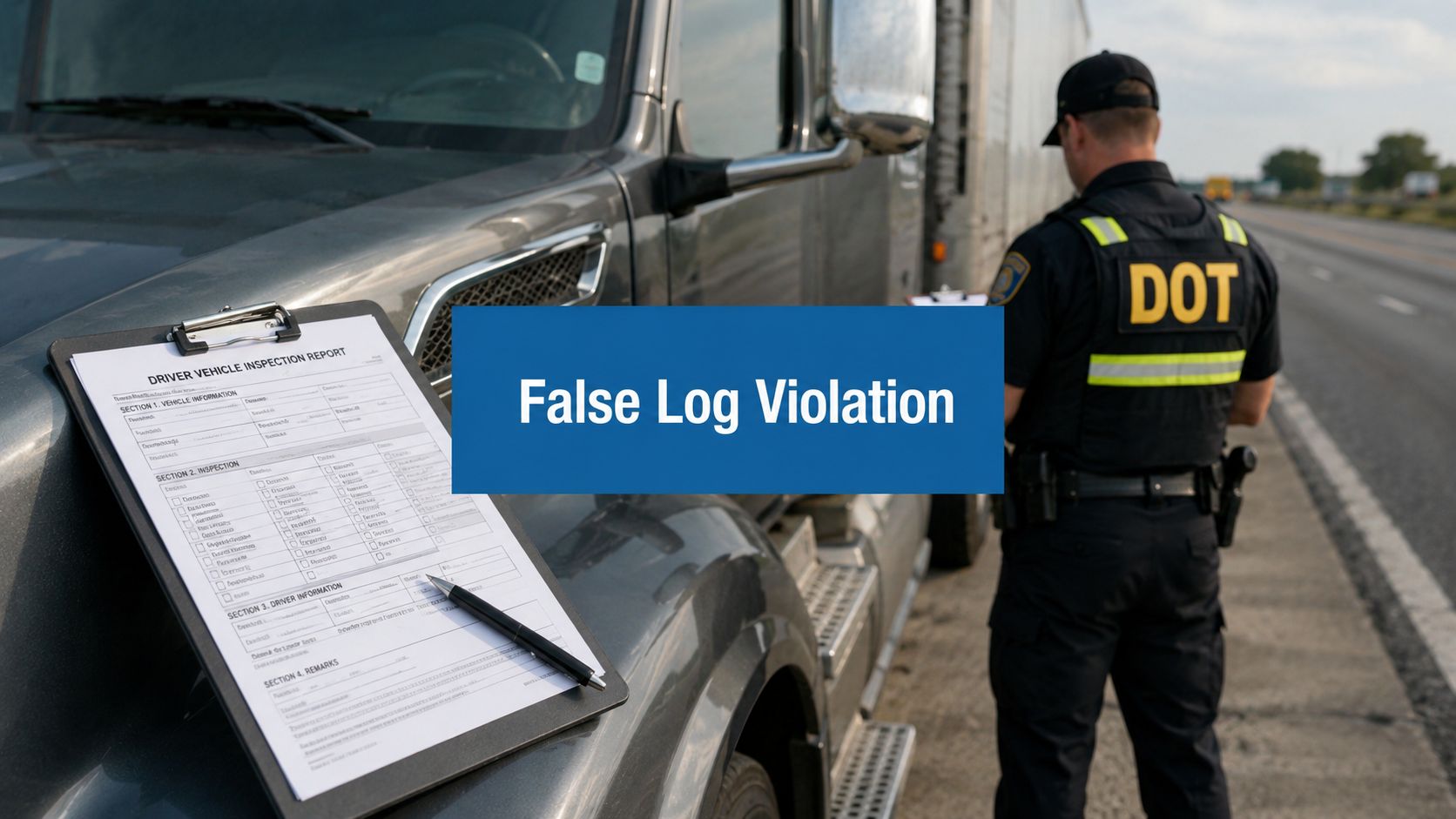
False log DOT violation can put your fleet in a bad spot fast. You get an inspection report, see the violation, and immediately know this isn’t just a paperwork nuisance. It can affect your safety profile, pull management time away from operations, and raise questions about whether the issue was a one-off mistake or a bigger process problem.
Most fleets make the same mistake at this point. They either treat every false log citation like intentional cheating, or they assume they can talk their way out of it later. Neither works well. In practice, many of these cases start with bad status selection, unassigned driving, sloppy edits, or poor ELD habits, but enforcement still treats the record as a serious compliance issue.
What matters now is understanding what the violation means, what evidence can help you challenge it, and what changes will keep it from happening again. If you’re already dealing with a citation, start with this guide and then review your broader DOT violation response process.
Your Guide to False Log DOT Violations
A false log citation usually lands at the worst time. Your driver is already delayed, your office is trying to sort out what happened, and now you’re wondering whether this one inspection is going to snowball into a bigger FMCSA problem.
That concern is justified. From 2019 through 2023, FMCSA investigators found nearly 21,000 false log violations during DOT audits, representing about 6% of all violations discovered. During the same period, log falsification was the fourth most common driver-related violation found during roadside inspections, according to industry reporting on FMCSA data.
The first thing to keep in mind is that the label can cover more than outright fraud. Sometimes the officer believes your record of duty status does not match what happened. That can come from intentional concealment, but it can also come from poor exception handling, bad coaching, or a driver who doesn’t fully understand how the ELD should be used in real-world situations.
Practical rule: Treat every false log citation as both an enforcement event and a systems audit. You’re not just responding to one report. You’re testing whether your internal controls are good enough.
If you own or manage a fleet, your job is to respond in two tracks at once. First, preserve evidence and determine whether the citation should be challenged. Second, find the operational failure that allowed the mismatch to happen.
What a False Log Violation Really Means
A false log DOT violation means the record presented to enforcement does not accurately reflect the driver’s actual duty status, movement, or hours. In the paper-log era, people tended to think of this as a made-up handwritten logbook. In the ELD era, it’s often more subtle.
That matters because your response changes depending on the cause. A driver who knowingly hides excess driving time needs one kind of response. A driver who mishandles personal conveyance or leaves unassigned driving unresolved needs another.

Three ways these violations usually show up
The easiest way to think about it is in three buckets.
- Intentional manipulation
You have a record that was altered to hide drive time, extend available hours, or disguise on-duty work. This is the classic enforcement scenario. - Unintentional errors
You have a log that became inaccurate because the wrong status was selected, edits were handled badly, or supporting records don’t line up with the final duty record. - ELD-specific issues
You have device-related exceptions and workflow failures. Unassigned driving, misuse of special categories, and inconsistent annotations are common examples.
A lot of fleets underestimate the third bucket. They assume the ELD solves the recordkeeping problem by itself. It doesn’t. It gives you more data, but it also gives enforcement more ways to compare your story against time-stamped events.
Common triggers behind a false log finding
Several patterns show up repeatedly in fleet reviews:
- Personal Conveyance used for business movement
If the move benefits the carrier operationally, that’s where trouble starts. - Unassigned driving left unresolved
If vehicle movement sits in the system without a clear explanation, it can look like concealed drive time. - On-duty and off-duty misclassification
This happens when loading, waiting, fueling, or yard activity gets logged under the wrong status. - Bad edits without clear annotations
An edit that fixes a genuine mistake can still look suspicious if nobody documents why it was made.
If you need a refresher on the rule framework behind log records, review 49 CFR 395.8 guidance for records of duty status.
A false log case often turns on consistency. If your ELD, dispatch notes, fuel activity, toll records, and trip timing tell the same story, you have something to defend. If they don’t, the label gets harder to challenge.
There’s also a legal reason to take these violations seriously beyond FMCSA scoring. In a crash case, a log violation can become part of a broader negligence argument. If you want a plain-English explanation of that concept, Mattiacci Law’s overview of negligence per se is a useful primer.
How Violations Are Detected and the Impact on Your Fleet
Most fleet owners focus on the citation itself. The bigger issue is how the violation was found, because that usually tells you where your compliance process is weak.

Roadside detection
At roadside, the officer is working from a shorter window. They review the ELD output, the driver’s statements, trip details, and whatever supporting context is available during the inspection. If something doesn’t line up, the false log issue starts there.
A lot of fleets lose control before the review even begins because the driver can’t transfer records properly or can’t explain an obvious discrepancy. If your team needs better prep for inspection-day procedures, this guide on ELD data transfer during roadside inspection is worth using in driver training.
What usually gets attention at roadside is not one isolated event. It’s a mismatch that looks hard to explain. An officer may see movement that doesn’t fit the logged status, edits that appear self-serving, or supporting documents that suggest the duty timeline is incomplete.
Audit and compliance review detection
The audit side is different. Here, the reviewer has time to compare patterns across a longer period. That’s where recurring exception handling failures become dangerous.
An audit can expose:
- Repeated unassigned driving with weak explanations
- Frequent personal conveyance activity that doesn’t match operations
- Edit patterns that consistently recover hours
- Missing or thin supporting documents when the timeline should be easy to verify
This is why fleets that look “mostly fine” on a daily basis still get hit hard later. The single event might be debatable. The pattern often isn’t.
Business impact
The consequences are not theoretical. A knowing falsification of records can carry a civil penalty of up to $13,072 per offense, and the violation carries a severity weight of 7 in CSA scoring, which can push your Hours of Service BASIC in the wrong direction quickly, according to industry reporting on FMCSA enforcement consequences.
That creates three real business problems:
- You lose operational time
A roadside issue can delay the load, distract dispatch, and force immediate back-office review. - You increase audit pressure
A serious log issue can make your broader HOS practices more interesting to regulators. - You create insurance and litigation headaches
Even when the event starts as an administrative error, the record can still look bad if it isn’t cleaned up and documented properly.
Don’t ask only, “Can we fight this?” Also ask, “Why did our system allow this record to leave the yard looking this way?”
Your Step-by-Step Response to a False Log Citation
When a citation hits your desk, speed matters. So does discipline. The goal is not to write a passionate explanation. The goal is to build an objective timeline.
FMCSA guidance is clear on the practical point that matters most here: a successful rebuttal in a DataQ or compliance review typically depends on reconstructing the timeline with objective, time-stamped supporting documents like ELD data, dispatch records, fuel receipts, and tolls, not just on claiming the officer was mistaken, as reflected in FMCSA Safety Planner guidance.
What to do in the first 24 hours
Start with control, not blame.
Get the inspection report immediately
You need the exact violation language, time, location, and any notes tied to the finding.
Interview your driver while the trip is still fresh
Ask what happened before, during, and after the event. Keep it factual. Don’t coach an answer.
Lock down relevant records
Pull the ELD logs, edits, annotations, dispatch communications, GPS history, and trip documents before anything is lost or overwritten.
Stop informal explanations
Don’t let anyone email a vague defense or call the violation “obviously wrong” without evidence to back it up.
If you’re already dealing with one of these cases, this overview of a false log book violation response helps frame what should be collected before you submit anything.
Build the timeline before you argue the case
Many fleets often fail in this regard. They start with a conclusion instead of a timeline.
Use the records to answer basic questions:
- When did the truck move?
- What duty status was shown at that time?
- What trip instruction existed?
- What external record confirms the location or activity?
- Was there an edit, and if so, why?
If your proof depends on “the officer misunderstood,” you probably don’t have enough proof yet.
Evidence for a DataQ Challenge
| Document Type | What It Proves | Where to Find It |
|---|---|---|
| ELD event record | Duty status changes, drive segments, edits, annotations | Your ELD portal or provider export |
| Dispatch records | Load instructions, dispatch timing, expected route activity | TMS, dispatch software, or dispatcher files |
| Fuel receipts | Location and time tied to the trip | Accounting files, fuel card portal, driver paperwork |
| Toll records | Time-stamped route activity | Toll account portal or billing records |
| GPS or telematics history | Vehicle movement and stop times | Telematics dashboard or fleet tracking platform |
| Bills of lading and shipping records | Pickup and delivery timing | Operations files or customer load documents |
| Driver statement | Context for exceptions, errors, or misunderstood events | Internal written interview |
| Edit history and annotations | Whether corrections were legitimate and documented | ELD audit trail |
Write a clean, evidence-based challenge
A solid challenge is short, organized, and document-driven. Lead with the specific event. Then explain the timeline in order. Attach only records that support the timeline directly.
A good format looks like this:
- State the violation exactly as reported
- Identify the disputed point clearly
- Walk through the time-stamped sequence
- Match each fact to a supporting document
- Request correction or removal based on the evidence
Don't over-argue. Don't accuse the officer. Don't add filler. If the record is wrong, the documents should show it.
Building a False-Log-Proof Compliance Program
A clean response process helps after the fact. A stronger compliance program keeps the problem from repeating.

Focus on exception management
Most preventable false log problems show up first as exceptions. Unassigned driving sits too long. Personal conveyance gets overused. A driver edits a record but leaves a weak annotation. None of that guarantees a citation, but all of it raises the odds.
You want a review process that catches exception activity early and routes it to the right person. In smaller fleets, that may be the safety manager or owner. In larger fleets, it may sit with a log auditor or compliance coordinator.
A practical weekly review should look for:
- Unassigned drive time that hasn't been claimed or explained
- Special driving categories that don't match the trip context
- High edit volume by the same user or unit
- Missing annotations on corrected records
- Trips where dispatch timing and log timing don't fit
Train to real scenarios, not just the rulebook
A lot of fleets say they train on HOS. What they really do is hand over a slide deck and move on.
That's not enough. Your drivers need scenario-based training that mirrors the mistakes they make in the field. Use examples pulled from your own operation. Cover shipper delays, yard moves, roadside inspections, split-duty misunderstandings, and what to do when the ELD doesn't match what just happened.
The best training question is not “Do you know the rule?” It's “What would you select in the unit, right now, in this exact situation?”
A short SOP is often more useful than a long policy manual. Keep it specific. Show the approved steps for edits, annotations, claiming unassigned driving, and escalating uncertain situations before the trip is closed.
Put auditing and support into the workflow
Prevention works when it's routine. That means you don't wait for a monthly review to discover a log issue that happened two weeks ago.
Build a rhythm:
- Daily checks for high-risk exceptions
- Weekly reviews for recurring driver patterns
- Coaching follow-up with documentation
- Escalation rules for repeated noncompliance
- Management review when the same issue keeps resurfacing
If you need a starting point, a structured fleet safety program template can help formalize these controls.
You can run this internally with your ELD platform, telematics tools, and disciplined supervision. Some fleets also use outside compliance support to monitor logs, review exception reports, and help with corrective workflows. My Safety Manager is one example of a service that supports those operational tasks.
Frequently Asked Questions About False Logs
| Question | Answer |
|---|---|
| What is a false log DOT violation? | It means the duty-status record presented to enforcement does not accurately reflect what happened. That can involve intentional falsification, but it can also come from mishandled ELD events, poor edits, or wrong status selection. |
| Does a false log violation always mean fraud? | No. Some cases involve deliberate concealment, while others come from administrative mistakes or weak exception handling. Enforcement may still cite the record even if intent is disputed. |
| Can you challenge a false log citation? | Yes, but the challenge needs evidence. The strongest rebuttals are built on time-stamped records that reconstruct the trip clearly. |
| What documents help the most in a challenge? | ELD event data, dispatch records, fuel receipts, toll activity, GPS history, bills of lading, and clear annotations usually matter most. |
| Is a driver statement enough to remove the violation? | Usually not by itself. A statement can help explain context, but objective records carry more weight than memory or opinion. |
| What’s the biggest mistake fleets make after a citation? | They argue first and investigate second. That leads to weak submissions, inconsistent stories, and missed records. |
| Can unassigned driving cause a false log problem? | Yes. If vehicle movement remains unresolved or is handled poorly, it can look like concealed drive time. |
| Does personal conveyance misuse matter that much? | Yes. When personal conveyance is used for business-related movement, the log can become inaccurate fast. |
| How long should you keep supporting records? | FMCSA guidance referenced in this topic points to retaining supporting documents for at least six months, which is one reason fast record preservation matters after a citation. |
| What’s the best prevention strategy? | Routine exception review, scenario-based driver coaching, documented SOPs for edits and special categories, and quick follow-up when records don’t align. |
Take Control of Your Compliance Today
A false log citation often lands the same way. A driver calls from the road, the paperwork does not line up cleanly, and now the fleet has a record that can follow it into audits, insurance conversations, and customer reviews.
The fleets that recover best treat that moment like an evidence problem, not a debate. They lock down records the same day, assign one person to reconstruct the timeline, and decide quickly whether the citation should be paid, challenged, or used as a trigger for corrective action.
That discipline protects more than one driver file. It protects CSA exposure, reduces repeated log errors, and keeps small recordkeeping issues from turning into a pattern investigators can trace across the fleet.
My Safety Manager helps fleets review HOS activity, tighten log review workflows, and respond to false log issues with documented, consistent follow-up.
Regulatory References
Use these regulations to verify what the officer cited, what records the driver was required to maintain, and where the carrier's responsibility begins. This is the fastest way to separate a paperwork mistake from a violation you need to correct and document.
| Regulation | Topic | Link |
|---|---|---|
| 49 CFR 395.8 | Driver’s record of duty status | View 49 CFR 395.8 on eCFR |
| 49 CFR 395.11 | ELD requirements for records of duty status | View 49 CFR 395.11 on eCFR |
| 49 CFR 395.22 | Motor carrier responsibilities for ELDs | View 49 CFR 395.22 on eCFR |
| 49 CFR 395.24 | Driver responsibilities for ELD operation | View 49 CFR 395.24 on eCFR |
| 49 CFR 386.81 | Civil penalties for recordkeeping and related violations | View 49 CFR 386.81 on eCFR |
After a false log citation, the job is to match the citation to the exact rule, pull the supporting records, and decide whether to contest it or correct the underlying process. Fleets that do this quickly make better decisions and leave a cleaner file for audits, insurer questions, and internal review.
If you need outside help reviewing logs, organizing evidence, and setting a repeatable response process, My Safety Manager can support that work.
