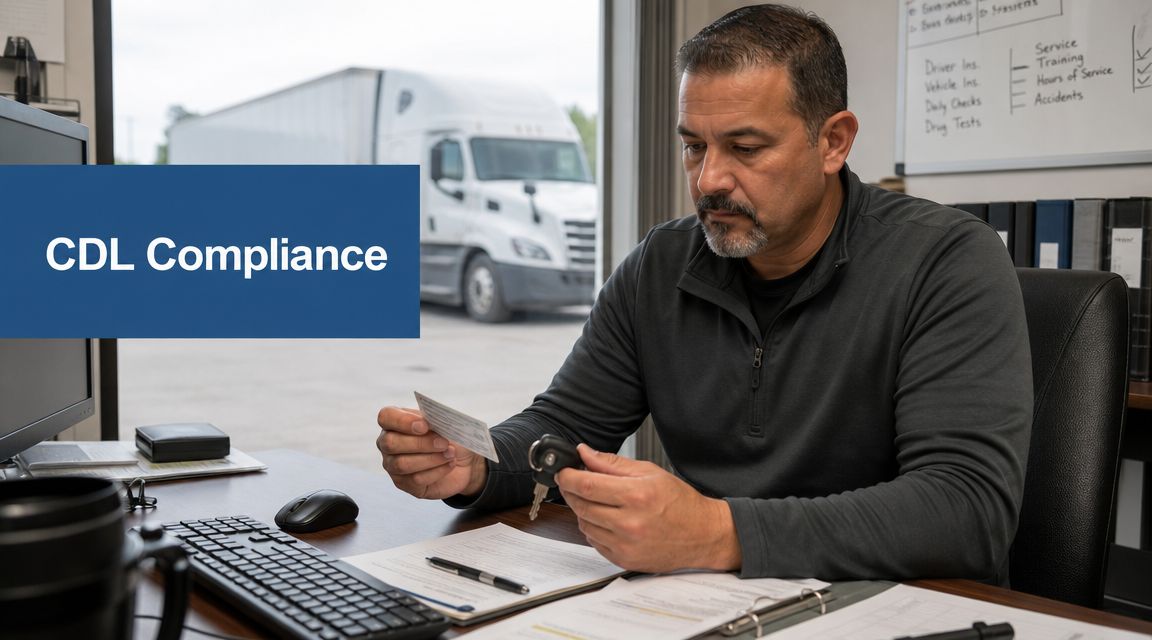
Driving a CMV without a valid CDL is a nightmare scenario for fleet owners and safety managers, carrying massive fines and legal risks that can threaten your entire operation. You might think your annual MVR checks and DQ files have you covered, but what about the driver whose med card expired last week, triggering an automatic license downgrade by their home state? Or the weekend traffic ticket that led to a suspension you know nothing about? These are the silent, ticking time bombs that expose your company to devastating liability. This guide explains what's really going on with these "hidden" violations and gives you a clear plan to protect your business.
The Hidden Risk of an Invalid CDL in Your Fleet
You might think you have this covered. You run your MVRs and keep your Driver Qualification files in order. But the real danger isn't the stuff you're actively tracking; it's the silent risks that creep up and catch you completely off guard.
What happens when your driver’s medical certificate expires and, unbeknownst to you, their home state automatically downgrades their CDL to a regular license? What about a weekend traffic ticket in their personal car that leads to a suspension you know nothing about? These are the real-world scenarios that create a ticking time bomb in your fleet.

Why This Risk Is Growing
The game has changed. Years ago, the focus was almost entirely on violations that happened in the truck. Not anymore. Regulators now have a much wider view, and your driver can lose their CDL privileges for conduct that has nothing to do with their CMV. This includes certain traffic offenses in their personal vehicle and, of course, driving a truck after their CDL was already suspended or revoked. You can see how these new Clearinghouse rules are impacting drivers to get a sense of the ever-growing compliance burden. Managing this has become a core part of any good HR risk guide for SMB leaders.
In this guide, we're going to pull back the curtain on what “driving without a valid CDL” really means to the FMCSA. We’ll show you the full scope of the consequences for your drivers and your business and give you a concrete, step-by-step plan to make sure this never happens in your fleet.
What ‘Invalid CDL’ Actually Means for Your Business
When you hear "driving a CMV without a valid CDL," you probably picture someone who never earned a license trying to drive a big rig. In reality, that’s rarely where the real risk lies for your fleet.
The real danger sneaks up on you. It's when your driver's once-perfectly-valid CDL becomes invalid, often without anyone in your office realizing it until it’s too late. Other related keywords you might search for include "CDL downgrade," "operating CMV with suspended license," and "unqualified driver violations."
These kinds of violations can put your entire operation in jeopardy. Some of the most common and easily overlooked scenarios are:
- Your driver operating with an expired medical certificate, which can trigger an automatic license downgrade.
- A license getting suspended because of a personal issue, like a DUI in their own car on a Saturday night.
- Your driver operating a vehicle that requires a specific endorsement they don’t have, like a Tanker or HazMat. Our guide on CDL restrictions and endorsements explained breaks this down further.
Understanding these subtle but serious distinctions is the foundation of a rock-solid compliance strategy. States like Pennsylvania and Georgia don't mess around; they classify driving a CMV without the correct CDL or endorsement as a serious offense. You can see how states handle these disqualifications and traffic offenses in their FAQs.
The Steep Price of a Single CDL Violation
Thinking you can get away with letting an unqualified driver behind the wheel? The consequences of a single CDL violation stretch far beyond a simple roadside ticket, hitting your company with immediate and severe financial and operational blows.
Regulators don't take this lightly. You're looking at fines starting at $7,155 levied directly against your business just for letting it happen. One event like this can also wreck your CSA scores, specifically in the Unsafe Driving and Driver Fitness BASICs. That kind of hit is a major red flag and could easily trigger a full-blown DOT audit. A single DOT violation can spiral out of control faster than you can say "inspection."

But here's the real kicker: the massive liability you're exposed to if that driver gets into an accident. Plaintiff's attorneys live for "negligent entrustment" cases. They actively hunt for situations where a carrier, knowingly or not, put an unqualified driver on the road.
A verdict in one of those cases can be a catastrophic event for your company. Even if you survive, good luck finding affordable insurance ever again.
How Violations Are Found and Penalties Escalate
Don't make the mistake of thinking an invalid CDL will only get noticed after a crash. Enforcement is way more proactive than that, with roadside inspections and post-accident investigations being the most common ways drivers get caught.
During any stop, an officer can check the Commercial Driver's License Information System (CDLIS) in seconds. But it's not just about what happens on the road.
Automation and Escalating Consequences
Enforcement is also becoming more automated. State DMVs are now tied directly into the FMCSA's databases. For example, a lapsed medical certificate can automatically trigger a license downgrade in the system, often without you or your driver ever getting a physical notice.
One serious violation is trouble enough. But a second one within three years can trigger a lengthy driver disqualification, turning a simple compliance miss into a full-blown operational nightmare. Other major offenses can stack up and make things even worse, and there is some helpful guidance for CDL DWI charges that your drivers should be aware of.
Interestingly, studies show that detection rates for disqualified drivers at roadside inspections can range anywhere from 24% to 66%. This means enforcement is inconsistent, but the gamble is never worth the risk. You can get a better sense of what to expect by reading our article on what happens during a CDL violation roadside inspection.
The penalties for these violations snowball quickly. A single mistake might seem manageable, but the FMCSA's rules are designed to get repeat offenders off the road.
Escalating Penalties for Driver Violations
The table below shows just how rapidly the consequences stack up for a driver who accumulates serious violations within a 3-year period.
| Number of Serious Violations in 3 Years | Minimum Disqualification Period |
|---|---|
| 1 | No Disqualification (but violation on record) |
| 2 | 60 Days |
| 3 or more | 120 Days |
As you can see, what starts as a single citation can lead to your driver being sidelined for months. This is why staying on top of every driver's CDL status isn't just good practice—it's essential for keeping your trucks moving.
Building a Proactive Defense to Prevent Violations
When it comes to CDL violations, an ounce of prevention is worth a pound of cure and a whole lot of cash. The only real way to dodge the massive penalties we’ve discussed is to stop an unqualified driver from ever getting behind the wheel of one of your trucks. This means building a proactive defense.
Your defense hinges on a "living" Driver Qualification file. A reactive approach, like only checking MVRs once a year, is a recipe for disaster. That’s a huge blind spot. You need a system that actively tracks CDL and medical card expirations and flags new violations the moment they hit a driver's record.
This isn't just a "nice-to-have" process; it's your first and best line of defense. The infographic below shows just how fast a simple oversight can snowball into a catastrophic, business-threatening problem.

As you can see, something as common as an expired medical card can quickly escalate into a full-blown "operating without a valid CDL" violation. Without automated tracking, that driver could be on the road for weeks or months, racking up liability for your company with every mile.
Frequently Asked Questions (FAQ) About CDL Validity
What happens if my driver’s medical card expires?
When a medical certificate expires, the state licensing agency (DMV) automatically downgrades the driver's CDL to a regular license. If your driver operates a CMV after this happens, it is a serious violation. You have allowed someone to be driving a CMV without a valid CDL.
Can a DUI in a personal car affect a CDL?
Yes. A conviction for driving under the influence (DUI) in any vehicle, including a personal car, will result in a CDL disqualification. The first offense typically leads to a one-year disqualification.
How often should you check your drivers’ MVRs?
The FMCSA requires an annual review of each driver's Motor Vehicle Record (MVR) under § 391.25. However, best practice is to use a continuous MVR monitoring service to get real-time alerts for new violations, suspensions, or status changes, closing the gap between annual checks.
What are the penalties for the company if a driver is caught driving without a valid CDL?
Your company can face federal fines starting at $7,155 per offense. It also leads to a severe hit on your CSA scores and dramatically increases your liability in the case of an accident, potentially leading to a negligent entrustment lawsuit.
What is the difference between a driver having no CDL and an invalid CDL?
"No CDL" usually means the person never obtained a commercial license. An "invalid CDL" means the driver once had a valid CDL, but it has since been suspended, revoked, or downgraded (e.g., due to an expired medical card). For a motor carrier, the risk is often with the invalid CDL, as it can happen without your immediate knowledge.
What is negligent entrustment?
Negligent entrustment is a legal claim that holds you, the motor carrier, responsible for an accident because you allowed an unqualified or unfit driver to operate your vehicle. Permitting a driver with a known (or should have known) invalid CDL to drive is a classic example that is very difficult to defend in court.
Does a driver need the physical CDL card with them?
Yes, under § 383.23, a driver must have their physical CDL in their possession while operating a CMV. While not as severe as the license being legally invalid, it is still a citable violation.
Take Control of Your Fleet's Compliance
Keeping track of every driver's CDL, med card, and training records is a full-time job. All it takes is one simple oversight to create a massive headache for your entire operation. A single violation can trigger a full-blown DOT audit, and nobody wants that.
That’s exactly why we built My Safety Manager. Our team of DOT compliance pros can become your safety department. We manage your driver qualification files, run your drug and alcohol program, and constantly monitor driver records to catch problems before they become violations.
Stop reacting to problems and start preventing them. Visit us at www.MySafetyManager.com to schedule a demo and see how our program can secure your fleet.
Regulatory References
Here are the key Federal Motor Carrier Safety Regulations (FMCSR) that govern CDL requirements and driver qualifications discussed in this article.
- § 383.23 Commercial driver's license: This is the core rule requiring a driver to hold a valid CDL for the specific type of vehicle being operated.
- § 383.51 Disqualification of drivers: This section details the offenses that lead to a driver's CDL being suspended, revoked, or disqualified.
- § 391.11 General qualifications of drivers: This regulation outlines the minimum requirements for any driver operating a CMV, including having a valid license.
- § 391.41 Physical qualifications for drivers: This part establishes the medical standards a driver must meet and maintain, which is directly tied to the validity of their CDL through their medical certificate.
