
DOT random drug testing is a non-negotiable part of your world if you run a commercial fleet. As a fleet owner or safety manager, are you absolutely sure your program can withstand a surprise DOT audit? This federally mandated program is designed to keep our roads safe, but getting it wrong can lead to crippling fines and operational shutdowns.
You might be relying on a third-party administrator but still feel a bit in the dark, wondering if your driver pool is accurate or if selections are truly random. Maybe you’re not entirely clear on the exact procedure to follow after a positive test. That uncertainty is a huge liability, creating gaps in your safety program that an auditor will find in a heartbeat.
This guide is here to cut through the regulatory noise and give you a clear, straightforward roadmap. We’ll break down exactly what DOT random drug testing involves, why it’s so critical, and how to build a program that isn’t just about ticking boxes but becomes a cornerstone of your safety culture. For a broader look, our guide to the complete DOT drug and alcohol program can also fill in some gaps.
Building Your Compliant DOT Drug Testing Program
DOT random drug testing isn’t just a box to check; it’s a critical safety system. As a safety manager or fleet owner, you’re responsible for a program designed to deter drug and alcohol use through its unpredictability.
But this is where many fleets get tripped up. Are the right people in your testing pool? Are you running enough tests to satisfy an auditor? The most common mistake is treating the rules like suggestions, which is a fast track to hefty fines and major operational headaches.
You might think just having a list of your CDL drivers is good enough, but a truly compliant program needs more attention to detail. Let’s demystify the federal regulations and show you exactly how they work to protect your drivers, your business, and everyone else on the road. We’ll break down who belongs in the random pool and what those all-important annual testing rates really mean.
Who Belongs in Your Random Testing Pool
The foundation of any compliant DOT random drug testing program is the “pool.” Think of this less like a simple list and more like a carefully managed roster of every single employee who performs a safety-sensitive function.
For trucking, it’s straightforward: the pool must include every driver who is required to have a Commercial Driver’s License (CDL) and operates a Commercial Motor Vehicle (CMV) for your company.
The core principle is simple but strict: every driver in your pool must have an equal chance of being selected every single time a test is ordered. This isn’t about targeting specific individuals; it’s about maintaining a fair, unbiased, and legally defensible system.
This means you can’t pull someone from the pool just because they were tested last month or because they only drive part-time. If they hold a CDL and get behind the wheel of a CMV for you, they have to be in the mix every single time.
Meeting the Annual Testing Rates
Each year, the Federal Motor Carrier Safety Administration (FMCSA) sets the minimum random testing rates for both drugs and alcohol. These percentages aren’t goals or suggestions—they are the absolute minimum number of tests you must conduct annually.
The rates are based on the average number of driver positions you have in your pool throughout the year. Here’s how it works:
- Drug Testing Rate: If the FMCSA sets the rate at 50% and you have an average of 100 drivers in your pool, you must conduct at least 50 random drug tests during that calendar year.
- Alcohol Testing Rate: If the rate is 10% for that same 100-driver pool, you’re required to conduct at least 10 random alcohol tests.
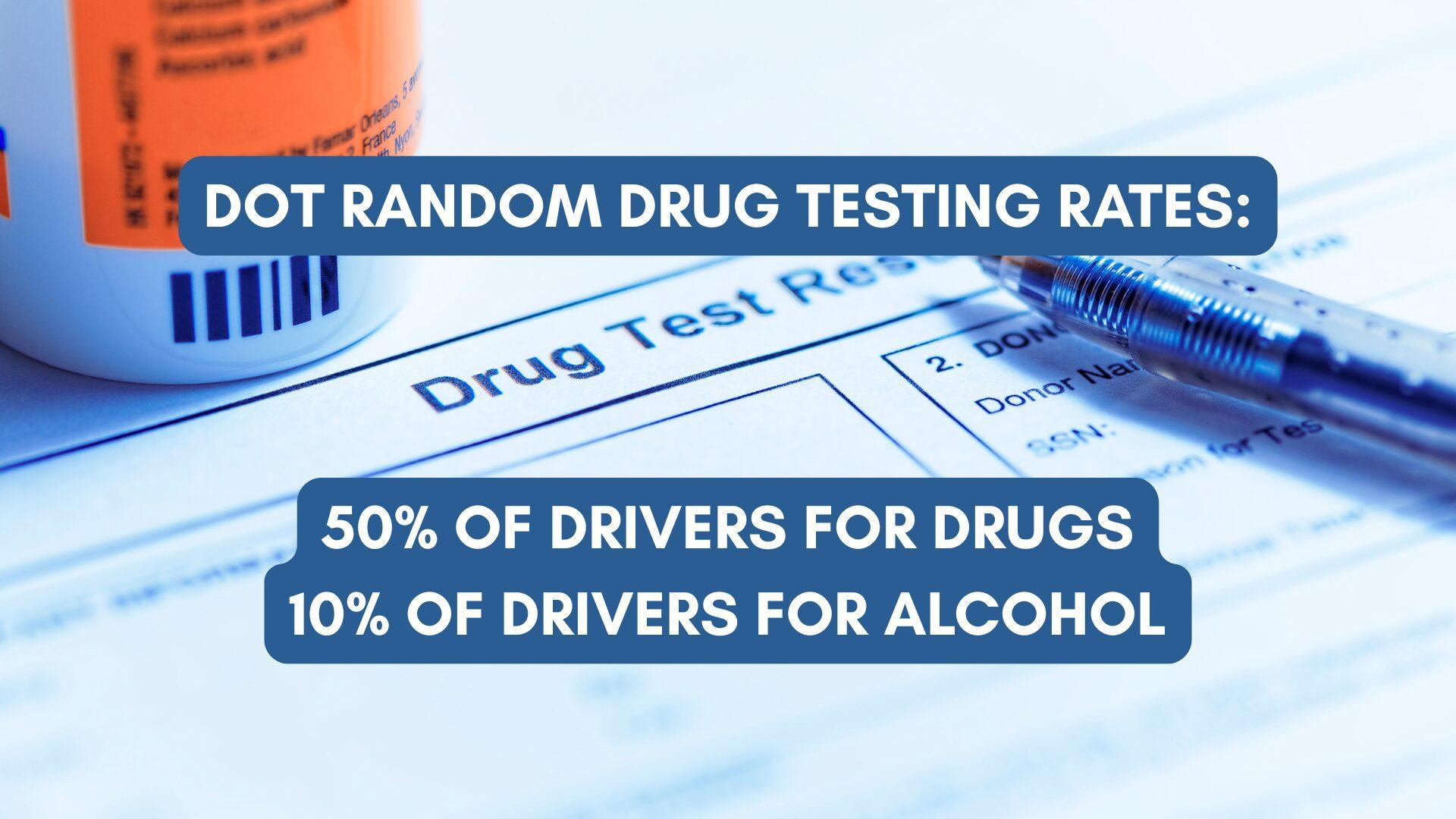
These rates can—and do—change based on industry-wide data, so staying on top of the latest numbers is essential. You can learn more about the current percentages in our breakdown of the 2025 FMCSA drug and alcohol testing rates.
Falling short of these minimums is a serious violation that an auditor will spot immediately. The trick is to spread your tests out across the year to keep things unpredictable and stay compliant.
For a quick reference, here’s a simple breakdown of the essential components of a DOT random drug testing program.
DOT Random Drug Testing At a Glance
| Component | What You Need to Know |
|---|---|
| The Random Pool | Must include every CDL driver performing safety-sensitive functions. No exceptions. |
| Selection Method | Must be truly random, giving every driver an equal chance of selection each time. |
| Annual Drug Rate | A percentage set by the FMCSA (e.g., 50%) based on your average number of drivers. |
| Annual Alcohol Rate | A separate percentage set by the FMCSA (e.g., 10%). |
| Testing Frequency | Spread tests throughout the year to maintain unpredictability. Don’t bunch them up. |
| Compliance | Meeting these minimums is mandatory. Failure is a guaranteed audit violation. |
Think of this table as your cheat sheet. Getting these fundamentals right is the key to building a program that not only passes audits but also genuinely improves safety.
How the Random Selection Process Really Works
DOT random drug testing has to be truly, scientifically random. If it’s not, you’re looking at massive liability and a guaranteed audit failure. As a safety manager or fleet owner, the buck stops with you to make sure this process is defensible, but a surprising number of programs have hidden flaws.
You might think that as long as you’re testing someone, you’re compliant. That’s a common mistake. Pulling names out of a hat, testing drivers who just happen to be at the terminal, or letting a supervisor pick someone based on a “gut feeling” are all recipes for disaster. These methods aren’t scientifically valid and will get torn apart under scrutiny.
The regulations demand a completely unbiased process where every single driver in your pool has an equal shot at being selected, every single time. Let’s break down what a rock-solid, audit-proof selection process actually looks like.
Using a Scientifically Valid Selection Method
The word “random” has a very strict legal definition here. The DOT requires a method that a statistician could verify, leaving zero room for human bias. Simply put, your convenience or intuition has no place in the selection process.
The core principle is this: every driver in the pool must have an equal chance of being selected during each and every selection period.
Here are the most common ways to do it right:
- Computer-Based Random Number Generator: This is the gold standard and what nearly everyone uses. Your Consortium/Third-Party Administrator (C/TPA) uses specialized software that assigns a number to each driver and then lets the computer randomly spit out the selections. It’s the most defensible method.
- Manual Random Number Table: You don’t see this much anymore, but you could use a random number table to pick drivers. If you go this route, you have to document the process meticulously to prove its randomness.
No matter which method you use, documentation is everything. You have to be able to produce records that show exactly how the selections were made for every single testing cycle.
The Critical Importance of an Accurate Driver Pool
Your selection method is only as good as the list of names it’s pulling from. An outdated or inaccurate driver pool is one of the fastest ways to fail an audit. That pool needs to be a live, current reflection of every single safety-sensitive employee on your payroll.
This requires constant attention. You need a bulletproof process to:
- Add New Drivers Immediately: The second a driver is officially hired into a safety-sensitive role, their name goes into the random pool. No delays.
- Remove Terminated Drivers Instantly: The moment a driver is terminated or moves to a non-safety-sensitive job, their name must come out of the pool.
Keeping a terminated driver in the pool is a major compliance violation. If that driver’s name gets picked, you can’t complete the test. This can cause you to fall short of the required annual testing rates and potentially invalidate the entire selection cycle.
Managing this list is a core safety responsibility. It’s why so many fleets partner with a C/TPA. A good drug and alcohol consortium handles all of this for you, taking the headache and the liability off your plate.
Spreading Tests Throughout the Year
The final piece of the puzzle is timing. Predictability is the enemy of a random testing program. If your drivers figure out that all the tests happen in the first week of the quarter, the program loses all its power as a deterrent.
You must spread your DOT random drug testing selections and the actual collections reasonably throughout the year. The DOT doesn’t have any specific requirements on when selections must be made. But, a best practice is to spread them out at least quarterly.
For example, if you have 100 drivers and the FMCSA drug testing rate is 50%, you need to complete 50 tests over the year. The best way to do this is to run a selection each quarter and test roughly 12-13 drivers each time. Bunching all 50 tests into January kills the element of surprise for the next eleven months. A good drug and alcohol consortium manager will manage this schedule for you, ensuring a consistent, unpredictable, and compliant program.
The Step-by-Step Testing Procedure
Once a driver’s name comes up in a DOT random drug testing selection, the clock starts ticking. The entire process that follows is strict, time-sensitive, and leaves absolutely no room for error. Understanding each step is critical for any safety manager or fleet owner to manage the situation correctly and avoid turning a routine test into a serious violation.
It all starts with the notification. This is a critical moment governed by a single, unbending rule: once you notify a driver they’ve been selected, they must proceed immediately to the designated collection site. Any unexplained delay can be seen as a refusal to test, which carries the same severe consequences as a positive result. This rule is in place to prevent anyone from trying to alter the outcome of the test.
Your Role as the Designated Employer Representative
In this process, you or another designated employee will act as the Designated Employer Representative (DER). Think of the DER as the central hub—the essential link between your company, the driver, and the entire testing apparatus, including the collection site, the lab, and the Medical Review Officer.
Your responsibilities as the DER are crystal clear:
- You are the only person who receives the test results from the Medical Review Officer.
- You are responsible for taking immediate action based on those results, like removing a driver from safety-sensitive functions after a verified positive test.
- You must ensure the entire process, from notification to the final result, remains confidential and fully compliant with DOT regulations.
This visualization gives you a high-level view of how a random testing program flows.
As you can see, keeping an updated driver pool and documenting every single step are just as important as the selection itself.
The Collection Process Explained
When your driver gets to the collection site, a certified collector follows a precise, federally mandated protocol. For a urine drug screen, the most important part of this is the split-specimen collection.
Here’s how it works: the driver provides a urine sample, which is then split into two separate containers. These are labeled as the “A” sample and the “B” sample. The “A” sample gets sent to a certified lab for the initial analysis. The “B” sample is sealed and stored—it only comes into play if the “A” sample tests positive and the driver requests a re-test.
For alcohol testing, the process usually involves an approved breath alcohol screening device. If that initial screening shows a result of 0.02 or greater, a confirmation test is mandatory after a waiting period of at least 15 minutes. This waiting period is designed to ensure the initial result wasn’t skewed by mouth alcohol from something like mouthwash.
The Medical Review Officer’s Critical Role
After the lab analyzes the “A” sample, the results don’t come straight to you. They first go to a Medical Review Officer (MRO), who is a licensed physician with specialized training in substance abuse. The MRO is arguably your most important safeguard in the entire DOT random drug testing process.
If a specimen comes back from the lab as positive, the MRO’s job is to contact the driver directly for a verification interview. During this confidential conversation, the MRO works to determine if there’s a legitimate medical explanation for the result, like a legally prescribed medication.
Only after the MRO has completed this verification process and ruled out any alternative medical explanations will the result be officially reported to you, the DER, as a verified positive. This step protects both you and your driver from false positives and ensures the final result is medically sound.
The significant role of regulated testing in transportation has helped fuel a massive industry. In fact, the global market for employer drug testing is projected to grow to nearly $9.1 billion by 2033, with North America leading the charge due to stringent regulatory frameworks. You can read the full research about drug testing market trends to learn more about this growing field.
Navigating Violations and The Return-to-Duty Process
A positive test result or a refusal from a driver is a serious event. When this happens, you need to respond immediately and follow the DOT rulebook to the letter. A violation isn’t just a positive lab result; it also includes a driver testing with an alcohol concentration of 0.04 or higher, or refusing to submit to a test in the first place. There’s no gray area here.
Your first and most important step is to immediately remove the driver from all safety-sensitive functions. This isn’t a suggestion—it’s a federal mandate. That driver cannot get behind the wheel of a commercial vehicle for you or anyone else until they have successfully gone through the entire Return-to-Duty process.
The Mandatory Return-to-Duty Process
The DOT’s Return-to-Duty (RTD) process is the only legal way for a driver to get back on the road after a drug or alcohol violation. It’s a structured, multi-step journey overseen by a credentialed professional. There are no shortcuts, and as the employer, you play a critical role in making sure every step is followed.
Here’s how the process unfolds, always in this specific order:
- Evaluation by a Substance Abuse Professional (SAP): The driver must be evaluated by a qualified SAP. This isn’t a rubber-stamp meeting. The SAP is a trained professional who conducts a thorough assessment and then prescribes a specific course of education, treatment, or both.
- Completion of the SAP’s Program: The driver has to complete every single requirement the SAP lays out. This could be anything from attending a few educational classes to enrolling in an intensive outpatient treatment program.
- Follow-Up SAP Evaluation: Once the program is done, the driver meets with the same SAP for a follow-up. If the SAP determines the driver has successfully complied, they’ll issue a report clearing them to take a return-to-duty test.
- Passing the RTD Test: Next, the driver must take and pass a DOT return-to-duty drug and/or alcohol test. This part is critical: the test must be done under direct observation, which means a collector literally watches the driver provide the urine sample.
- Follow-Up Testing Plan: Even with a negative RTD test, it’s not over. The SAP provides you with a follow-up testing plan. This plan includes a minimum of six unannounced, directly observed tests within the first 12 months. This testing plan can be extended for up to five years.
Your Reporting and Recordkeeping Duties
Your job isn’t done just by taking the driver off the road. You have critical reporting duties that are both time-sensitive and non-negotiable.
You are required to report the violation to the FMCSA Drug & Alcohol Clearinghouse within three business days of getting the verified result. This includes positive tests, refusals to test, and even your actual knowledge of a violation. Failing to report on time is a serious compliance breach.
Trying to manage all of this while running your business can feel like a heavy lift. Knowing the exact steps and requirements is crucial, which is why having a clear guide to the SAP program and the return-to-duty process can be a lifesaver. Properly handling a violation protects your company, maintains your safety standards, and keeps you fully compliant with DOT regulations.
Keeping Your Records Audit-Proof

When an auditor walks through your door, their motto is simple: if it isn’t documented, it didn’t happen. Maintaining perfect records for your DOT random drug testing program isn’t just good practice; it’s the only way to prove you’re compliant and survive a safety audit without a scratch.
An auditor will comb through your files to verify every single part of your program, from the policy itself to the final test results. This is where a messy system can cost you dearly. You need to be able to pull any required document at a moment’s notice, showing that your program is managed professionally and by the book.
Think of your recordkeeping as the official story of your compliance journey. Let’s break down exactly what that story needs to include to make any future audit a smooth, stress-free event.
Your Essential Audit Checklist
To be truly audit-proof, you need a complete and organized file for your drug and alcohol testing program. An auditor will expect to see these key documents ready to go, whether in a physical binder or, even better, a digital dashboard.
Here’s what you absolutely must have on hand:
- Your Official DOT Policy: This includes the signed acknowledgment form from every driver, proving they have received and understood your company’s rules.
- Proof of Random Selections: You need the documentation for each selection period (like each quarter) that shows which drivers were picked by the random generation process.
- Driver Notification Records: Keep a log of how and when you notified each selected driver to report for their test. This is critical for defending against any claims of a refusal to test.
- All Test Results: This means the Custody and Control Forms (CCFs) for every single test, whether it came back positive, negative, or was canceled.
- Annual Testing Data: You must have a summary that proves you met or beat the FMCSA’s required percentages for both drug and alcohol testing for the calendar year.
Understanding Record Retention Timelines
Not all records need to be kept for the same amount of time. The DOT has specific retention timelines you must follow, and you can bet an auditor will be checking those dates. Getting this wrong is an easy violation for them to spot.
Your recordkeeping isn’t just about the past; it’s about protecting your company’s future. A complete set of records is your best defense, proving you’ve done everything by the book and made safety a priority.
Here are the key timelines you need to know:
- Keep for Five Years: You must hold onto records of any verified positive drug test results, alcohol test results of 0.04 or higher, refusals to test, and all documentation related to the Return-to-Duty process.
- Keep for Two Years: Your records of the random selection process itself must be kept for at least two years.
- Keep for One Year: Records of negative and canceled drug test results, plus alcohol test results below 0.02, must be kept for a minimum of one year.
Random testing has become a standard safety measure across many industries. About 47% of U.S. worksites with 50 or more employees use random testing, but in sectors like transportation and communications, that number jumps to 76.1% because of how safety-sensitive the jobs are. You can find more historical data by exploring insights on workplace testing prevalence from the BLS.
Managing these records, on top of all the required queries and reporting in the federal database, can feel like a full-time job. Our comprehensive guide to the DOT Clearinghouse can help clarify your responsibilities there. Using a digital compliance dashboard can automate much of this, ensuring your records are always organized and ready for inspection.
Frequently Asked Questions about DOT Random Drug Testing
Can the same driver be selected more than once a year for a DOT random drug test?
Yes, absolutely. A truly random process means every driver in your pool has an equal chance of being selected every single time a selection is made. Once a driver is tested, their name goes right back into the pool. It’s possible for one person to be selected multiple times while another is not selected at all.
Who pays for a DOT random drug test?
As the employer, you are required to pay for all DOT-mandated drug and alcohol tests. This includes random, pre-employment, post-accident, and reasonable suspicion tests. You cannot require a driver to pay for the collection, lab analysis, or MRO review. However, you are not required to pay for the driver’s Substance Abuse Professional (SAP) evaluation or subsequent treatment after a violation.
What happens if our company doesn’t meet the annual DOT testing rates?
Failing to meet the minimum annual testing percentages set by the FMCSA is a serious violation. During an audit, this can lead to significant fines, an “Unsatisfactory” safety rating, and a mandatory corrective action plan. In severe or repeated cases, it could even result in an out-of-service order for your fleet.
What actions count as a refusal to test under DOT regulations?
A refusal to test carries the same consequences as a positive test. It includes more than just saying “no.” A refusal can be failing to appear for a test in a reasonable time, not providing a sufficient urine or breath sample without a valid medical reason, tampering with a specimen, or admitting to the collector that you have adulterated a specimen.
How should I handle a driver selected for a random test who is on vacation or sick leave?
If a selected driver is on a long-term, documented absence (like vacation, FMLA leave, or layoff), you should document the reason for their unavailability. You cannot test them upon their return to make up for the missed test. Instead, you must return to the random pool and make another selection to ensure you stay on track to meet your annual testing requirements for the year.
Regulatory References
Here are the key federal regulations from the Department of Transportation (DOT) and the Federal Motor Carrier Safety Administration (FMCSA) that govern your random drug and alcohol testing program.
- 49 CFR Part 40 – Procedures for Transportation Workplace Drug and Alcohol Testing Programs: This is the master rulebook for the entire testing process, detailing procedures for collectors, labs, and Medical Review Officers.
- 49 CFR Part 382 – Controlled Substances and Alcohol Use and Testing: This regulation is specific to the trucking industry, defining who must be tested, the types of tests required, and the consequences for violations.
- 49 CFR § 382.305 – Random Testing: This section provides the specific legal requirements for conducting random testing, including the scientific selection method and annual rate compliance.
- FMCSA Drug & Alcohol Clearinghouse: The official online database where employers must report violations and conduct queries on drivers.
Juggling your random pool, coordinating tests, and keeping records straight can feel like a full-time job. My Safety Manager offers a complete solution to handle it all for you, ensuring you’re always prepared for a DOT audit. Discover how we can simplify your compliance at My Safety Manager.

You must be logged in to post a comment.