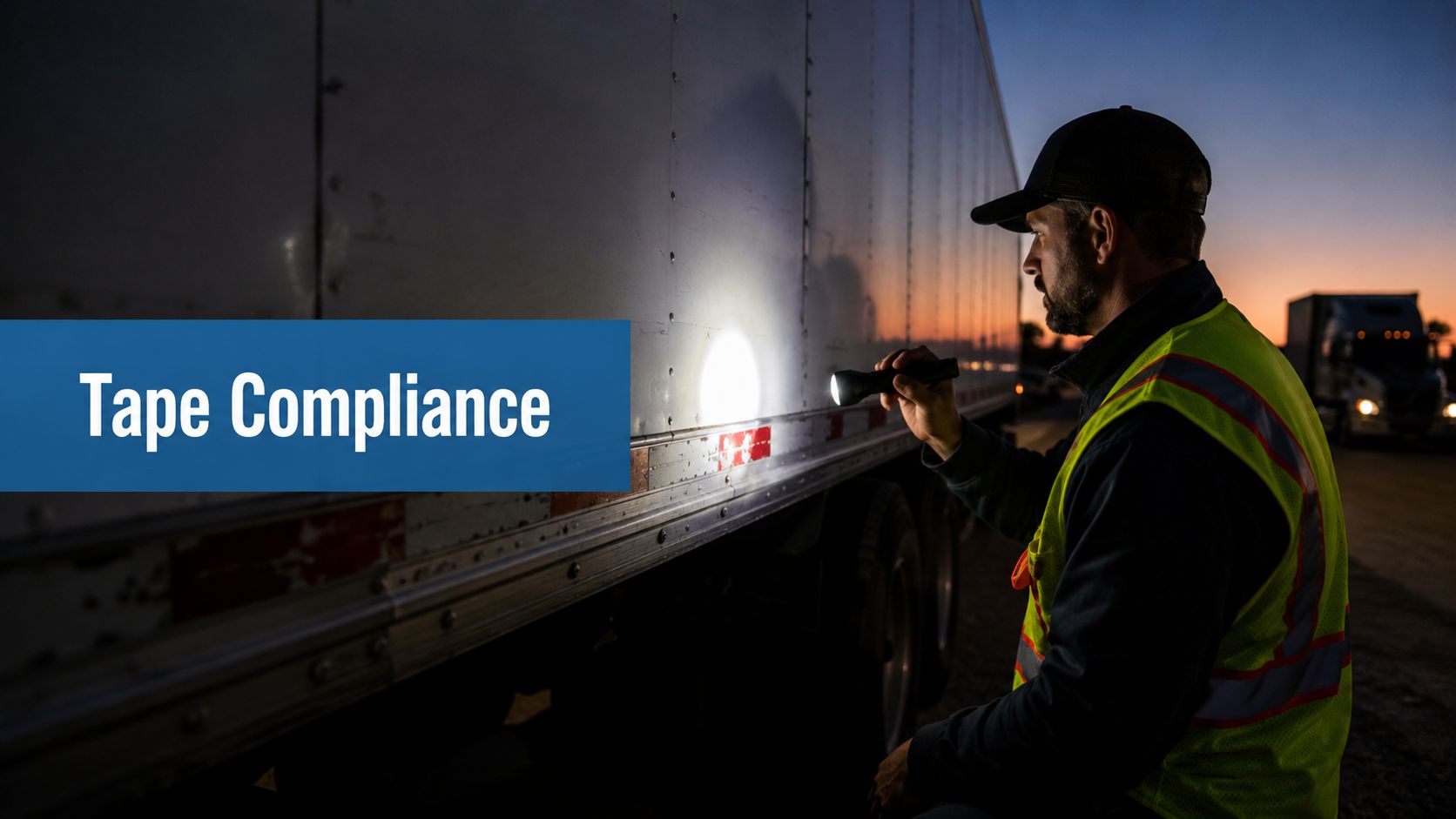
Conspicuity tape violations trailers can turn a routine weigh-station stop into a serious fleet problem. You send in a clean-looking trailer, then an inspector walks the sides and rear with a flashlight and finds missing sections, dull sheeting, or graphics covering the reflective material.
The common mistake is treating tape as a one-time installation item. A trailer can still have tape installed and fail because the material is degraded, the pattern is wrong, the side coverage falls short, or the rear corners were repaired without following the original layout. You need a maintenance system that checks both presence and performance.
This guide walks you through the federal rules, the violations inspectors cite, roadside consequences, repair steps, inspection routines, and documentation practices. It also shows how a compliance service can help you keep repeat findings off your inspection record. Conspicuity tape matters because it helps other road users recognize your trailer at night and in poor visibility, so inspectors treat defective marking as a safety defect, not a cosmetic blemish.
The Weigh Station Moment Every Fleet Owner Dreads
Your trailer looks presentable from the yard entrance. The panels are clean, the lights work, and there isn't an obvious hole in the side marking. At the weigh station, however, the inspector uses a flashlight and checks the tape from the angle that matters on the road. A driver returns to the cab with a Driver Vehicle Examination Report listing several conspicuity findings.
The financial pain rarely comes from the citation alone. A roadside defect can create repair downtime, an out-of-service risk, attention to your Vehicle Maintenance BASIC, and questions from your insurance carrier. If the same trailer or maintenance process produces repeat findings, your fleet may have to explain why its inspection controls aren't catching visible defects.
What inspectors notice first
Inspectors usually start with the obvious visual cues:
- Missing sections: A gap where tape should run along the side or rear.
- Surface deterioration: Peeling edges, cracking, heavy fading, dirt, or sheeting that no longer reflects strongly.
- Obstruction: Decals, wraps, body panels, straps, or other material covering the retroreflective surface.
- Incorrect layout: Short corner pieces, incomplete rear strips, or a side pattern that doesn't provide the required coverage.
- Wrong identification: Red and white material replaced with an unapproved color or an inconsistent pattern.
A trailer can fail even when someone recently replaced part of the tape. The replacement must match the applicable standard and placement requirements, not merely look reflective in daylight.
The practical compliance question
Start by identifying the trailer's manufacturing date, width, GVWR, and marking configuration. Then compare the actual trailer against the applicable federal requirement, measure the side coverage, and inspect every rear segment and corner.
Practical rule: If your technician can't explain why every section is present, visible, and correctly placed, the trailer isn't ready for a serious roadside inspection.
The sections ahead address federal and commonly encountered marking rules, roadside findings, consequences, repair controls, inspection records, and managed compliance support. That matters because the federal history behind conspicuity marking explains why a flashlight finding can carry more weight than a simple appearance issue.
The Federal Rules Behind Trailer Conspicuity Tape
Federal conspicuity requirements begin with the trailer's dimensions and rating, not the driver's CDL class. Under FMVSS No. 108 in 49 CFR 571.108, trailers 2032 mm, or 80 inches, or more in overall width with a GVWR over 10,000 pounds must use retroreflective sheeting, reflex reflectors, or both. A trailer built exclusively for living or office use is an exception identified in the standard.
The weight threshold is easy to misread. The rule does not wait for a higher commercial threshold such as 26,000 pounds. A trailer rated at 10,001 pounds GVWR has the same conspicuity obligation as one rated at 26,000 pounds when both meet the width requirement. The NHTSA interpretation guidance explains that the applicable threshold is over 10,000 pounds.
Manufacturing date also affects the analysis. Trailers manufactured in the United States on or after December 1, 1993 must carry the required retroreflective material on their sides and rear. FMCSA later established maintenance duties for motor carriers and addressed retrofit expectations for older equipment. Its June 19, 1998 notice of proposed rulemaking concerning older trailers provides historical context in the FMCSA regulatory record.
Installation is only half the obligation
A trailer can leave the factory compliant and fail at a roadside inspection later. Under 49 CFR 393.11(b), missing or inadequate lower-rear retroreflective sheeting on covered trailers can be cited as a vehicle-maintenance violation. The carrier must keep the marking present, visible, and able to reflect light. Inspectors therefore look beyond whether tape was installed at some point.
Side marking does not always need to be one uninterrupted strip. NHTSA guidance explains that the side requirement can be met when at least half of the trailer length is covered. That allowance is a coverage rule, not permission for random gaps. The material still has to follow the required arrangement and remain effective.
Rear placement has its own requirements. NHTSA guidance calls for a horizontal strip across the full width, as close to the side edges as practicable, plus white marking at the upper rear corners. Reflective material in the wrong locations can still produce a violation.

Fleets using equipment influenced by international specifications may encounter Class C, ECE 104-approved material and more detailed placement conventions. The ECE 104 and Regulation 48 overview describes contour marking, a lower edge roughly 250 to 1500 mm above the ground, upper corner segments at least 250 mm long, and rear placement about 200 mm from stop lamps. Those details show why tape that merely looks reflective in daylight may still mismatch the applicable rule. For a practical fleet reference, review DOT reflective tape requirements.
The Violations Inspectors Cite Most Often
A trailer can carry plenty of reflective material and still receive a finding. Inspectors assess whether the marking remains visible, effective, correctly colored, and arranged as required. The common problems are degraded or covered tape, short replacement pieces, wrong-color material, and side coverage that falls below the rule.
Defects inspectors spot first
Missing sections are easy to document. A torn strip, a repaired panel without replacement tape, or material removed during body work leaves a visible gap. For a trailer covered by the standard, that condition connects to the maintenance requirement in 49 CFR 393.11(b).
Degraded sheeting often survives a quick daytime glance. The tape may still be attached while showing fading, cracking, peeling, cloudiness, or contamination. A flashlight check at night can expose the difference between tape that is present and tape that reflects properly. If it does not return a strong reflection, its attachment to the panel does not cure the defect.
Obscured tape commonly appears after branding or repair work. Decals, graphics, wrap material, dirt, and replacement panels can cover the reflective surface. NHTSA's interpretation on decals and retroreflective sheeting explains that decals obscuring the sheeting are prohibited. Give the graphics vendor the marking layout before artwork is applied, rather than waiting for an inspector to identify the obstruction.
Wrong colors or patterns produce a straightforward finding. The required arrangement uses red and white material. A one-color replacement, an incorrect sequence, or mixed products that change the required appearance can fail even when the tape looks bright.
Placement and coverage problems
Short upper rear corner segments matter because rear marking follows a defined arrangement. Incomplete lower-rear treatment can fail when the horizontal strip does not extend across the trailer width as close to the side edges as practicable. NHTSA rear-marking guidance shows why an inspector evaluates the rear as one marking layout, not as unrelated pieces.
Insufficient side coverage is easier to miss during repairs. Discontinuous side marking may be allowed, but at least 50% of the trailer length must be covered. Replacing only the visibly damaged pieces can leave the trailer short of that requirement. Treat the coverage rule like a measuring line, not a visual guess.
Broken reflex reflectors can create a separate defect when a trailer uses reflectors instead of, or alongside, sheeting. Cracked, missing, poorly placed, or obstructed units may fail under the broader lighting and reflective-device requirements.
Post-repair mismatches appear when a shop installs short pieces, changes colors, or shifts the marking around a new panel without checking the original specification. An uneven pattern near the repaired area often gives the problem away.

For a broader prevention reference, review these common roadside inspection violations. Severe missing or ineffective marking on a trailer subject to the standard can contribute to an out-of-service decision when the inspector finds an immediate visibility or safety concern.
Penalties, Out-of-Service Orders, and CSA Score Impact
A conspicuity violation usually starts at the roadside inspection. The inspector records the condition on the DVER, identifies the applicable vehicle-maintenance requirement, and decides whether the trailer can continue. The decision often turns on what the tape does in practice. Missing, badly degraded, obscured, wrong-color, or too-short segments can make the trailer harder to see, especially at night.
A serious visibility or safety defect can require correction before the trailer moves. A less severe finding may still remain in the inspection record and affect the carrier's compliance profile. The outcome is not determined by one universal fine. State enforcement practices, the violation classification, and the condition's severity can change the financial result.
How the finding follows your fleet
Vehicle-maintenance defects contribute to the Vehicle Maintenance BASIC. Repeated conspicuity findings can move the carrier's percentile position in the wrong direction and lead to warning correspondence, intervention activity, or a compliance review. One tape defect does not define the fleet, but recurring findings show that the maintenance process is not controlling visible problems.
The same record can raise questions during insurance renewal. Underwriters may ask how the carrier verifies repairs, checks trailer condition, and prevents repeat defects. Shippers and brokers may also review safety information before awarding or renewing work. A trailer held for correction loses productive time, even when replacing the tape is straightforward.
Inspectors do not need to find the tape entirely missing to cite a problem. A glossy decal over the reflective surface, dirt that reduces the return of light, a short replacement strip, or an incorrect color pattern can support a finding. The DOT out-of-service violations list provides a useful reference for evaluating how a defect may affect operations.
What protects you: Keep a dated inspection record, repair order, product information, and before-and-after photographs. Together, these documents show what the fleet found, what the shop corrected, and when the trailer returned to service.
If the inspector's entry appears incorrect, documentation gives your compliance team something concrete to review. Keep the DVER, repair evidence, and trailer history together. A technician's memory of replacing “the bad section” will not establish that the required pattern, coverage, and visibility were restored.
Remediation Steps and a Pre-Inspection Checklist
Fixing a conspicuity problem should follow a controlled workflow, not an improvised strip-and-stick repair. Start by cleaning the surface and removing loose material. Then measure the affected area, check the total side coverage, inspect the rear layout, and identify any graphics or decals that interfere with the sheeting.
Use replacement material specified for the applicable federal standard. Confirm the color, reflectivity, dimensions, and intended application before installation. A shop should also check whether body repairs changed the available mounting surface or moved lamps and reflectors.
A repeatable repair sequence
- Photograph the defect first. Capture the full trailer side or rear, then close images of peeling, missing, dirty, or covered sections.
- Prepare the surface. Remove failing tape and clean the panel so the new material can adhere properly.
- Measure the marking. Record side coverage, rear width, corner segment lengths, and distances from nearby lamps where applicable.
- Resolve conflicts. Remove or reposition decals, graphics, hardware, or other material that blocks the reflective surface.
- Install matching material. Follow the product instructions and preserve the required red-and-white arrangement.
- Verify in darkness. Shine a flashlight at the installed marking from a practical inspection angle and look for an even return of light.
- Close the work order. Attach final photographs, product information, technician identification, and the trailer unit number.
For an organized inspection routine, use a DOT trailer inspection checklist. Your schedule should include the pre-trip check, a recurring shop inspection, a check after a long load, and another inspection after body work. The exact interval should fit your operation, but the control must be consistent and documented.
What your technician should check
- Presence: No required section is missing.
- Color: Red and white material follows the required arrangement.
- Coverage: The side marking covers at least half of the trailer length where that rule applies.
- Segment length: Rear corner pieces meet the applicable specification.
- Adhesion: Edges aren't lifting, bubbling, or peeling.
- Cleanliness: Mud, grease, and road film don't suppress reflectivity.
- Obstructions: Decals, wraps, straps, panels, and equipment don't cover the marking.
- Rear placement: The lower strip and upper corner markings follow the required layout.
A flashlight check is useful because an inspector isn't evaluating how attractive the tape looks in direct sunlight. Your maintenance team should verify that the surface returns a clear reflection at night. If washing and detailing are part of your fleet routine, this resource on complete fleet maintenance 2026 can help you coordinate cleaning with condition checks. Log the result every time.
Recordkeeping and Documentation Best Practices
A repair record should let you answer five questions without calling the shop: which trailer, what defect, who fixed it, what product was used, and when was the repair verified? If your file can't answer those questions, it won't provide much support during a compliance review.
Record the trailer unit number, inspection date, technician, work-order number, and defect description. Add photographs from before and after the repair. Save the product make and model, its FMVSS No. 108 compliance statement, and the lot number when available.
Make the record easy to retrieve
Store documents by trailer unit, not only by invoice date. A searchable maintenance platform or structured electronic folder should let you find the trailer's inspection history from the office and from the road. Keep the DVER with the correction record when a roadside finding has already occurred, so the file shows the relationship between the violation and the repair.
Your records should also show verification. A final photograph, technician sign-off, and a note confirming the flashlight check can establish that someone reviewed the completed work instead of closing the purchase order.
Documentation is a maintenance control, not paperwork for its own sake.
During a compliance review, an examiner may ask how you identify defective equipment and confirm correction. During insurance renewal, your records can demonstrate that you use an active vehicle-maintenance program rather than waiting for roadside enforcement to identify problems.
The same information helps you find patterns. If several trailers lose tape after washing, investigate the cleaning process. If repairs fail near the same body panel, review surface preparation or material selection. Documentation turns isolated repairs into information your maintenance manager can use.
How a Compliance Service Keeps Tape Violations Off the Record
A recurring tape finding usually points to a process gap. The shop may repair the trailer, but nobody assigns the follow-up inspection. A fleet manager may receive photographs, but the files aren't attached to the unit record. The CSA profile may worsen before anyone connects the inspection history to a recurring trailer-maintenance issue.
My Safety Manager's compliance program combines vehicle-maintenance tracking, document storage, and CSA BASIC score monitoring. You can log inspections and repairs by trailer unit, attach photographs and product specifications to the work record, and review the Vehicle Maintenance profile for signs that findings are accumulating.
The platform also provides an online compliance dashboard and access to compliance experts for questions that arise while you're reviewing a citation or preparing for an inspection. The stated pricing model is $49 per month per driver, with no hidden fees or contracts, according to the publisher's product information. The service is designed to place conspicuity tape inside your broader maintenance process, alongside the records and follow-up controls that prevent repeat defects.
You still need technicians to inspect the trailer and make sound repairs. A managed system helps you assign the task, retain the evidence, and see whether the correction closed the compliance loop. Review the DOT compliance management service if you want to move this work from scattered reminders into a repeatable program.
Visit www.MySafetyManager.com to start a compliance program or speak with the team about vehicle-maintenance tracking, document control, and CSA BASIC monitoring.
Frequently Asked Questions About Conspicuity Tape Violations
Is conspicuity tape required on trailers under 80 inches wide?
The federal requirement generally covers trailers 80 inches or more wide with a GVWR over 10,000 pounds, subject to applicable exceptions. Verify the trailer's actual width and GVWR before concluding that markings are unnecessary.
Does the requirement depend on trailer age or weight?
Both factors can matter. The manufacturing cutoff is December 1, 1993, while the equipment threshold uses width and GVWR. It does not use a 26,000-pound cutoff.
How often should you replace conspicuity tape?
Replace tape when it is missing, damaged, peeling, obscured, contaminated, or no longer reflects effectively. Use condition as the trigger rather than relying on a fixed replacement age. Inspectors look at whether the marking works now.
Do reflective decals count as compliant tape?
A decal that covers required retroreflective sheeting can defeat compliance. Branding material must not obscure or cover the required marking.
What does a tape-related out-of-service order look like?
The inspector records the defect. If the condition is severe enough to make the trailer unsafe, correction may be required before it continues. The roadside action depends on the observed deficiency and applicable enforcement criteria.
Can one tape citation affect insurance?
It can enter the inspection and vehicle-maintenance history an insurer reviews. One finding does not decide renewal by itself, but repeated findings can prompt further underwriting questions. A pre-trip check should catch degraded, obscured, wrong-color, or incomplete tape before inspection.
Regulatory References
- 49 CFR 393.11, Lamps and reflective devices
- 49 CFR 571.108, FMVSS No. 108
- NHTSA interpretation on side conspicuity coverage
- NHTSA interpretation on trailer width and GVWR
Keep your trailer records, inspection photos, and repair follow-up in one system with My Safety Manager. Use the program to track vehicle maintenance, monitor CSA BASIC activity, and get compliance support before a damaged or obscured marking becomes your next roadside finding.
