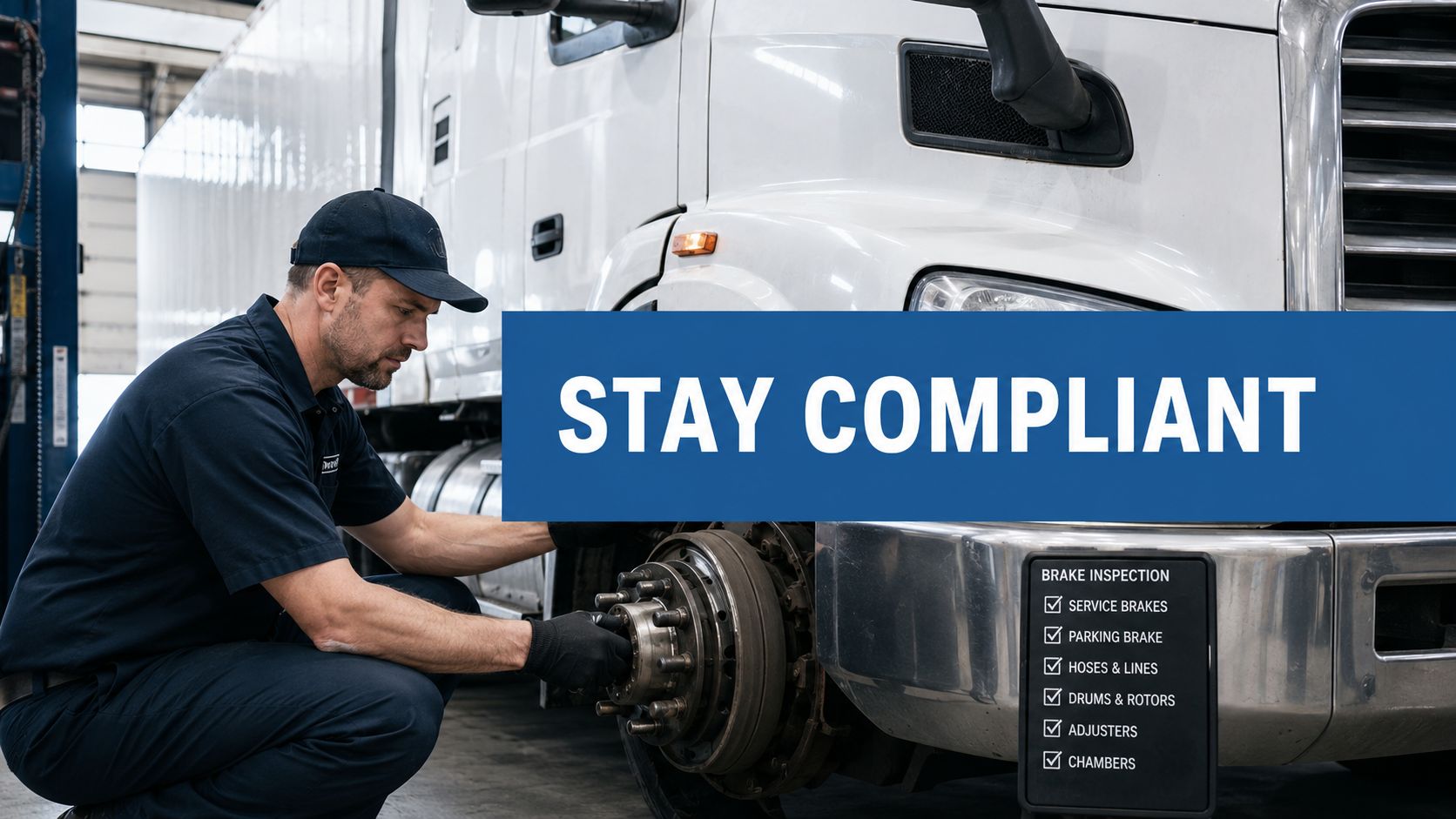
CMV periodic inspection requirements sit on your desk whether you run one truck or a growing fleet. You already know the annual inspection matters, but the biggest challenge is keeping units legal without losing time to expired stickers, bad paperwork, or a shop that hands you a report that won't hold up in an audit.
A lot of fleets get tripped up by ordinary mistakes. You schedule off the wrong date. You assume a roadside inspection covered the annual. You trust that any mechanic can sign the form. Then a roadside stop or file review exposes a gap you didn't know you had.
What's going on is simple. Federal rules require a periodic inspection at least once every 12 months, and the paperwork has to be right too. This guide gives you the practical process for handling CMV periodic inspection requirements in a way that works in day-to-day operations, not just on paper.
Meeting Your CMV Periodic Inspection Requirements
Every interstate CMV in your operation has to go through a periodic inspection at least once every 12 months under 49 CFR 396.17. That same FMCSA guidance also requires you to retain the original or a copy of the periodic inspection report for 14 months. If you treat the annual inspection as just a sticker issue, you're already behind.
The pressure usually shows up in three places. You're tracking dates across multiple units. You're relying on shops with uneven documentation habits. And you're trying to keep trucks moving while repairs, reinspection, and paperwork all happen on time.
What the rule means in practice
The annual inspection is a separate compliance task. A roadside inspection during the year doesn't replace it. If the vehicle fails because a safety-critical component is defective, you can't put that vehicle back in service until the repair is completed and it passes inspection.
That's why your annual inspection process has to connect with your maintenance process. If you're evaluating maintenance approaches, build your inspection calendar into that system so annuals don't become last-minute shop emergencies.
Practical rule: Don't manage annual inspections from memory, inbox searches, or windshield stickers alone. Track the due date, the inspector, the repair status, and the stored report together.
What works and what does not
A workable system is boring on purpose:
- Track every unit centrally: Use one list, dashboard, or compliance tool that shows the current inspection status for each vehicle.
- Schedule before you're under pressure: Give yourself room for defects, parts delays, and a reinspection if the first pass finds issues.
- Review the paperwork yourself: If the report is vague, incomplete, or generic, fix that before the truck rolls.
A lot of owners also use a standard pre-audit form so the truck is cleaned up before it goes to the inspector. If you want a practical format, this commercial vehicle inspection checklist is useful for building that internal review step.
The Official Annual DOT Inspection Checklist
The annual inspection applies to a defined group of vehicles. FMCSA treats a CMV subject to this requirement as a vehicle used in interstate commerce with a GVWR or actual weight of 10,001 pounds or more, designed to transport more than eight passengers for compensation, or carrying placardable amounts of hazardous materials, as outlined in this annual DOT inspection summary. That same source notes the inspection remains valid for 12 months from the last day of the month in which it was performed.
That scope matters because many fleets assume the rule mainly targets tractors and trailers. It also reaches straight trucks, certain passenger vehicles, and hazmat operations that meet the CMV definition.
Appendix A annual inspection checklist
The inspection itself has to cover the safety-critical items listed in Appendix A to Part 396. In day-to-day terms, you should think in systems, not individual parts. If one system is weak, the inspector is going to see the vehicle the same way a roadside officer does. It's a maintenance story written across the truck.
| System/Component | Key Items to Inspect |
|---|---|
| Brake system | Service brakes, parking brake, components, condition, and proper operation |
| Coupling devices | Fifth wheel, pintle hooks, safety devices, mounting, and secure connection |
| Exhaust system | Leaks, improper routing, insecure mounting, and visible damage |
| Fuel system | Tank condition, leaks, lines, caps, and mounting security |
| Lighting devices | Headlamps, tail lamps, stop lamps, turn signals, reflectors, and general operation |
| Steering mechanism | Linkage, steering components, free play concerns, and secure mounting |
| Suspension | Springs, hangers, U-bolts, shocks, air components, and signs of failure |
| Tires | Condition, visible damage, inflation issues, and overall serviceability |
| Wheels and rims | Cracks, damage, missing or loose fasteners, and mounting integrity |
| Windshield and wipers | Wiper operation, condition, and visibility concerns |
| Frame and body | Structural issues, attachment points, and obvious damage affecting safety |
| Emergency equipment if applicable | Presence and condition where required for the operation |
Why these systems matter
Brakes, tires, lights, and coupling devices tend to drive the most immediate operational consequences. If those are bad, the truck can’t be defended as road-ready. Steering, suspension, and frame issues are just as serious, but fleets often miss them because they don’t show up as obviously during quick yard checks.
A good habit is to pre-inspect the truck with the same categories the annual inspector will use. That changes the conversation from “Did it pass?” to “Were we prepared?” You’ll catch leaking wheel seals, damaged air lines, loose lights, and tire condition problems before the annual becomes a failure event.
For a field-ready version you can use with your team, this DOT truck inspection checklist is a practical starting point.
If you know what the inspector must examine, you can prepare the vehicle before the shop ever touches it. That saves downtime and cuts down on repeat visits.
The review standard you should use
When you receive the completed annual, don’t just confirm there’s a signature. Read it against the truck you sent out. If your unit had obvious issues before the inspection but the form looks generic, ask questions. A clean-looking report on a rough truck is a warning sign, not a relief.
Who Is Qualified to Perform an Annual Inspection
Here, many fleets create risk without realizing it. Your trusted mechanic may be excellent at repairs, but that doesn’t automatically make that person a qualified annual inspector under the federal standard.

Under 49 CFR §396.19, the person performing the inspection needs at least one year of training or experience. If you accept a certification without verifying that minimum standard, the inspection can be treated as invalid, and that can expose you to civil penalties reaching $16,000 per violation, as noted in this discussion of qualified annual and brake inspectors.
The in-house mechanic problem
Small fleets often assume an internal technician can handle annuals because that person knows the equipment better than anyone else. Sometimes that’s true. Sometimes it isn’t.
The risk isn’t familiarity with the truck. The risk is whether that person meets the qualification standard and can inspect all required components correctly. If some items can’t be visually verified, or the technician lacks the needed background in CMV inspection criteria, your report may not stand up when it matters.
How to verify an inspector
Use a simple verification process before the inspection starts:
- Ask for qualification support: Get documentation showing the inspector’s training or experience history.
- Confirm CMV-specific knowledge: You want someone who understands Appendix A inspection criteria, not just general diesel repair.
- Check the shop’s reporting format: If the report is just a stamp or a one-line pass notation, that’s a bad sign.
- Keep your own copy of qualification records: If you outsource annuals, keep proof of why you relied on that inspector.
A lot of fleets never ask these questions until after a violation. That’s backward. Vet the person first, then schedule the work.
A clean annual from the wrong person can create more trouble than a failed annual from the right one.
If you’re deciding whether in-house staff can legally handle the work, this guide on doing your own annual DOT inspection helps you frame that decision the right way.
Your Guide to Recordkeeping and Documentation
A passed inspection with weak paperwork is still a compliance problem. At this point, many otherwise careful fleets lose control of the process.

You must retain the periodic inspection report for at least 14 months under §396.21(a), and a compliant report must include the inspection date, motor carrier details, vehicle identification, and the inspector’s certification, according to this breakdown of periodic inspection record requirements. A generic “passed” note isn’t enough.
The two documents you need to think about
There are really two documentation jobs:
- The report you keep in your files
- The proof of inspection that stays on the vehicle
The filed report is your audit document. It needs enough detail to prove the inspection happened properly and identify the unit and inspector. The proof on the truck is what supports the vehicle during a roadside encounter. If your driver can’t show current proof, you’ve handed enforcement an easy issue to write.
A recordkeeping process that holds up
Most fleets don’t need a complicated records program. They need a repeatable one.
- Store the full report by unit number: Don’t bury annuals in general shop invoices.
- Link repairs to the inspection event: If the annual found defects, keep the repair support with that report.
- Set a purge rule carefully: The retention period for this document is longer than the inspection’s active life, so don’t delete based only on expiration.
If you’re tightening your office process, this overview of document retention advice is useful for building a cleaner filing standard across paper and digital records.
What good documentation looks like
A good annual inspection file lets another person (like Motor Carrier Enforcement) answer basic questions quickly. What vehicle was inspected? When? By whom? For which carrier? Was the vehicle repaired if defects were found? Can the driver show proof on the road?
That’s the standard I’d use when reviewing every annual packet before closing it out. A strong support tool for that review is this DOT vehicle maintenance file checklist.
Common Annual Inspection Violations and Penalties
Most annual inspection violations don’t start with a bad attitude. They start with a rushed process, a bad assumption, or a truck that got dispatched before someone closed the paperwork loop.

Expired or missing annual inspection
This is the easiest violation to prevent and one of the most common operational misses. The truck’s inspection date comes and goes, or the vehicle has been inspected but the proof isn’t on the unit.
What usually causes it? Decentralized scheduling. The truck changes terminals, the sticker is overlooked, or someone assumes the office copy is enough.
Prevention: Put dispatch, maintenance, and safety on the same status view. A truck should not be assigned if its annual is too close to expiration or its proof of inspection is missing.
Invalid inspection because the wrong person signed it
This one hurts because you may think you were compliant until the file gets questioned. A shop invoice or certificate looks official, but the person behind it wasn’t properly qualified.
Prevention: Build inspector verification into vendor setup. Don’t wait until an audit or roadside event to ask who signed the annual and why that person was eligible.
Vehicle defects found during the annual
If a vehicle fails because of defective safety-critical components, it can’t go back into service until repairs are completed and the vehicle passes inspection. In practice, fleets get in trouble when operations pressure overrides maintenance control.
Don’t let a truck leave the yard because “the repair is minor” or “the part is on order.” If the annual found a disqualifying defect, dispatch doesn’t get a vote.
Weak supporting paperwork
You’ll also see problems when the annual form is too generic, illegible, or disconnected from related repairs. That’s not just an office nuisance. It can undermine your ability to prove compliance.
For training and internal review, it helps to compare your current practices against a broader DOT out-of-service violations list so your team sees how annual inspection issues tie into roadside consequences.
Your Step-by-Step Compliance Action Plan
A strong annual inspection program doesn’t need to be fancy. It needs to be predictable. If you make the process routine, compliance gets easier and downtime gets more manageable.

A scheduling detail many fleets miss is that the inspection validity ends on the last day of the inspection month in the following year, not the exact anniversary date. An inspection performed on March 15 is valid through March 31 of the next year, as explained in this annual vehicle inspection timing guide. That small buffer gives you room if you use it wisely.
A practical six-step system
-
Build one master inspection calendar
Track every unit by month, not just by day. That keeps your team focused on expiration windows instead of isolated dates. -
Schedule early enough to absorb defects
If you wait until the final week, any repair issue can turn into a compliance problem. Give yourself time for shop delays and a return visit if needed. -
Confirm the inspector before the truck arrives
Don’t assume the shop will assign the right person. Ask ahead and document the answer. -
Pre-check the truck internally
Have your team review lights, tires, brake concerns, coupling components, and visible leaks before the official annual. It’s cheaper to find obvious issues in your yard. -
Review the completed packet before closing the job
Make sure the report identifies the carrier, the vehicle, the date, and the inspector correctly. If repair support is needed, attach it immediately. -
File it where operations can access status fast
The file can live in paper, digital storage, or a managed compliance platform. What matters is that your team can verify the truck’s status without guessing. If you want outside help, My Safety Manager is one option for managing inspection and maintenance compliance records in a structured way.
The scheduling habit that saves fleets trouble
Base your reminder cycle on the month-end validity rule. I’d set internal review points well before the expiration month closes, then tighten follow-up as the date approaches. Fleets that wait for the “actual anniversary day” often create preventable pressure for no reason.
Frequently Asked Questions About CMV Inspections
Does a roadside inspection replace the annual periodic inspection
No. A roadside inspection does not satisfy the separate annual periodic inspection requirement for interstate CMVs.
How often do you need a CMV periodic inspection
You need it at least once every 12 months for a CMV subject to the rule.
When does the annual inspection actually expire
It expires at the end of the last day of the inspection month in the following year, not on the exact day the inspection was performed.
What vehicles are covered by the annual inspection rule
Interstate vehicles that meet the CMV definition, including qualifying vehicles by weight, certain passenger vehicles, and placardable hazmat vehicles.
Can your own mechanic perform the inspection
Only if that person meets the federal qualification standard for an annual inspector.
What if the truck fails the inspection
You can’t place it in service until the required repairs are completed and the vehicle passes inspection.
What paperwork has to stay on the vehicle
Proof of the most recent inspection must be physically present on the vehicle.
How long do you have to keep the inspection report
You must keep the periodic inspection report for at least 14 months.
Is a simple pass certificate enough for your files
No. A generic pass note is not enough if it doesn’t include the required identifying and certification details.
Stay Compliant Effortlessly and Regulatory References
A common failure point is not the inspection itself. It is the shop call on a busy Friday when someone realizes a truck expired last month, the inspector’s qualification file is missing, or the report is still sitting in a glove box instead of your records.
The fleets that stay compliant treat the annual inspection as a controlled process. Put one person in charge of the calendar. Set renewal reminders well before the end of the inspection month. Confirm inspector qualifications before the vehicle goes into the bay. Review every report for missing VINs, plate numbers, dates, and certification details before the truck is dispatched. That is how you avoid preventable violations.
If your team is spending too much time chasing inspection paperwork, My Safety Manager can help organize inspection tracking, records, and routine DOT compliance tasks in one workflow.
Regulatory References
- 49 CFR 396.17 Inspection of motor vehicles in operation
- 49 CFR 396.19 Inspector qualifications
- 49 CFR 396.21 Periodic inspection recordkeeping requirements
- 49 CFR Part 396 Appendix A
If you want a simpler way to keep up with inspections, records, and day-to-day DOT compliance, take a look at My Safety Manager. It gives you a structured way to manage the compliance work so you can spend more time running trucks and less time chasing paperwork.
