Brake out of adjustment DOT violation is the kind of roadside problem that can turn an ordinary dispatch day into a service failure, missed delivery, and a long afternoon of calls. If you own trucks or manage safety, you already know how fast one inspection can become an operations problem.
What trips up a lot of fleets is that they treat brake adjustment as a minor maintenance item until an inspector does the math. A lot of people assume one bad brake means one ticket and then you move on. That's not how it plays out when defective brakes add up across the vehicle or combination.
What's really happening is simple but easy to miss. Inspectors don't just look for a bad brake. They measure brake condition in a way that can build toward an out-of-service decision. If you understand that math, you can spot risk earlier, respond better at roadside, and tighten up the maintenance habits that keep your trucks moving.
That Dreaded Roadside Call You Never Want to Get
The phone rings, and your driver says the truck is in inspection. A few minutes later, the update gets worse. The officer found a brake out of adjustment DOT violation.

That call hits hard because you're instantly juggling three problems at once. You're thinking about the load, the customer, and whether this turns into an out-of-service event. You're also trying to figure out whether this was a one-off issue or a sign that your brake program is slipping.
Why this violation catches fleets off guard
Most fleets don't get surprised by the idea that brakes matter. They get surprised by how fast a brake adjustment issue can change from a citation into downtime. A truck can leave the yard feeling normal enough to the operator, then fail a roadside inspection because pushrod travel is beyond the allowed limit.
That's why this violation is so frustrating. It often starts as a maintenance control problem, not a dramatic mechanical breakdown. If your shop process, DVIR follow-up, and preventive checks aren't tight, the first real warning may come from an inspector.
Practical rule: If a brake issue shows up at roadside, assume the real problem started earlier in your maintenance process.
What this means for your business
A brake violation doesn't stay in one lane. It affects dispatch, repair coordination, customer confidence, and your compliance record. If the truck is shut down, the operational cost shows up immediately. If it isn't shut down, you still have a maintenance defect on record that needs attention.
For fleet owners and safety managers, the goal isn't just avoiding tickets. It's avoiding unplanned downtime caused by a defect you could have caught in the yard, the shop, or a pre-trip.
Understanding the Violation and the 20% OOS Rule
A brake out of adjustment violation starts with one brake assembly, but the out-of-service decision is made at the vehicle level. That distinction matters, because fleets often focus on the bad brake and miss the enforcement math that shuts the unit down.

Under CVSA roadside criteria, a brake out of adjustment counts as a defective brake. A vehicle or combination goes out of service when defective brakes reach 20% or more of the service brakes. CVSA identified hundreds of these "20% brakes" violations during Brake Safety Day, and brake adjustment was one of the conditions tied to that threshold, according to CVSA's 2023 Brake Safety Day results.
The part fleets need to understand
A citation for one brake and an out-of-service order are related, but they are not the same enforcement result. The citation addresses the defect that was found. The out-of-service order comes from the count. Once enough brakes are classified as defective, the truck is parked until the problem is corrected.
That is the risk. Inspectors are applying a percentage rule, not making a judgment about whether the truck "felt fine" on the way to the scale.
For fleet owners, the practical takeaway is simple. You need to know how many service brakes are on the unit being inspected and how close that unit is to the 20% line. A single adjustment issue may stay a violation. Two or more on the wrong configuration can turn into downtime fast.
If your team needs a broader reference for how roadside shutdown standards work across categories, keep a current list of DOT out-of-service violations and thresholds. Brake adjustment is easier to control when supervisors, technicians, and drivers understand that it is part of a larger out-of-service framework.
The fleets that handle this well do not treat brake adjustment as just another repair ticket. They track it as a counting problem with direct consequences for CSA exposure, roadside delays, and load recovery.
The Roadside Inspection How Brakes Are Measured
The roadside surprise usually happens after the driver says the truck was stopping normally. That is not what the inspector is measuring. The inspection turns on brake stroke, chamber type, and how many brakes on that unit count as defective once the numbers are added up.
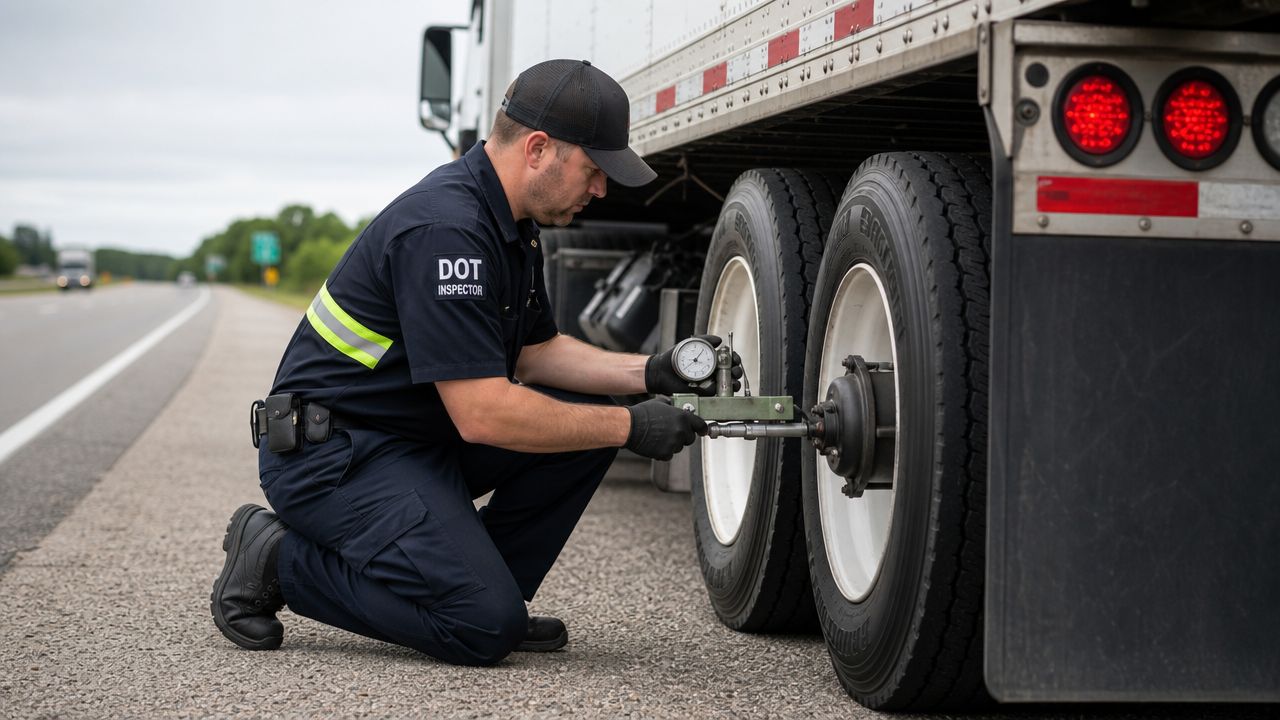
At roadside, inspectors check pushrod stroke against the allowed limit for that specific brake setup. The measurement is taken in 1/8-inch increments, so small errors matter. If the chamber is identified wrong, or the stroke is measured against the wrong limit, the count changes. If the count changes, the out-of-service decision can change with it.
How the defect count is built
Under CVSA out-of-service criteria, a brake that is 1/8 inch beyond its adjustment limit counts as half-defective. A brake that is 1/4 inch or more beyond the limit counts as fully defective, as explained in this Overdrive discussion of brake adjustment and out-of-service math.
That math is what shuts trucks down. On a 10-brake combination, two fully defective brakes equal the 20% out-of-service threshold. So do four half-defective brakes. Mixed counts matter too. One fully defective brake plus two half-defective brakes also reaches the same threshold.
That is the part many fleets miss. The truck does not need one dramatic failure. Several smaller adjustment problems across different wheel ends can add up to an out-of-service order.
What the inspector is actually looking at
The officer is not judging whether the brakes "felt fine" on the drive in. The officer is checking each service brake as an individual component and then applying the count across the whole vehicle or combination.
Steering axle defects deserve extra attention because inspectors scrutinize them closely and fleets feel the consequences fast. A front-end adjustment issue can turn a routine inspection into a repair event with a tow, mobile service bill, missed delivery window, and a preventable mark on your CSA record.
If your staff needs a clearer picture of where this check fits in the inspection sequence, use this Level 1 DOT inspection overview in driver and maintenance training.
What shops need to verify before the truck leaves
In the shop, brake adjustment should be checked as a counting exercise, not just a repair line item. I tell fleets to make technicians answer three questions every time:
- What chamber type is on the brake? The adjustment limit depends on correct chamber identification.
- How far past the limit is the stroke? That determines whether the brake counts as half-defective or fully defective.
- How many brakes on this unit are affected? That tells you whether the truck is close to the out-of-service threshold.
Brake adjustment limits by chamber type
Adjustment limits vary by chamber type and configuration, so your technicians need a written reference tied to the equipment you run and the markings on the chamber.
| Brake Chamber Type | Standard Stroke Adjustment Limit |
|---|---|
| Varies by chamber type and configuration | Use the chamber's applicable adjustment limit and manufacturer marking |
Shops that rely on memory get burned here. If chamber identification is wrong, the measurement is wrong. If the measurement is wrong, the defect count is wrong, and roadside is where that mistake gets exposed.
Immediate Steps After Getting a Brake Violation
When your truck gets written up for brake adjustment, your first job is to slow the situation down and get facts. You need the inspection report, the exact defect description, and a clear answer on whether the vehicle is out of service.
If the truck is placed out of service, it can't continue until the defect is corrected. That means your response has to be operational and administrative at the same time.
What to do at roadside
Use a simple sequence:
Confirm the status
Find out whether you have a violation only or an out-of-service order. Those are very different situations.Coordinate the repair
Depending on the location and the defect, that may mean a mobile mechanic, a nearby vendor, or qualified repair support already available to your operation.Protect the paperwork
Get photos, technician notes, and a copy of every repair detail you can collect. If there is a disagreement later, documentation matters.
Field advice: The repair itself is only half the job. If your paperwork is sloppy, you create a second compliance problem after the truck is fixed.
Handle the DVER correctly
After the inspection, stay organized with the Driver Vehicle Examination Report and repair certification process. Your team should know who receives the form, who confirms the repair, and who submits the required response. A good workflow for the DVER process helps prevent missed follow-up after the truck is back on the road.
Fleets often stumble. They focus so much on getting rolling again that they treat the post-inspection paperwork as an afterthought. That can come back to hurt you later when records are incomplete or deadlines are missed.
When to challenge a violation
Not every violation should be challenged. Some should be fixed, documented, and used as a lesson. But if you believe the citation is incorrect, build your case with inspection documents, repair records, technician statements, and any photos that support your position.
Don't send opinions. Send evidence.
A weak challenge wastes time. A strong one is specific, documented, and tied to the actual inspection finding.
Long-Term Fallout CSA Scores Insurance and Audits
A brake out of adjustment violation doesn't end when the truck leaves the scale house. The long-term damage is what most fleet owners underestimate.
The first problem is your maintenance profile. Brake defects signal that your vehicle maintenance controls may be inconsistent. That's exactly the kind of pattern enforcement and underwriting teams pay attention to.
Why one brake ticket can lead to more scrutiny
Brake issues are easy for outsiders to interpret. If your fleet shows poor brake maintenance, people assume there may be problems in inspection routines, repair quality, supervision, or follow-up. Fair or not, that's how the business side of compliance works.
That's why your team should monitor how violations affect your truck driver CSA score and fleet safety profile. A single event may not define your operation, but repeated brake findings create a story about your maintenance culture.
The insurance conversation gets harder
Underwriters don't like preventable mechanical defects, especially on core safety systems. Brake violations raise obvious questions:
- Are DVIR issues being repaired
- Are PM intervals being followed
- Are roadside findings isolated or recurring
- Is the fleet reacting to breakdowns instead of controlling maintenance
You don't need a stack of violations before this becomes a business issue. Once a fleet starts looking loose on brake maintenance, insurance renewal discussions get harder, and audit exposure tends to feel more immediate.
Clean paperwork won't save a weak maintenance culture. It only documents it more clearly.
Audits look for systems, not excuses
If a regulator or insurer looks deeper, they won't care much about a one-time story from dispatch. They'll want to see whether your fleet has a repeatable maintenance system, clear defect reporting, and documented repair control.
That's why smart fleets treat roadside brake violations as an early warning. The inspection report tells you where the truck failed. Your records tell everyone else whether the company learned anything from it.
Preventing Brake Violations with Proactive Maintenance
Brake violations are usually built weeks before the inspection. The roadside stop is just where the math catches up.
A fleet avoids out-of-adjustment findings by running a maintenance process that finds small brake problems before they turn into defective-brake counts. That matters because one missed wheel end is rarely just one missed wheel end. On a 10-brake tractor-trailer, two full defects can meet the 20% out-of-service threshold. A half-defective brake can also matter if another brake is already fully defective. Shops need to maintain brakes with that calculation in mind, not just with a pass-fail mindset.
A common mistake is trusting automatic slack adjusters to cover weak inspection habits. They do not. For vehicles manufactured after October 19, 1994, an out-of-adjustment brake can also point to a 393.53(b) violation if the required automatic adjuster is not working properly. That means the shop has to correct the brake condition and examine why the adjuster, linkage, lubrication, or related hardware failed in service.

What actually works
Fleets that keep brake violations down tend to do a few things consistently.
Pre-trips are specific
Drivers need to recognize brake issues by feel, sound, and response. A vague inspection habit will miss pull, lag, air loss, or uneven braking.DVIRs trigger repair action fast
If a driver reports a brake concern, maintenance needs a clear response path the same day. Delayed review is how minor defects stay on the road long enough to become inspection failures.Technicians inspect the cause, not just the symptom
If a brake is out of adjustment, the job is not finished when the stroke looks better. Check the automatic slack adjuster, clevis, bushings, chamber condition, drum or rotor wear, and lubrication points. Repeat brake findings usually start here.PMs look for patterns across equipment
One trailer with recurring brake defects can point to a shop process issue, a vendor issue, or a unit that is not getting enough inspection time. Trend review matters.
What does not work
Some habits look organized but still produce roadside violations.
Quick manual correction without diagnosis
That may get the truck out of the bay, but it does not keep the same defect from showing up at the scale house.Paper compliance without verification
A clean file does not prove the repair was done correctly. Someone should verify the work before the unit goes back into service.Treating every brake problem as a driver failure
Drivers are the first line of defense, but brake adjustment control sits mostly with maintenance. Fleets that miss this point keep repeating the same cycle.
Build a workflow your shop can repeat
Use one inspection method across drivers, technicians, and outside vendors. That means a written checklist, clear defect coding, repair approval steps, and a final verification step before release. A practical starting point is a semi-truck brake inspection checklist that everyone uses the same way.
For multi-unit fleets, visibility matters. Some safety managers can control this with disciplined spreadsheets and strong shop supervision. Others use maintenance and compliance software to track DVIR defects, open repairs, and verification records in one place. My Safety Manager is one example fleets use for that recordkeeping and follow-up.
The same lesson shows up in other safety programs. These insights for avoiding OSHA penalties make a similar point. Companies get better results when the process does not depend on memory, guesswork, or whoever happens to be on shift that day.
Frequently Asked Questions
| Question | Answer |
|---|---|
| What is a brake out of adjustment DOT violation? | It's a brake defect found when pushrod travel exceeds the allowed adjustment limit during inspection. |
| Does one out-of-adjustment brake always put your truck out of service? | No. One brake can be a violation without triggering an out-of-service order, depending on the total defective-brake count on the vehicle or combination. |
| What is the 20% brake rule? | Under CVSA criteria, a vehicle or combination is placed out of service when defective brakes reach 20% or more of the service brakes. |
| How many bad brakes put a typical tractor-trailer out of service? | On a typical 5-axle tractor-trailer with 10 brakes, 2 defective brakes meet the 20% threshold. |
| Can a brake count as only part of a defect? | Yes. A brake at least 1/8 inch beyond the limit is treated as half-defective, while one 1/4 inch or more beyond the limit is fully defective. |
| Why do fleets get repeated brake adjustment violations? | Usually because the underlying maintenance issue was never solved. Automatic slack adjusters, wear points, inspection discipline, and repair follow-up all matter. |
| Can automatic slack adjuster problems create another violation? | Yes. For vehicles built after October 19, 1994, an out-of-adjustment brake can also point to a 393.53(b) issue if the required automatic adjuster is not functioning properly. |
| What should you do right after a brake violation? | Confirm whether the truck is out of service, arrange repair, preserve documentation, and complete the repair certification process correctly. |
| Is this only a driver problem? | No. In most fleets, brake adjustment problems are mainly a maintenance management issue, not just an operator issue. |
| What is the best way to prevent this violation? | Use a consistent brake inspection and repair workflow that ties together pre-trips, DVIR review, PM inspections, and documented corrective action. |
Regulatory References
| Regulation | Link |
|---|---|
| 49 CFR 393.47 Inspection of brakes | View 49 CFR 393.47 on the eCFR |
| 49 CFR 393.48 Adjustment limits | View 49 CFR 393.48 on the eCFR |
| 49 CFR 393.53 Automatic brake adjusters and brake adjustment limits | View 49 CFR 393.53 on the eCFR |
| 49 CFR 396.11 Driver vehicle inspection report | View 49 CFR 396.11 on the eCFR |
| 49 CFR 396.9 Inspection of motor vehicles in operation | View 49 CFR 396.9 on the eCFR |
If you want help tightening your brake compliance process, cleaning up DVIR follow-up, and building a maintenance workflow that stands up during inspections, take a look at My Safety Manager. It gives you a practical way to organize compliance tasks before a roadside brake issue turns into downtime.
