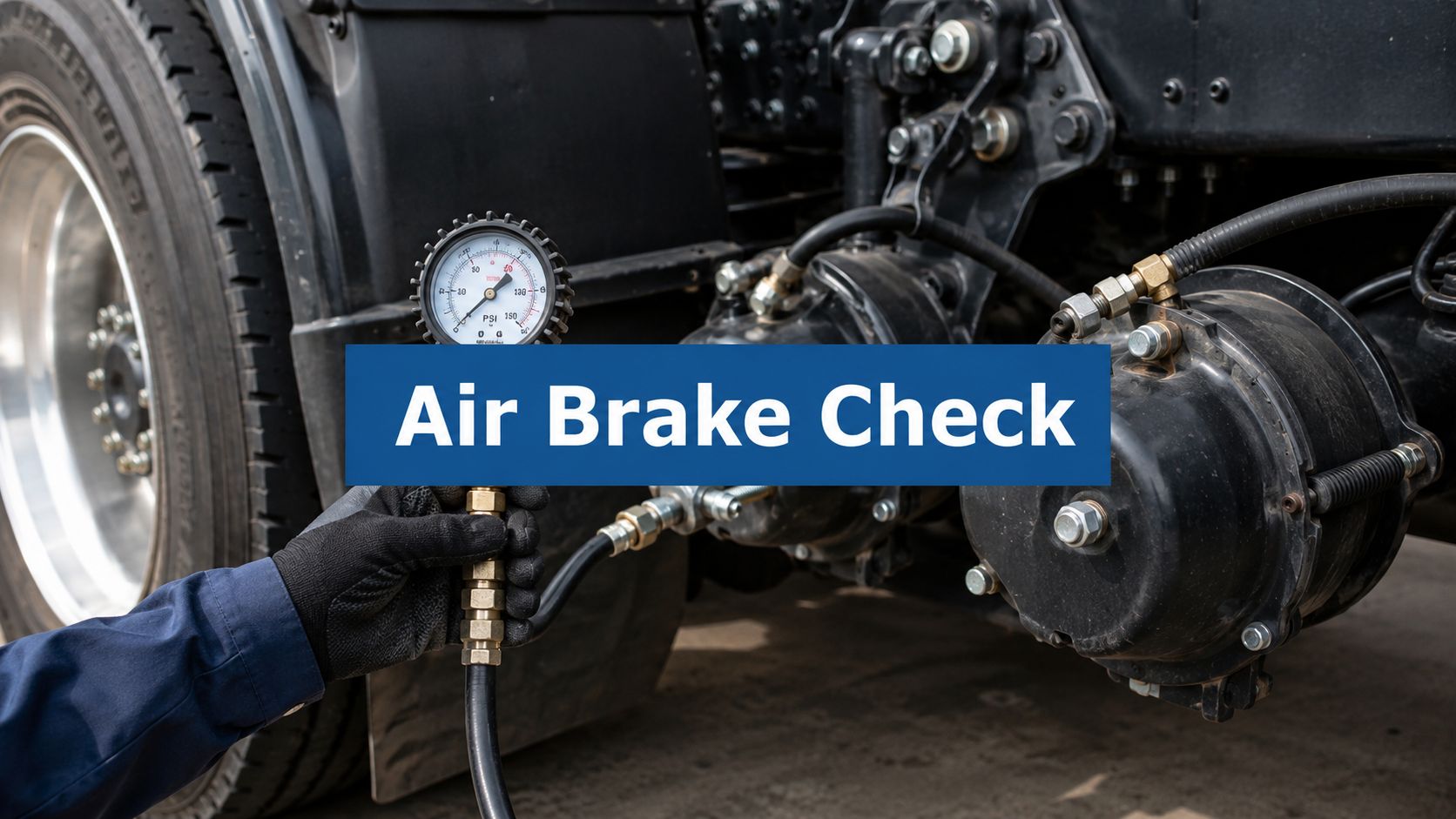
Air brake leak inspection for CDL drivers is one of those jobs that looks simple until a truck gets parked on the roadside for something you could've caught in the yard. If you own a fleet or manage safety, you already know the pain. A truck that should be earning turns into a compliance problem, a service call, and a missed load.
What usually goes wrong is not a total lack of inspection. It's a rushed one. You build air, glance at the gauges, hear nothing obvious, and move on. Then an inspector hears an audible leak at a brake chamber, or a driver reports that the pressure drop was “probably fine” without timing it. That gap between “looks okay” and “meets the standard” is where trouble starts.
The issue isn't just the CDL test routine. It's how you apply that routine in actual operation when equipment has sat overnight, weather changes, or a result lands right on the line. If you want your trucks to stay compliant and moving, you need a repeatable way to test, interpret, troubleshoot, and document air brake leaks.
Why Air Brake Leaks Are More Than Just Hissing Air
An air leak is not a cosmetic defect. It's a brake system problem, and enforcement treats it that way.
CVSA's 2023 Brake Safety Day found brake-related critical vehicle inspection items on 11.3% of the commercial motor vehicles inspected, and it recorded 479 “20% brakes” out-of-service violations. Under CVSA's criteria, a vehicle can be placed out of service when 20% or more of its service brakes have a defect such as an audible air leak at the chamber. That comes straight from the CVSA 2023 Brake Safety Day results.
That matters because too many people still treat a hiss as a maintenance note instead of an operating decision. If the leak is tied to a brake component, you're not dealing with a small annoyance. You're dealing with a defect that can take the truck off the road immediately and put your operation in the same category as the violations listed in these DOT out-of-service violations.
What fleets get wrong
The most common failure is speed. You tell yourself the truck was fine yesterday, the driver is experienced, and the route is short. So the pre-trip gets compressed into a habit instead of a test.
That approach fails for two reasons:
- Air systems change with use and after sitting. A truck can sound and feel normal until you release the parking brakes and load the service side of the system.
- Audible leaks aren't always loud at first. A chamber, line fitting, gladhand seal, or valve can leak just enough to pass a casual listen and still fail a proper check.
Practical rule: If the inspection depends on guesswork, it isn't protecting you.
What actually keeps you compliant
You need two things working together.
First, your driver has to perform the test the same way every time. Second, your company needs a clear rule for what happens when the result is borderline, failed, or uncertain.
A clean air brake leak inspection for CDL drivers does more than help with a road test. It protects braking capability, reduces roadside surprises, and gives you a defensible answer when someone asks, “Who checked this truck, and what did they record?”
Performing the Complete Air Brake Leak Test
The leak test works best when you treat it as one continuous check, not a memorized script. You're confirming that the system can hold air at rest and under brake application, not just that the gauges move.

Start with a fully charged system
Before you judge leakage, make sure the truck is on stable footing and secured. Chock the wheels if needed. Build the air system to normal operating pressure. A widely used North American inspection standard reflected in TMC guidance says a fully charged system is typically around 125 PSI, and acceptable leakage rates are tied to one-minute pressure-drop limits, not rough estimates from memory, as outlined in this TMC air system guidance.
Once the system is fully charged, shut the engine off. Then release the parking brakes when it's safe to do so for the test. Many hurried inspections become invalid at this point. If parking brakes stay applied, you're not testing the system the way you think you are.
Separate the static test from the applied test
The static test checks how well the system holds pressure with the brakes released. The applied test checks what happens when you press and hold the service brake. They answer different questions.
Use this as your quick reference:
| Vehicle Type | Static Test (Brakes Released) | Applied Test (Brakes Applied) |
|---|---|---|
| Single vehicle | Less than 2 PSI in one minute | Less than 3 PSI per minute |
| Combination vehicle | Less than 3 PSI in one minute | Less than 4 PSI per minute |
For the applied portion used in CDL-style inspections, the common procedure is to start with the system fully charged, engine off, parking brakes released, then hold the service brake for 60 seconds while watching for pressure loss. For combination vehicles, the pass threshold is no more than 4 PSI loss, and for single vehicles it is 3 PSI. Many inspection procedures also tell you to ignore the initial drop right after pedal application and time the stabilized reading, as shown in the CVSA Operation Airbrake inspection procedure.
Ignore the first brief drop after you press the pedal. Watch the stabilized gauge reading for the timed portion. That's the part that tells you whether the system is holding.
What a good process looks like in practice
A solid inspection flow usually includes these actions:
- Secure the unit first: Prevent movement before releasing parking brakes.
- Charge the system completely: Don't test a half-built system and call it close enough.
- Kill the engine for the leak checks: Compressor activity can hide what the system is doing.
- Time the test: A watch or phone timer is fine if your company allows it and the process is consistent.
- Listen while you watch the gauges: Numbers matter, but so does the location and sound of leakage.
If you're trying to tighten up your broader pre-trip process, a practical truck maintenance checklist can help you align brake checks with the rest of your daily inspection routine instead of treating them as a standalone event.
For fleets that want a documented training standard, this DOT pre-trip inspection guide is useful because it puts the brake test in the context of the full pre-trip, which is how it gets done in the yard.
Understanding What Your Test Results Really Mean
A pass or fail is only the first layer. The part that separates experienced operators from box-checkers is knowing what the result is telling you.

Borderline isn't the same as normal
One of the biggest gaps in typical CDL advice is that it gives you the one-minute threshold but doesn't help you interpret borderline results. That gap is real. As noted in this discussion of how to pass the CDL air brakes test, most guides don't explain what counts as an actionable leak versus normal behavior such as system stabilization or governor-related variation.
That matters because a truck can land in a gray area. You might see a brief drop right after brake application, then a stable reading. That's different from a gauge that keeps creeping down while you hold pressure. The first may be normal stabilization. The second is the truck telling you something is leaking under application.
How to read the result like a safety manager
Think of the outcome in three buckets:
- Clean pass: The system stabilizes, the pressure loss stays under the limit, and you don't hear an obvious leak. Record it and move on.
- Borderline result: The unit lands right at the threshold or the gauge behavior is inconsistent. Don't wave it through on instinct. Repeat the test under controlled conditions and document what you saw.
- Clear failure or audible leak: Treat it as a repair issue, not a driver judgment call.
A borderline result is where a lot of bad decisions happen. Someone says, “It only lost about the limit,” or “It did it once, then looked better.” That's not a maintenance standard. That's wishful thinking.
If a truck only “passes” when the test is rushed, interrupted, or interpreted generously, you don't have a pass. You have a truck that needs more inspection.
What different patterns suggest
You don't need to be a technician to notice patterns that matter.
A leak that becomes obvious only when you apply and hold the brake can point you toward service-side components. A ripped service brake diaphragm is one example often mentioned in training discussions. A leak you hear with brakes released may suggest a different part of the system, such as connections or lines that are leaking before service application changes the system state.
The key is to stop treating every failed test as the same problem. The leak rate pattern gives you clues about where to look next and how urgent the repair may be. If your team needs a policy baseline, these DOT air brake regulations help frame the compliance side so the decision isn't left to whoever happens to be standing by the truck.
How to Find and Troubleshoot Common Air Leaks
Once the leak test points to a problem, the next job is locating it without turning the inspection into random parts swapping.

Listen first, then verify
Start with your ears. A sharp hiss often sends you toward a line, fitting, or chamber area. A leak around moisture can sound softer or uneven. In a quiet yard, you can often narrow the problem area before you touch anything.
Then confirm it visually. A soap-and-water spray is still one of the simplest ways to pinpoint escaping air at fittings, connections, hoses, and chambers. If bubbles form and keep building, you've found something worth fixing, not guessing about.
The spots that deserve your attention
On an American-style semi-truck, these are the common places to check closely:
- Brake chambers: Listen around the chamber body and connection points. If the leak changes when the service brake is applied, don't ignore that clue.
- Gladhands and seals: Damaged seals or poor connections can leak enough to create chronic inspection trouble.
- Service and emergency lines: Look for rubbing, cuts, loose fittings, and aging hose sections.
- Valves and fittings: Follow the sound. Small leaks at fittings can become larger operational problems later.
- Trailer connections: If the issue seems to appear only with the trailer hooked up, isolate the trailer side instead of assuming the tractor is at fault.
What works and what doesn't
What works is a consistent search pattern. Pick a starting point and move the same way every time. That keeps you from missing the obvious because you jumped around.
What doesn't work is relying on “I don't hear anything now” after changing engine noise, parking brake position, or trailer hookup without noting what changed. Air leak troubleshooting is about conditions. You want to know when the leak appears, not just whether it's loud.
A useful shop note or DVIR entry should include details like these:
- When the leak occurs: Brakes released, brakes applied, trailer connected, trailer disconnected
- Where it seems strongest: Left rear chamber, gladhand area, service line near frame rail
- How you confirmed it: Audible leak, soap bubbles, repeated pressure-drop failure
That level of detail helps maintenance act faster and keeps your record stronger. For a basic system overview that helps newer team members understand what they're inspecting, this air brake system reference can support driver coaching without turning the yard into a classroom.
Improving Documentation and Fleet-Wide Compliance
A good inspection without a usable record is only half done. If a driver finds a leak, but the write-up is vague, incomplete, or inconsistent, your maintenance team loses time and your compliance story gets weaker.

What a defensible record includes
Real-world inspection documentation is still an underserved area. Guidance usually tells you how to perform the test, but not how to document it when the result is messy, conditions are cold, or the truck has been sitting. That gap is noted in this article on checking air brakes, which points out the lack of clear direction around digital pre-trip workflows and defensible records.
That's exactly where fleet owners get exposed. A record that says “checked brakes, okay” doesn't help much. A stronger record says what was tested, what the gauges showed, whether the reading stabilized, whether an audible leak was present, and what action was taken.
Use short, direct entries:
- Condition of test: Truck cold after sitting, or tested after normal air build
- Type of test: Static leak check, applied leak check
- Observed result: Passed, borderline and repeated, or failed
- Follow-up action: Sent to maintenance, held out of service, monitored pending shop confirmation
Shop-floor advice: Write the defect so a technician can walk to the truck and know where to start.
Why fleet systems matter
Paper forms can work for a one-truck operation with tight oversight. They usually break down once you have multiple units, multiple drivers, and repairs happening across different locations. The problem isn't paper itself. The problem is inconsistency.
You need to be able to answer basic questions quickly:
- Which units had repeated brake-related write-ups?
- Was the defect corrected before dispatch?
- Are your drivers recording actual observations or copying the same phrase every day?
- Can you show a pattern of inspection, repair, and sign-off if an auditor or insurer asks?
A documented workflow proves invaluable. For example, My Safety Manager gives fleets a way to centralize compliance records, training, and inspection oversight so brake-check documentation doesn't live in scattered texts, clipped paper DVIRs, or someone's memory. If you're building a stronger maintenance record process, this DOT vehicle maintenance file checklist is a practical starting point for what should be retained and reviewed.
The trade-off most owners face
The actual trade-off is not convenience versus safety. It's short-term speed versus long-term control.
If you let drivers make undocumented judgment calls on borderline brake results, trucks may leave faster. But when a leak turns into a roadside violation, everyone pays for that speed. The better approach is simple. Standardize the test, standardize the write-up, and standardize who has authority to clear or hold the unit.
Your Air Brake Inspection Questions Answered
FAQ
What is the correct one-minute leak test setup?
Start with the system fully charged, shut the engine off, release the parking brakes when safe to do so, and hold the service brake for the timed portion of the applied test.
Can you use a phone timer for the one-minute check?
Yes, if your company allows it and the process is consistent. What matters is that you time the test instead of estimating.
Should you count the immediate pressure drop when you first press the brake pedal?
No. Many inspection procedures tell you to ignore the initial drop and time the stabilized reading.
What should you do with a borderline result?
Repeat the test under controlled conditions, document exactly what happened, and don't dispatch the truck based on guesswork alone.
Does cold weather change the need for the test?
Cold weather can make inspections more challenging, but it doesn't remove the need to perform and document them carefully.
If you hear air but the gauge looks acceptable, is that still a problem?
It can be. An audible leak tied to a brake component deserves attention even if the gauge behavior doesn't immediately look dramatic.
Where do leaks commonly show up on a tractor-trailer?
Common points include brake chambers, gladhands, seals, air lines, fittings, and trailer connections.
What should a driver write on the DVIR if a leak is found?
Note when it happens, where it seems strongest, and how it was confirmed, such as by audible leak or soap-bubble check.
Regulatory References
- 49 CFR § 392.7 Equipment, inspection and use
- 49 CFR § 393.45 Brake tubing and hose adequacy
- 49 CFR § 393.47 Brake actuators, slack adjusters, linings, pads, and drums
- 49 CFR Part 396 Inspection, repair, and maintenance
- 49 CFR § 396.13 Driver inspection
If you want a cleaner way to manage inspections, training, records, and follow-up across your fleet, take a look at My Safety Manager. It gives you a practical system for keeping air brake inspections documented, maintenance issues tracked, and compliance work from turning into a daily scramble.
