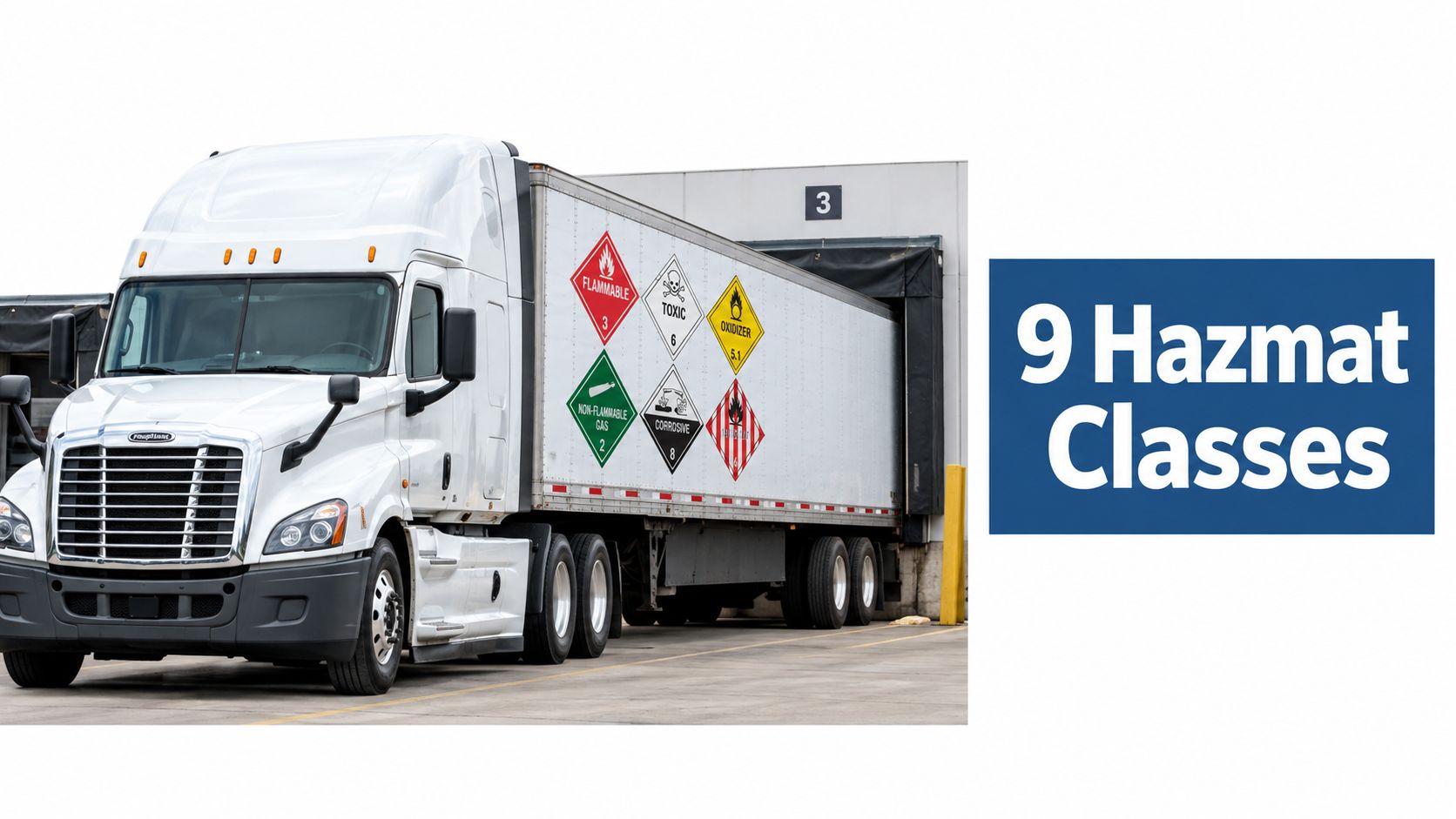
9 Hazmat classes identify the primary hazards regulated during transportation, from explosives and gases to corrosives and miscellaneous materials. Your fleet must match each material's classification with the correct packaging, labels, placards, shipping papers, training, and handling controls.
9 hazmat classes are the operating language behind hazardous materials transportation, and they matter long before your American-style semi-truck reaches the highway. In U.S. freight, trucks moved 1.2 billion of the 2.2 billion tons of hazardous materials shipped in 2007, representing 53.9% of hazmat tonnage, according to the Bureau of Transportation Statistics freight analysis. That makes classification a fleet issue, not a niche concern for specialized carriers.
What usually breaks down is familiar. The shipper provides incomplete information, a package carries the wrong label, the placard doesn't match the load, shipping papers omit a required detail, incompatible cargo gets loaded together, or a training record can't be produced during an inspection. A hazmat endorsement helps, but it doesn't replace your company's loading controls, documentation review, or emergency planning.
This guide gives you a practical risk view of all nine DOT hazmat classes, then turns the classification system into a repeatable dispatch, loading, transport, and inspection workflow. Use it alongside compliant safety signage Australia when reviewing broader signage principles.
Classification is the starting point for every compliance decision. Until you know the material, its division, subsidiary hazards, UN identification, quantity, and packaging, you can't reliably decide how to label, placard, document, segregate, or transport it.
Table of Contents
- 1. Class 1 Explosives and Detonation Hazards
- 2. Class 2 Gases and Pressure Hazards
- 3. Class 3 Flammable Liquids and Vapor Control
- 4. Class 4 Flammable Solids and Reactive Cargo
- 5. Class 5 Oxidizers and Organic Peroxides
- 6. Class 6 Toxic and Infectious Substances
- 7. Class 7 Radioactive Materials
- 8. Class 8 Corrosive Materials
- 9. Class 9 Miscellaneous Hazardous Materials
- 9 Hazmat Classes: Hazards & Controls
- Turn the Nine Classes Into a Fleet Control System
1. Class 1 Explosives and Detonation Hazards
Class 1 covers explosives and articles capable of producing an explosive effect. Your fleet may carry ammunition, fireworks, detonators, dynamite, or TNT. A minor packaging failure can become a blast, projection, or fragmentation event if the load experiences impact, heat, friction, mishandling, or a crash.
The class has six divisions, and the division determines the controls you verify. Division 1.1 indicates a mass-explosion hazard, while Division 1.4 involves a more limited explosive hazard. Confirm the assigned division before dispatch, then match the vehicle placards, package labels, segregation controls, and route plan to that classification. The UN Model Regulations framework organizes dangerous substances and articles by their primary hazard, supporting consistent transport documentation and emergency response.
What your dispatch and loading process should control
Do not accept a vague commodity description. Before assigning equipment, require the shipper's declaration, correct UN identification, packaging details, quantity, division, and any subsidiary hazard. For Class 1 shipments, verify that the required EX-number approval appears on the shipping papers where applicable.
Your operating controls should include:
- Shipper verification: Compare the declaration with the actual packages before loading.
- Specialized handling: Assign personnel trained in explosive cargo, securement, access control, and incident escalation.
- Training records: Keep driver and loader qualification records available for inspection.
- Route planning: Confirm applicable routing, parking, and facility restrictions before departure.
- Emergency coordination: Identify who contacts emergency services and the shipper if an incident occurs.
A small load still demands disciplined controls. Review hazmat placards on trucks before the vehicle leaves your yard, and confirm the placard and package marking match the shipping description. GPS monitoring can support visibility and incident reconstruction, but it cannot correct misclassification or weak loading procedures.

2. Class 2 Gases and Pressure Hazards
Class 2 includes gases transported as compressed gas, liquefied gas, or dissolved gas under pressure. Its three divisions distinguish flammable gases, non-flammable and non-toxic gases, and toxic gases. Propane, oxygen, chlorine, ammonia, and natural gas are practical examples your fleet may encounter in industrial, energy, food, and manufacturing freight.
Pressure changes the risk profile. A cylinder or tank can leak, rupture, or release a concentrated gas cloud. Depending on the material, your exposure may involve fire, oxygen displacement, toxic inhalation, or cold-contact injury. The right response depends on the specific gas, not just the broad Class 2 label.
Make the paperwork operational
Your shipping papers should allow your team and emergency responders to identify the material and its hazards quickly. The DOT hazmat shipping papers guidance can help your safety team review the information your dispatch and drivers need to carry and present.
Before loading, check cylinder or tank condition, closures, valve protection, securement, and evidence of damage. Keep incompatible materials separated according to the applicable requirements, and never treat a leaking cylinder as a minor packaging issue.
Use a material-specific job aid for each recurring gas. It should identify immediate isolation actions, ignition controls where relevant, contact information, and the point at which your team stops handling the incident and calls qualified emergency responders.
A Class 2 load is both a chemical hazard and a pressure system. Your inspection must address the contents, container, valves, securement, and response information together.
Temperature awareness also matters during long-haul transport. Telematics can support monitoring for temperature-sensitive cargo, but alarms only help when someone is assigned to review them and act. Your hazmat endorsement and recurrent training should reinforce the difference between a flammable gas, an inert gas, and a toxic gas.
3. Class 3 Flammable Liquids and Vapor Control
Class 3 covers flammable liquids. Gasoline, fuel additives, paint thinners, solvents, and similar products can create a fire risk when vapors meet an ignition source. In a tank or enclosed cargo area, the vapor can be the immediate hazard even when the liquid looks fully contained.
For dispatch and loading decisions, the flash point matters. Liquids with a lower flash point demand tighter controls because they give off ignitable vapors more readily than higher-flash-point materials. That affects how you stage the load, where you park it, what you keep nearby, and how much time your crew spends near the product.
Control ignition before it becomes an incident
Your loading rack should have a defined grounding and bonding procedure. Verify the equipment and the connection before product transfer, and make the sequence easy for every person involved to follow. A job aid is more useful than a general reminder because it tells your team exactly when to connect, inspect, transfer, disconnect, and document.
Review:
- Static controls: Confirm grounding and bonding equipment is available and used.
- Ignition sources: Keep unauthorized devices, open flames, and unsuitable equipment away from loading and unloading.
- Tank condition: Check for damage, leaks, corrosion, and closure problems.
- Weather and routing: Account for conditions that can complicate safe loading, parking, or incident response.
- Product identity: Match the shipping description and UN identification to the actual material.
Your fleet should also review the hazardous material code 1203 guide when gasoline or another recurring Class 3 product appears in the load plan. The correct code, packaging, labels, placards, and shipping papers must agree. A routine fuel-related shipment becomes high risk when the paperwork says one thing and the tank, package, or placard says another.
Tank choice matters too. A DOT 406 cargo tank is built for specific flammable liquid service, so you need to match the package to the product, not just the route. If you are moving a product with a low flash point, inspect closures, vents, and emergency equipment before departure, and confirm that your drivers know how to isolate the load if a leak or vapor release starts.

4. Class 4 Flammable Solids and Reactive Cargo
Class 4 covers flammable solids, spontaneously combustible materials, and materials dangerous when wet. Its three divisions describe different ways a solid can create danger during transport. Metallic powders, oily materials, wet calcium carbide, and certain phosphorus compounds require different controls from ordinary dry freight.
A solid cargo can change condition during the trip. Friction, moisture, heat, or contamination may cause internal heating, ignition, or the release of dangerous gas. Review the product-specific Safety Data Sheet, shipping description, labels, placarding requirements, packaging instructions, and emergency information before accepting the load. The material's appearance alone is not enough to determine whether it is safe to move.
Build the inspection around the cargo and its surroundings:
- Moisture prevention: Keep dangerous-when-wet materials away from water during loading, parking, and unloading. Check the trailer and loading area for conditions that could introduce moisture.
- Temperature awareness: Follow shipper instructions for temperature limits and monitoring when the material's properties require it.
- Package integrity: Look for torn packaging, leaks, swelling, heat damage, discoloration, unusual odors, or other signs of reaction. Stop the loading process if the package condition does not match the shipping information.
- Load separation: Apply applicable segregation requirements. Do not place reactive cargo beside incompatible freight because both packages are closed.
- Staff training: Teach loaders and drivers how to recognize self-heating, reaction signs, moisture exposure, and damaged packages. They need clear instructions for escalation before departure.
- Documentation: Record material-specific precautions in the load notes so dispatch, the driver, the receiving site, and emergency personnel can act on the same information.
Packaging, labels, placards, and shipping papers must describe the actual cargo. If the shipper's description conflicts with the package condition or observed material, hold the shipment and request clarification. Seasonal planning can reduce exposure to heat and moisture, but it does not replace classification or packaging controls.
Inspect the cargo environment throughout the route, not only at pickup. For Class 4 freight, confirm that the package and surrounding conditions remain suitable until delivery.
5. Class 5 Oxidizers and Organic Peroxides
Class 5 covers oxidizers and organic peroxides, and you need to handle them as active fire risks, not just another hazmat label. Oxidizers can feed combustion by supplying oxygen or supporting burning in nearby material. Organic peroxides bring added concerns because they can be flammable, heat-sensitive, and prone to decomposition if they are contaminated or stored poorly.
Hydrogen peroxide, calcium hypochlorite, and other peroxide compounds demand exact identification at dispatch and at the dock. A trailer that looks normal can become a much worse fire scene if an oxidizer rides next to a combustible or flammable load. Segregation starts with the load plan, not with the shipping paper after the freight is already on the truck.
Build compatibility into every load plan
Start with the exact Class 5 entry, then verify packaging instructions, temperature limits, and any subsidiary hazards. For organic peroxides, get the shipper's stability and emergency information before loading. If your team is guessing whether two products can share space, the plan is not ready.
Use a written compatibility check:
- Product review: Confirm the proper shipping name, UN number, class, division, and subsidiary hazards.
- Package review: Check closures, damage, contamination, and temperature controls.
- Segregation review: Keep incompatible materials apart in the trailer and at the facility.
- Response review: Make emergency information available to your team and responders.
- Training review: Teach the difference between a material that burns and one that intensifies another fire.
Use the 49 CFR Part 397 hazmat safety resource when your fleet reviews routing, parking, and operating rules for hazardous materials. The practical rule is simple. The exact material and division determine how you load, park, and inspect the freight.
A color-coded internal load plan can help dispatch and dock staff spot problems faster. It only works as a support tool, though. Official package marks, placards, labels, and written instructions still control the shipment.
6. Class 6 Toxic and Infectious Substances
Class 6 covers materials that can harm people through poisoning or infection. Division 6.1 toxic materials includes pesticides, cyanides, and other substances that may cause injury through inhalation, ingestion, or skin absorption. Division 6.2 infectious substances includes bacterial cultures and other materials that can expose people to an infectious agent.
For fleet operations, the key risk is delayed recognition. A damaged package may produce no smoke, flame, or immediate pain. Dispatchers, drivers, and dock workers must know the material before they handle the shipment, and they must have a clear response process if the package is damaged or leaking.
At dispatch, verify the proper shipping description, package markings, labels, and shipping papers. Check whether the load requires Class 6 placards and whether the material has additional hazards that affect vehicle controls or segregation. Keep emergency medical and material information accessible to the driver and responders, rather than buried in unrelated files.
At loading, use the packaging specified for the material. Inspect rigid containers and outer packaging for punctures, leaks, broken closures, or contamination. Do not load a questionable package until the shipper resolves the discrepancy. Keep incompatible materials separated according to the applicable instructions, and confirm that the load plan matches the papers.
Your driver should never decide how to handle an unknown Class 6 spill at the roadside. Training should direct the driver to stop, isolate the area, prevent untrained people from approaching, notify the proper contacts, and provide responders with the vehicle location and cargo information. Product-specific instructions must guide PPE decisions. A hazard class alone does not identify the right protective equipment.
Document package checks, discrepancies, exposure reports, and corrective actions. At delivery, compare the package marks with the shipping papers again and inspect for damage before unloading. These routine checks help prevent a small packaging failure from becoming an exposure event.
7. Class 7 Radioactive Materials
Class 7 covers radioactive materials, where ionizing radiation drives every transport decision. Medical isotopes, research materials, industrial sources, and nuclear-related materials may require controlled transportation, specialized packaging, shielding, and strict handling limits. Your controls should address exposure, package integrity, labeling, placarding, documentation, and security together.
Most general fleets will not carry Class 7 regularly. If yours does, build a specialized operating model rather than adding a short radioactive-materials module to ordinary hazmat orientation. The shipper, carrier, facility, and emergency responders need the same understanding of the package, handling limits, security expectations, segregation requirements, and incident process.
Before dispatch, verify the material classification, package type, markings, labels, placards, shipping papers, and receiving-facility approval. Confirm who is authorized to handle the shipment and which inspections must occur at pickup and delivery. Do not accept a package if the paperwork, markings, or instructions do not match.
At pickup, inspect for damage or tampering without opening, altering, or testing the package. Follow the shipper's instructions for distance, time, shielding, and reporting. Keep the load secured and separated as required by the applicable instructions, and make sure the driver has the designated emergency contacts and cargo information.
Maintain:
- Qualification records: Keep current training and authorization documentation for everyone assigned to the shipment.
- Package checks: Record inspections and report discrepancies before movement.
- Exposure controls: Follow the shipper's and applicable regulator's instructions.
- Facility coordination: Confirm that the receiving site can accept the material before dispatch.
- Emergency escalation: Contact designated technical and regulatory resources instead of improvising.
The DOT hazmat regulations resource supports a broader compliance review, but Class 7 transport may involve requirements beyond a general fleet checklist. Use qualified specialists when the shipment exceeds your internal experience.

8. Class 8 Corrosive Materials
Corrosive cargo can injure people and weaken the equipment carrying it. Class 8 covers materials that destroy living tissue or damage metal and other materials through chemical action. Sulfuric acid, hydrochloric acid, sodium hydroxide, and similar industrial products may move in drums, intermediate bulk containers, tanks, or other specialized packaging.
The operational risk depends on both the chemical and its containment. A package can look sound while its interior, closure, valve, or fitting is deteriorating. A leak may damage a trailer, tank, adjacent freight, or the loading surface before anyone recognizes the problem.
Build the load around compatibility
Start with the shipping description, hazard labels, placarding requirements, and packaging specification. Confirm that the container material is compatible with the corrosive and that the shipper's instructions cover loading, unloading, spills, and emergency contacts. Inspect the package, closures, valves, fittings, securement points, and visible corrosion before loading. Repeat the inspection after delivery when the freight is removed.
Your dispatch and loading controls should cover:
- Documentation: Keep shipping papers, the Safety Data Sheet, and emergency contact information available to the driver and responsible site personnel.
- Protective equipment: Place required eye and skin protection where workers can reach it before handling the shipment.
- Response supplies: Select absorbents and tools for the specific acid, base, or other corrosive. General-purpose materials may react poorly or fail to contain the release.
- Segregation: Separate corrosives from incompatible cargo according to the applicable rules and the shipper's instructions.
- Training and escalation: Teach workers when to stop work, isolate the area, and contact qualified hazmat responders instead of attempting cleanup.
A neutralizing product is not automatically suitable for every Class 8 shipment. Acids and bases require different responses, and an incorrect treatment can increase exposure or spread the release.
For recurring corrosive freight, review packaging and tank inspection records with the product's compatibility in mind. A lower-cost container can create greater operational risk when its material, closure condition, or inspection history is uncertain.
9. Class 9 Miscellaneous Hazardous Materials
A pallet of returned laptops with swollen lithium batteries arrives without hazmat papers. The freight looks like ordinary electronics, but damage, heat, or a short circuit can change the handling decision immediately. Class 9 covers hazardous materials that do not fit the primary hazards in Classes 1 through 8, including dry ice, magnetized materials, materials at high temperatures, environmentally hazardous substances, and lithium batteries or electronics containing them under applicable transport rules. The FAA hazmat overview specifically identifies lithium batteries, battery-containing electronics, dry ice, and machinery with integrated hazardous components in its Class 9 discussion.
Use a decision path for every shipment:
Battery screening: Confirm whether devices contain lithium batteries. Ask about damaged, defective, recalled, swollen, or leaking units. Escalate immediately when the condition could change the shipment from routine freight to regulated hazmat handling.
Packaging and marking: Check that the contents cannot move, short-circuit, suffer impact, or become exposed. Verify the required package marks, labels, and shipping description before loading. A damaged package should not proceed through normal dispatch without review.
Documentation and coordination: Confirm that the shipper supplied the required transport information. Make sure the driver and receiving facility understand any handling conditions, and tell the receiver what to expect before delivery. Include Class 9 cargo in response information so personnel can identify it during an incident, even when placarding is not required.
Segregation, training, and dispatch: Keep incompatible cargo separated according to applicable requirements and shipper instructions. Train dispatchers, loaders, and drivers to stop, isolate the shipment, and escalate damaged or overheated cargo rather than treating it as routine freight. Review the quantity, exceptions, and placarding status before release.
Class 9 has a specific registration trigger. If you offer or transport Class 9 materials in a bulk packaging with a capacity greater than 3,500 gallons or 468 cubic feet, registration is required even though Class 9 materials do not require placarding under that rule, according to PHMSA registration information.
A missing placard does not close the review. Verify the package marks, papers, quantity, exceptions, and registration requirements before the vehicle leaves.
9 Hazmat Classes: Hazards & Controls
| Item | Implementation complexity | Resource requirements | Expected outcomes | Ideal use cases | Key advantages |
|---|---|---|---|---|---|
| Class 1: Explosives | Very high, detonation controls, strict routing | Explosives-certified packaging, HAZMAT + explosives training, secure storage, dedicated placarding | Minimized detonation/fragmentation risk; legal compliance | Military, demolition, fireworks, ammunition transport | Maximal risk reduction; clear regulatory framework |
| Class 2: Gases | High, pressure and inhalation controls | DOT-rated cylinders/tanks, pressure relief valves, ventilation, Tank (N) endorsement | Prevent ruptures, leaks, asphyxiation, fires | Industrial gases, fuel gas delivery, medical oxygen | Efficient bulk transport; predictable pressure management |
| Class 3: Flammable Liquids | High, vapor control and grounding required | Grounding/bonding equipment, cargo tanks, vapor control, Tank (N) endorsement | Reduced fire/explosion incidents; spill containment | Fuel distribution, solvents, chemical feedstocks | High transport efficiency for liquid fuels; established protocols |
| Class 4: Flammable Solids | Medium-high, moisture and spontaneous ignition monitoring | Moisture-proof packaging, temperature monitoring, non‑sparking tools | Lower spontaneous combustion and dust-explosion risk | Metallic powders, reactive solids, industrial waste | Mitigates hidden self‑heating hazards with monitoring |
| Class 5: Oxidizers & Peroxides | High, strict segregation and thermal control | Temperature-controlled storage, compatible containers, monitoring systems | Prevents violent reactions and thermal runaway | Bleaching agents, chemical manufacturing, peroxide transport | Prevents secondary fires; reduces reaction cascade risk |
| Class 6: Toxic & Infectious | High, bio/poison containment and medical controls | PPE, sealed containers, decontamination stations, medical protocols | Reduced poisoning/infection risk; traceability | Pesticides, medical samples, toxic chemicals | Protects human health; supports rapid medical response |
| Class 7: Radioactive Materials | Very high, radiation protection and licensing | NRC authorization, shielded packaging, radiation monitors, trained drivers | Controlled exposure; regulatory compliance; environmental protection | Medical isotopes, research sources, industrial gauges | Precise exposure control; extensive regulatory oversight |
| Class 8: Corrosive Materials | High, material compatibility and emergency response | Corrosion‑resistant containers, PPE, secondary containment, neutralization kits | Fewer chemical burns and container failures | Acids/bases for manufacturing, battery acids | Prevents tissue/structural damage; clear handling rules |
| Class 9: Miscellaneous Hazards | Variable, case-by-case assessment | Documentation review, specific containment or temp control as needed | Reduced unexpected incidents through tailored controls | Dry ice, elevated temp liquids, environmental pollutants | Flexible classification covers diverse, atypical risks |
Turn the Nine Classes Into a Fleet Control System
The nine classes work best as a decision system, not a memorization exercise. The PHMSA Hazardous Materials Regulations training material defines the classes by the predominant risk a material poses during transportation. Your job is to connect that risk to the controls used by dispatch, loading, maintenance, drivers, receiving, and safety management.
Start every load with classification and identification. Confirm the proper shipping name, UN number, class, division, subsidiary hazard, quantity, and packaging. A UN number is a four-digit identifier used to distinguish specific dangerous goods, while the class or division communicates the primary hazard. Your team needs both pieces of information to make a reliable compliance decision.
Use this workflow before release:
- Classify the material: Obtain complete shipper information and verify the class and division.
- Confirm UN identification: Match the UN number and proper shipping name to the product.
- Review shipping papers: Make sure the document identifies the material and gives your team and responders usable emergency information.
- Inspect packaging: Check condition, closures, compatibility, securement, and required performance features.
- Verify labels: Confirm each package carries the labels required for its hazard.
- Verify placards: Apply the correct vehicle or bulk-container placards when required.
- Review quantity and exceptions: Don't assume a small load is exempt, and don't assume a non-placarded load has no other requirements.
- Check segregation: Keep incompatible materials apart during loading, transport, and storage.
- Plan the route: Review restrictions, parking, weather, facility access, and emergency contacts.
- Confirm training: Verify hazmat training, recurrent training, and any required hazmat endorsement or qualification.
- Preserve records: Keep inspection, training, qualification, maintenance, and shipment records organized.
Federal placarding rules generally require each bulk packaging, freight container, unit load device, transport vehicle, or rail car containing hazardous material to be placarded on each side and each end, unless an exception applies. Review the placarding rule in 49 CFR 172.504 with the exact material and exception in front of you.
FAQ about the 9 hazmat classes
What are the 9 hazmat classes?
They are Class 1 explosives, Class 2 gases, Class 3 flammable liquids, Class 4 flammable solids, Class 5 oxidizers and organic peroxides, Class 6 toxic and infectious substances, Class 7 radioactive materials, Class 8 corrosives, and Class 9 miscellaneous hazardous materials.
Does every hazmat load need placards?
No. Placarding depends on the material, quantity, packaging, vehicle, and applicable exceptions. Class 9 materials generally don't require placards for domestic transportation, but other obligations can still apply.
When do you need a hazmat endorsement?
You need to determine endorsement requirements from the material, vehicle, and applicable commercial motor vehicle rules. A hazmat endorsement doesn't replace employer training, shipping-paper review, packaging checks, or placarding controls.
What must shipping papers accomplish?
They must identify the hazardous material clearly enough for dispatch, your team, inspectors, and emergency responders to understand what is being transported and which controls apply.
How are labels different from placards?
Labels are generally applied to packages. Placards identify hazards on transport vehicles, bulk packagings, freight containers, and other larger transport units when the rules require them.
Why does segregation matter?
Some materials can intensify combustion, react with moisture, release toxic gas, or worsen a spill when loaded beside incompatible cargo. Segregation reduces the chance that one incident becomes a larger chemical event.
How does Class 9 differ from the other classes?
Class 9 covers miscellaneous hazards that don't fit Classes 1 through 8. It can include lithium batteries, dry ice, magnetized materials, high-temperature materials, and environmentally hazardous substances, depending on the applicable classification.
Can Class 9 require registration even without placards?
Yes. Offering or transporting Class 9 materials in a bulk packaging over the stated capacity threshold can trigger registration requirements. Check the applicable PHMSA rule before dispatch.
Regulatory References
- 49 CFR 172.101, Hazardous Materials Table
- 49 CFR 172.200, shipping papers
- 49 CFR 172.400, package labeling
- 49 CFR 172.504, placarding
- 49 CFR 177.848, segregation of hazardous materials
Classification becomes valuable when it changes what your people do. Build the checks into dispatch release, loading sign-off, pre-trip inspection, roadside response, delivery, and post-trip recordkeeping. For additional operational context, review this natural gas guide for trucks when your fleet handles gas-related freight.
If your current process depends on memory, scattered spreadsheets, or paperwork that only one person can find, make the workflow easier to manage. My Safety Manager provides an online compliance dashboard, mobile training, and monitoring for driver qualifications and vehicle maintenance, which can help you connect hazmat responsibilities with your broader DOT and fleet safety program.
My Safety Manager helps you organize DOT compliance, mobile training, driver qualification monitoring, vehicle maintenance tracking, and hazmat-related fleet safety records in one online dashboard. Visit My Safety Manager to connect the nine-class workflow with your everyday compliance program and give your safety team a clearer way to manage required actions.
